
Fiber Optic HDMI Cable 50ft
4.3Editor score
48Gbps ultra-high-speed bandwidth
4K at 120Hz support
Broad HDMI feature support
Two-year warranty included
Our HDMI fiber optic cables guide compares ten long-distance options for 8K, gaming, in-wall installs, durability, compatibility, and signal performance.
HDMI fiber optic cables solve two common long-distance problems at once: signal degradation and bulky copper wiring. Their optical cores carry data over light, while active electronics at each end handle the electrical connection, making these cables especially useful for home theaters, gaming rooms, conference rooms, and permanent in-wall installations. Directionality, supported resolution, construction, and compatibility deserve close attention.
The ten products in this guide were compared using the supplied specifications, including advertised bandwidth, supported video modes, length, directional design, connector construction, in-wall rating, gaming features, and device compatibility. The list covers options from roughly 50 to 150 feet, including standard 50-foot cables, a 100-foot 4K model, armored and detachable designs, and several models specifically positioned for CL3-rated in-wall installation.
Each review explains the strongest reasons to consider a cable, along with important limitations such as one-way signal flow, possible display compatibility issues, connector replacement, or restrictions on audio return at greater lengths. The top selections represent an overall choice, a value-oriented option, and a premium installation. As with all electronics, availability and pricing can change, so compare the current listing details before purchasing.
4.3Editor score

4.7Editor score

4.4Editor score
The comparison below places the ten cables side by side, focusing on length, bandwidth, headline display modes, physical construction, and the practical features that distinguish a general-purpose fiber cable from an in-wall or armored installation model.




The Highwings Long 8K Fiber Optic HDMI Cable combines a 50-foot run with advertised HDMI 2.1 bandwidth of 48Gbps, making it the most balanced all-purpose option in this guide. Its 4.7 rating reflects a strong feature set for users who need long-distance transmission without giving up high-resolution gaming or modern audio functions. Supported modes include 8K at 60Hz and 4K at 120Hz.
We may earn a commission when you buy through this link, at no additional cost to you.
The cable's standout strengths are its gaming-oriented specifications and physical construction. The supplied information says it supports variable refresh rate, eARC, and backward compatibility, while the aluminum alloy shell and reinforced anti-bending tail add protection around the most likely stress points. Gold-plated contacts and military-grade tensile nylon further support its positioning as a durable everyday cable rather than a disposable in-wall lead.
The main compromise is directional operation. SOURCE must connect to a laptop, game console, Blu-ray player, or other source, while DISPLAY connects to the television, projector, or monitor. Reversing the ends produces no image, and unlike the RUIPRO model in this list, the connector ends cannot be detached for replacement. Buyers should also account for the cable's 50-foot length when planning around furniture, walls, or equipment racks.
This is the strongest general recommendation for a living-room gaming setup, home theater, or long desk-to-display arrangement. It provides more than enough bandwidth for the headline 8K and 4K modes while retaining eARC and VRR support. Choose it when a conventional one-piece cable is easier to manage than a detachable armored system, and carefully confirm the SOURCE and DISPLAY labels before installation.
With advertised support for 4K at 120Hz, variable refresh rate, and HDMI 2.1 bandwidth, this cable is well suited to modern consoles and capable gaming PCs. The optical design also avoids the copper attenuation that becomes more relevant as installation distance increases.
The aluminum alloy connector shell, anti-bending tail, and tensile nylon jacket target connector stress, one of the most vulnerable areas of any long cable. Gold-plated contacts are also intended to support consistent conductivity and resistance to oxidation.
We may earn a commission when you buy through this link, at no additional cost to you.
This 50-foot fiber optic HDMI cable is a value-focused option that still advertises the full 48Gbps HDMI 2.1 bandwidth found in more expensive models. Its 4.3 rating is the lowest among the ten products, but the specification sheet is unusually broad, including 8K at 60Hz, 4K at 120Hz, 2K at 240Hz, Dynamic HDR, Dolby Vision, eARC, VRR, ALLM, QFT, QMS, and DSC.
We may earn a commission when you buy through this link, at no additional cost to you.
The supplied information emphasizes the physical advantages of optical wiring. Compared with traditional copper cores, the cable is described as slimmer, more flexible, and less susceptible to electromagnetic interference over distance. Gold-plated connectors sit inside zinc alloy housings, and the product is advertised as having endured more than 20,000 bending cycles. It also operates without an additional power supply, making installation as simple as connecting SOURCE to DISPLAY.
There is one important caveat that deserves more attention than the product's general feature list suggests. The listing states that laboratory testing found compatibility issues with some LG OLED and LCD displays, meaning the cable may not work with those combinations. The plugs are also directional, and connecting them incorrectly results in no signal. These are manageable issues, but they are particularly relevant to buyers who already own specific LG equipment.
The cable is best for PS5, PS4, Xbox, laptop, projector, television, monitor, Blu-ray player, and A/V receiver connections that need a 50-foot run. It is a sensible choice for a user who wants advanced HDMI 2.1 features without paying for an armored or detachable design. Confirm your television or monitor model against the compatibility notice, and identify the source and display ends before installation.
VRR, ALLM, DSC, and support for 4K at 120Hz make this a practical choice for current consoles and gaming PCs. The advertised 2K at 240Hz mode adds another option for compatible displays and source hardware.
The supplied listing specifically warns about some LG OLED and LCD television combinations. Buyers should verify their exact display model before installation, especially if they intend to use high-bandwidth 8K or 4K at 120Hz modes.
We may earn a commission when you buy through this link, at no additional cost to you.
The RUIPRO 8K Detachable Full Fiber Optic Armored HDMI 2.1 Cable is the premium installation pick in this roundup. Its 4.4 rating, full optical-fiber design, and 33-foot length make it particularly appropriate for carefully planned home theaters, conference rooms, engineering installations, and medical or professional environments where cable integrity and serviceability matter.
We may earn a commission when you buy through this link, at no additional cost to you.
The detachable connector system is the defining feature. If an end is damaged during installation or a future standard changes, the head can be replaced without discarding the entire cable. The product information also describes the system as easier to upgrade, while the cable's thin, soft construction is intended to simplify threading through conduit, particularly when a pull string is used.
Protection is another major advantage. The full cable uses a stainless-steel armored structure designed to resist bending, compression, tension, and tangling, while the optical composition is intended to provide stronger interference resistance. At 33 feet, it is shorter than most of the competition, and that should be accepted only if the required route can be completed without strain or an unnecessary extension.
This is the best choice for an installer or technically confident buyer who values replaceable parts and rugged construction over maximum reach. Its advertised 48Gbps bandwidth and support for uncompressed 8K at 60Hz, 4K at 120Hz, Dynamic HDR, and eARC make it suitable for modern displays and gaming systems. Plan the route carefully, keep the detachable ends protected during installation, and confirm both ends are fully seated.
Detachable ends reduce the impact of connector damage, which is a significant concern when a cable is already threaded through a wall or conduit. They also create a practical upgrade path if a head needs to be replaced.
The stainless-steel structure adds mechanical protection while the underlying fiber cable remains thin and flexible. This combination suits installations where a conventional copper lead may be difficult to route but exposed wiring also needs extra durability.
We may earn a commission when you buy through this link, at no additional cost to you.
The Highwings 50-foot in-wall fiber optic HDMI cable is built around a straightforward premise: a high-bandwidth, slim cable that can be routed through a residential wall. Its 4.5 rating reflects a well-rounded feature set, while CL3 rating makes it the obvious choice to examine for permanent in-wall use rather than temporary room-to-room wiring.
We may earn a commission when you buy through this link, at no additional cost to you.
The product information lists HDMI 2.1 compatibility, backward compatibility with older HDMI versions, 8K-oriented capability, and support for eARC, VRR, and modern high-bitrate audio formats. Named source and display categories include laptops, Blu-ray players, televisions, monitors, projectors, Xbox Series X, graphics cards with HDMI output, and A/V receivers. That broad list makes the cable useful during a renovation when exact equipment may change later.
The slim optical construction is the key practical benefit for in-wall work. The supplied information says it is thinner and lighter than traditional copper-core alternatives, which can make pulling through conduit easier. A drawback is that the cable remains unidirectional, and the labeled plugs must be attached to the correct devices. Unlike the RUIPRO option, it does not offer detachable heads, so installation care is especially important.
This is a strong recommendation for a new home theater, renovation, or structured wiring plan that requires a 50-foot CL3-rated route. It combines modern 8K and gaming support with a fiber construction intended to support long bandwidth and reduced interference. Check the entire cable path before installation, avoid sharp bends, and confirm that the source and display ends will remain accessible after the wall is closed.
CL3 rating makes this model easier to consider for permanent residential routing than a conventional unrated copper cable. The listing specifically positions it for home renovation and future-oriented structured wiring.
The cable advertises HDMI 2.1 performance, VRR, and eARC for modern setups while remaining backward compatible with older HDMI versions. That makes it a flexible choice for rooms where consoles, PCs, and legacy media devices may all be connected.
We may earn a commission when you buy through this link, at no additional cost to you.
The Snowkids 8K HDMI Fiber Optic Cable is one of the most capable conventional one-piece options in the guide, with a 100-foot length, advertised 48Gbps bandwidth, and a 4.6 rating. It is designed for situations where a conventional copper lead would be too short or difficult to route, while still emphasizing 8K, high-refresh gaming, and broad device support.
We may earn a commission when you buy through this link, at no additional cost to you.
The listed modes include 8K at 60Hz, 4K at 120Hz, 2K, 1080p, 3D, Ethernet, and 48-bit-per-pixel HDR. Modern features include eARC, VRR, QFT, QMS, ALLM, and DSC, with TrueHD 7.1 also mentioned. Compatibility spans HDTVs, laptops, monitors, PS5, Xbox systems, projectors, entertainment systems, video-conference equipment, and Blu-ray players.
The product's construction focuses on durability. A flexible strength design, 24K gold-plated connectors, and military-grade tensile nylon are advertised to withstand as many as 25,000 flex cycles. Its optical foundation is also presented as less prone to attenuation and interference than a copper core. The main limitation is that the connectors are fixed and directional, so an accidental swap or damage to an end would affect the whole cable.
Choose this model for a large gaming room, loft, basement, home theater, or commercial setup where a 100-foot route is genuinely required. It provides more than enough reach for distant source equipment and supports the core gaming features listed by the manufacturer. Ensure the route will not require repeated sharp bends, keep both active ends accessible, and test the complete setup before hiding the cable permanently.
At 100 feet, the cable addresses installations where a standard HDMI lead cannot reach. Optical transmission is intended to carry high-bandwidth data over that distance with less attenuation and interference than a copper alternative.
VRR, ALLM, DSC, and 4K at 120Hz support make the cable relevant to current consoles and PCs. QFT and QMS are also listed for users building a modern home theater around quick media switching.
We may earn a commission when you buy through this link, at no additional cost to you.
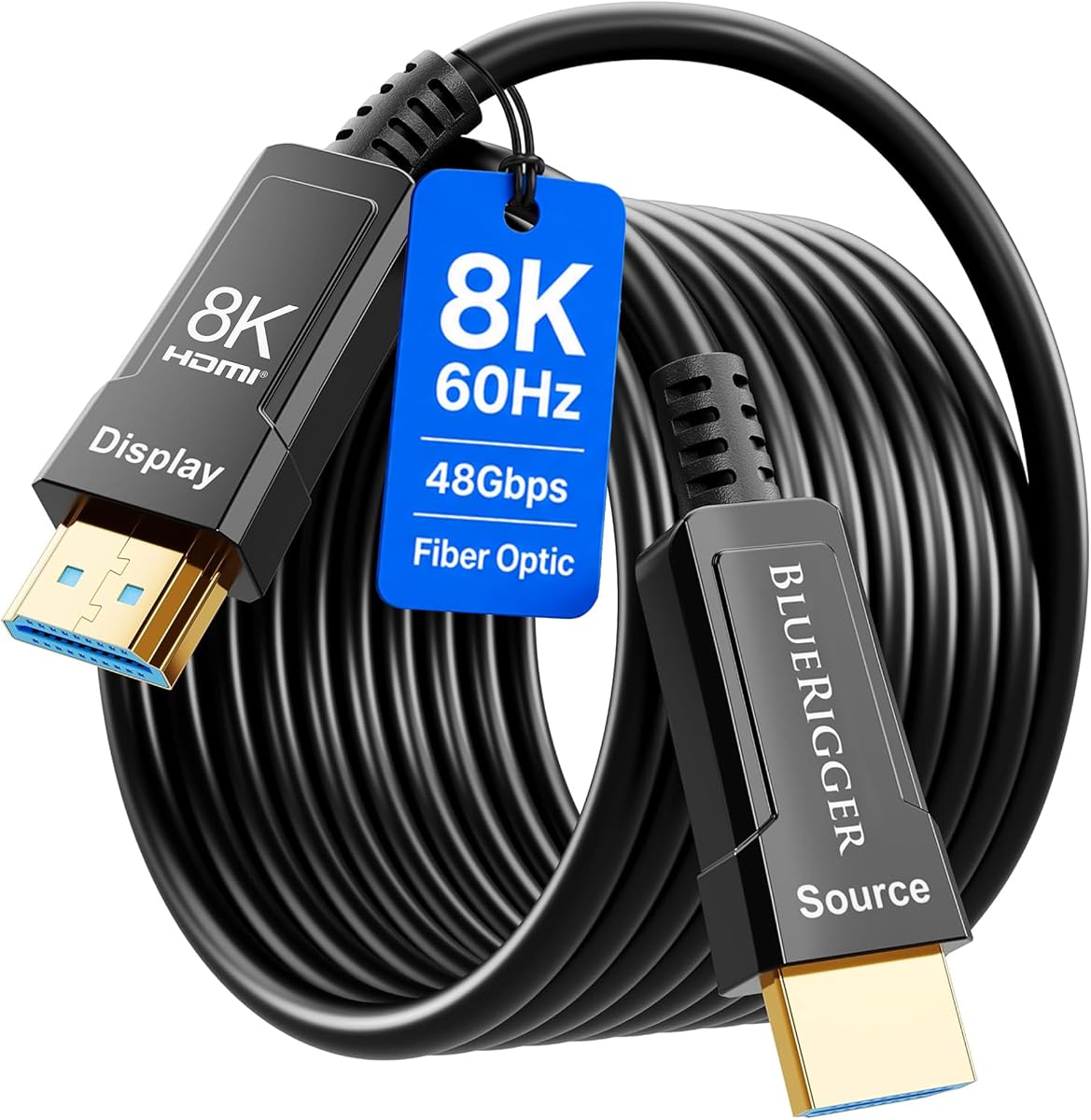
The BlueRigger 10K 8K Fiber Optic HDMI 2.1 Cable combines a 4.7 rating with a 50-foot length, CL3 in-wall rating, and a strong set of gaming features. It is a particularly balanced option for installers who need a modest long run, plenty of bandwidth, and support for high-refresh displays without dealing with the extreme length of a 100- or 150-foot cable.
We may earn a commission when you buy through this link, at no additional cost to you.
The cable advertises 48Gbps bandwidth, 8K at 60Hz, 4K at 144Hz, Dynamic HDR10+, and 12-bit color processing. Its gaming mode includes VRR, while the broader feature list includes HDCP 2.3 and 2.2, QMS, QFT, ALLM, DTS Master, DTS:X, Dolby Atmos, and Dolby Vision. This mix targets both high-end televisions and audio equipment rather than focusing exclusively on video throughput.
Construction uses active optical cable technology, four optical fiber strands, 24K gold-plated contacts, and a durable zinc alloy shell. CL3 rating makes permanent in-wall installation a central use case. The trade-off is directionality: SOURCE and DISPLAY are clearly marked, but the ends cannot be reversed. This is a minor installation concern rather than a functional problem once the correct orientation is established.
The BlueRigger is a strong recommendation for a dedicated gaming room, media room, or renovation where the television and console are separated by 50 feet. It also works with Apple TV, Roku, Xbox, PS5, Nintendo Switch, PCs, Blu-ray players, laptops, monitors, and projectors according to the supplied compatibility list. Pick it when in-wall suitability and high-refresh gaming matter more than maximum reach or detachable connectors.
The advertised 4K at 144Hz mode and VRR support target demanding console and PC gaming setups. The 48Gbps bandwidth provides headroom for the listed high-resolution and HDR formats.
The CL3-rated jacket and relatively compact optical construction make the cable easier to incorporate into a planned wall route than a bulky conventional lead. It is also suitable for professional AV racks and other shared electrical environments.
We may earn a commission when you buy through this link, at no additional cost to you.
The Cratree 8K Fiber Optic HDMI Cable is the reach specialist in this guide, measuring 150 feet, or 45 meters. Its 4.7 rating indicates strong customer reception, while the unusually slim 4.06mm profile and in-wall-friendly design make it relevant to large homes, commercial venues, and installations where a 50-foot lead cannot bridge the equipment.
We may earn a commission when you buy through this link, at no additional cost to you.
Signal handling is based on a dedicated optical engine and a high-performance processing chipset. Advertised specifications include 48Gbps total bandwidth, 8K at 60Hz, 4K at 120Hz, 3D, static and dynamic HDR, VRR, QMS, QFT, and 32 audio channels. The audio list also includes automatic synchronization, 1536kHz sampling, and eARC, making the cable relevant to more than a basic gaming display.
The connectors are 24K gold-plated and housed in aluminum alloy shells. A multi-layer shielding design is included to reduce signal degradation and interference, complementing the optical core. Its 150-foot length is also the main tradeoff: a very long cable adds complexity to routing, requires careful planning around active electronics, and should not be coiled tightly during installation.
Choose the Cratree when the installation truly requires 150 feet or when a slim cable is important for passing through a narrow pathway. It supports modern gaming, home theater, and presentation use, and it is backward compatible with HDMI 2.0 and earlier versions according to the supplied information. Verify the complete path, keep both connector ends accessible, and test the system before securing the cable in inaccessible locations.
The 4.06mm diameter is the cable's most installation-focused specification. That slimness can help when routing through tight conduit or across a large building where a thick copper cable would be awkward.
A dedicated optical engine and processing chipset form the basis of the design. Combined with shielding, these components are intended to maintain stable digital transmission over the unusually long run.
We may earn a commission when you buy through this link, at no additional cost to you.
The 8K Fiber Optic HDMI Cable 50 ft is a flexible, compact option for setups that value routing ease and interference resistance. It has a 4.6 rating and advertises 48Gbps bandwidth, 8K at 60Hz, 4K at 120Hz, HDR, eARC, VRR, and ALLM. The supplied information describes it as 50 percent thinner and lighter than copper alternatives, with 360-degree bendability.
We may earn a commission when you buy through this link, at no additional cost to you.
Its optical construction is presented as effective at eliminating EMI and RFI interference from nearby power cables, speakers, and wireless routers. That makes it relevant to professional AV racks and crowded wiring areas as well as homes. The broad device list includes PS5, PS4, Xbox Series X, PC graphics cards, laptops, Blu-ray players, televisions, projectors, monitors, and A/V receivers.
The most important limitation concerns audio return at longer distances. The product guidance states that cables at 60 feet or longer may not support ARC or eARC because of signal limitations, and recommends a shorter high-speed cable for those functions. This 50-foot unit is below that stated threshold and is advertised as supporting eARC, but the warning still matters if a future change involves extending the run. The listing also notes possible issues with certain LG OLED televisions.
This is a good fit for a tidy 50-foot installation where cable bulk is the main concern. The thin profile should be easier to hide behind a television, route around furniture, or fit into a crowded conduit. Confirm compatibility with your exact LG display if applicable, connect the SOURCE end to the console or PC, and reserve the DISPLAY end for the television, monitor, or projector.
The thin, 360-degree flexible design makes the cable easier to conceal and maneuver around tight bends. It is especially relevant behind wall-mounted displays and in entertainment furniture.
Optical transmission is designed to reduce the effect of electromagnetic and radio-frequency interference. The result is most relevant in rooms containing numerous power sources, network equipment, speakers, and other cables.
We may earn a commission when you buy through this link, at no additional cost to you.
The Highwings 4K Fiber Optic HDMI Cable is a specialist option for buyers who need an exceptionally long cable but do not require 8K or 4K at 120Hz. It measures 98 feet, carries data at up to 18Gbps, and holds a 4.7 rating. Its stated target is 3840 by 2160 at 60Hz, making it a sensible fit for high-definition 4K displays and sources.
We may earn a commission when you buy through this link, at no additional cost to you.
The cable uses gold-plated connectors and a strengthened joint design intended to prevent cracking at the connection points. The manufacturer states that it withstands more than 15,000 bends in laboratory testing. It is also backward compatible with HDMI 1.4, 1.3, and 1.2, and supports plug-and-play use without driver installation.
The clear limitation is bandwidth. With 18Gbps rather than 48Gbps, this cable cannot provide the full feature set of HDMI 2.1, including 4K at 120Hz or 8K at 60Hz. It also remains unidirectional. For a 4K television, Blu-ray player, or conventional gaming system viewed at 60Hz, those constraints may not matter, but owners of newer high-refresh displays should verify their needs carefully.
Choose this model for a large room, older home theater, projector location, or event setup that needs nearly 100 feet of reliable 4K transmission. It is less appropriate for a future-facing installation intended to run an 8K television or 4K at 120Hz gaming system. Its long reach, strong rating, and straightforward 4K focus remain compelling when those constraints align with the equipment in use.
The 18Gbps data rate is sufficient for the advertised 4K at 60Hz mode. It provides a practical path to long-distance video without requiring the full 48Gbps capacity associated with HDMI 2.1.
Backward compatibility and support for older HDMI standards make the cable useful with established equipment. The tradeoff is that it is not the strongest option for buyers planning a future 8K or high-refresh upgrade.
We may earn a commission when you buy through this link, at no additional cost to you.
The BENFEI 8K HDMI 2.1 Fiber Optic Cable combines a 100-foot length, CL3 in-wall rating, and advertised 48Gbps bandwidth. Its 4.6 rating places it among the stronger-rated products in the guide, while support for 8K at 60Hz and 4K at 240Hz makes it an ambitious choice for modern gaming and home theater installations.
We may earn a commission when you buy through this link, at no additional cost to you.
The supplied specifications include VRR, eARC, Dynamic HDR, HDCP 2.3, Dolby Atmos, and DTS:X. The cable is listed as compatible with PS5, Xbox Series X, current GPUs, 4K and 8K televisions, projectors, and soundbars. Its optical construction is advertised to provide zero signal loss over long distances, with a thinner, lighter profile than copper cable and a CL3-rated jacket for permanent installation.
Directionality is the main operational consideration. The source end must connect to a console, PC, or other transmitter, while the display end goes to the television, monitor, or projector. Connecting them backward produces no signal. The 18-month unconditional warranty offers some reassurance, but the fixed ends mean that careful handling during installation is still important.
This cable is a compelling all-around choice for a dedicated media room, renovated basement, or long gaming-room layout that needs 100 feet of reach. It is particularly suitable when the target equipment can exploit 4K at high refresh rates and the installation benefits from CL3-rated wiring. Plan the route, keep the endpoints accessible, and confirm the direction labels before the cable is concealed.
The advertised 4K at 240Hz mode, 48Gbps bandwidth, VRR, and eARC support target high-end console and PC installations. A 100-foot run provides room for equipment located well away from the display.
The CL3-rated jacket and slim optical body are intended for wall routing and structured installations. Buyers should still verify local construction requirements and follow applicable building practices for permanent cable work.
We may earn a commission when you buy through this link, at no additional cost to you.
The right fiber optic HDMI cable depends on route length, display and source capabilities, installation method, and audio requirements. Because these are active, directional cables, paying attention to specifications before purchase can prevent avoidable compatibility problems.
Measure the complete route rather than estimating with a tape measure. Include the distance behind each television, game console, media rack, or wall plate, and add enough slack for service loops and future maintenance. The guide includes 50-, 98-, 100-, and 150-foot options, with 50 feet being the most common middle ground and 100 to 150 feet suited to unusually large or complex installations.
A cable advertised for 8K at 60Hz or 4K at 120Hz needs a source, display, and cable that all support the same mode. Features such as VRR, ALLM, DSC, Dynamic HDR, and high-bitrate color are also system-wide requirements. A cable cannot create a mode that the television or source does not support, and older graphics cards, consoles, or displays may limit the final result.
Most modern entries in this guide advertise 48Gbps and HDMI 2.1 capabilities, while the Highwings 4K model uses 18Gbps and focuses on 4K at 60Hz. The 48Gbps group is the more future-facing option, particularly for high-refresh gaming, but compatibility still depends on the complete device chain. Consider the HDMI generation of every component rather than focusing only on the cable packaging.
All ten cables are unidirectional optical designs. The SOURCE plug belongs on the device that creates the signal, while the DISPLAY plug belongs on the television, monitor, or projector. Reversing them usually results in no image. This is especially important for permanently installed cables because it is easier to confirm orientation before connectors are hidden behind furniture or walls.
For permanent wall installation, prioritize a cable explicitly described as CL3 rated. The Highwings CL3 50-foot model, BlueRigger 50-foot model, and BENFEI 100-foot model all meet that stated requirement. Their thin optical bodies are easier to pull through conduit than bulky copper alternatives. Confirm local building rules, avoid sharp bends, and keep active endpoints accessible for troubleshooting.
VRR is important for smooth variable-refresh gaming, while ALLM supports automatic game-mode behavior. For home theater users, eARC provides a return path for compatible television audio, but one supplied product warning notes that ARC and eARC can become unreliable at 60 feet or longer. High-bitrate audio support such as Dolby Atmos and DTS:X also depends on the source, television, soundbar, or receiver.
Most products use fixed, one-piece connectors. The RUIPRO model distinguishes itself with detachable ends, allowing a damaged or outdated head to be replaced without replacing the full cable. That is especially useful for in-wall routes. Conventional cables may be simpler and less likely to separate during daily use, but they require more care during installation because damage to a fixed end affects the entire assembly.
Two supplied listings warn about possible compatibility issues with certain LG OLED or LCD televisions, particularly for high-bandwidth modes. Other listed source equipment includes current consoles, Xbox systems, laptops, PCs, Blu-ray players, projectors, monitors, streaming devices, and A/V receivers. Check the exact model of your display and confirm that the required resolution, refresh rate, HDR system, and audio-return functions are all supported.
Identify the SOURCE and DISPLAY ends before making any connection. SOURCE goes to the component that produces the image, such as a game console, computer, Blu-ray player, or streaming box. DISPLAY goes to the television, monitor, or projector. Power on the display and source as usual after both ends are fully seated; if there is no image, check this orientation first.
Route the cable without creating tight coils, sharp bends, or excessive tension. These cables are flexible, but the internal optical fibers and active electronics still benefit from a smooth path. When pulling optical cable through conduit, attach the pull string to the cable itself rather than twisting it around a connector. Keep both ends accessible and avoid placing a connector where furniture may press against it.
For permanent installations, photograph the route before it is concealed and record which endpoint was connected to which device. Test 4K, high-refresh video, gaming features, and audio return before closing the wall. Clean connectors with a dry, soft cloth, keep the active ends away from moisture, and avoid sharply bending the connector necks. If problems occur, test the source-to-display path before assuming the television or source is faulty.
Fiber optic cables are generally better suited to long runs because they are advertised to experience less attenuation and electromagnetic interference over distance. They also tend to be thinner and easier to route than comparable copper cables. A short, properly constructed copper cable can still work well, but fiber becomes more attractive as the installation approaches 50 feet or extends into a wall.
The most common cause is reversed endpoint orientation. The SOURCE end must connect to the console, computer, player, or other transmitter, and the DISPLAY end must connect to the television or monitor. Also confirm that both connectors are fully inserted, the source is selected to the correct HDMI input, and the display is detecting the intended device.
Most of the products in this guide advertise 48Gbps bandwidth with support for 8K at 60Hz and 4K at 120Hz. The BlueRigger and BENFEI list even higher 4K refresh rates. The actual result still depends on the source, graphics hardware, television or monitor, game or application, and whether every component supports the selected mode.
Many models advertise eARC, including the Highwings, RUIPRO, Cratree, 50-foot generic option, and BENFEI. However, the supplied guidance for one product warns that ARC and eARC may not remain stable on cables at 60 feet or longer. A shorter high-speed cable is generally the safer choice when dependable television audio return is the priority.
Only choose a model that is explicitly rated for in-wall use. The Highwings 50-foot CL3 cable, BlueRigger 50-foot CL3 cable, and BENFEI 100-foot CL3 cable are identified as CL3 rated in the supplied information. Confirm local building requirements, use suitable pathway material, avoid sharp bends, and keep both active ends accessible for future servicing.
No, these products are directional. Each end is marked SOURCE or DISPLAY and performs a specific role in converting the signal between electrical and optical transmission. Reversing the ends can result in no image. The connectors are also generally fixed, except for the RUIPRO model, which features replaceable detachable ends.
The supplied 50-foot option explicitly states that no extra power supply is needed, and the other products are presented as conventional plug-and-play HDMI cables. Their active electronics are powered through the connected source and display. Users should still follow the manufacturer's connection instructions and ensure both devices are powered during setup and testing.
The Highwings Long 8K Fiber Optic HDMI Cable 50 FT is the strongest all-around choice because it combines 48Gbps bandwidth, 8K and high-refresh 4K support, modern gaming features, and reinforced construction. The RUIPRO 33-foot model takes the premium installation position with replaceable connectors and a stainless-steel armored body, while the generic 50-foot Fiber Optic HDMI Cable offers a broad feature set for value-conscious buyers who verify display compatibility.
Prioritize the features your installation actually needs. A 50-foot CL3-rated cable is often the most practical option for a home theater renovation, while 100 or 150 feet makes sense only for genuinely large routes. Check directional labels, confirm bandwidth against the source and display, consider audio-return requirements, and make sure the cable can be routed without tight bends or inaccessible endpoints.
Ratings, product listings, availability, and pricing can change over time, so review the current manufacturer and retailer information before making a final purchase. Checking the exact specifications, warranty terms, compatibility notices, and current listing details will help ensure that the selected HDMI fiber optic cable fits both the route and the equipment it is intended to connect.