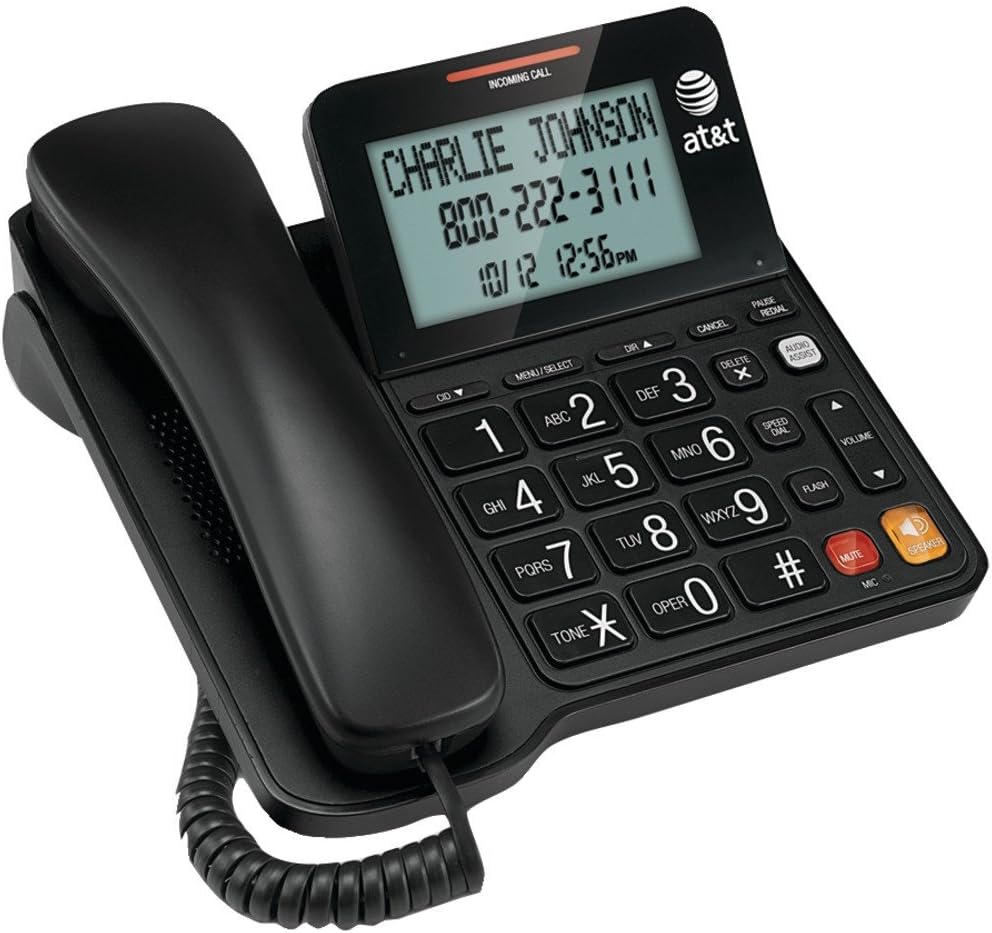
AT&T CL2940 Corded Phone
4.2Editor score
Audio Assist volume boost
Extra-loud adjustable ringer
Large tiltable caller display
Corded outage operation
Our Hearing Impaired Landline Phone guide compares ten helpful models for clearer calls, louder alerts, captions, easy controls, and dependable use.
A hearing impaired landline phone should make conversations easier without adding complicated setup or constant adjustments. Useful models combine stronger caller volume, adjustable ringer tones, visual alerts, speakerphone support, large displays, and accessible buttons. Some add real-time captions, noise reduction, slow speech, photo dialing, answering machines, or cordless freedom.
We compared all ten products using the features and specifications supplied for each model. The guide covers corded and cordless designs, hybrids, captioned service, hearing aid compatibility, amplified audio, visual indicators, call-management features, and ease of dialing. These are the most relevant distinctions for households choosing a more accessible home telephone.
Each review explains the strongest benefits, practical limitations, and the type of user most likely to value the design. The first three receive the roundup’s top awards, while the remaining selections provide alternatives for different budgets, household setups, and accessibility priorities. Product prices and availability can change, so compare current listings before purchasing.
4.2Editor score

4.3Editor score
4.3Editor score
This side-by-side comparison highlights the phone type, core amplification or captioning feature, accessibility aids, and included system components. It helps distinguish basic corded convenience from cordless mobility, hybrid systems, and captioned calling.


The Hamilton CapTel 2400iSPNBT is the roundup’s most complete option for users who struggle to follow speech during phone conversations. It holds a 4.3 rating and stands apart from the other models through a large touchscreen that can display real-time captions for incoming and outgoing calls. The result is a phone designed to support both listening and reading.
We may earn a commission when you buy through this link, at no additional cost to you.
Its accessibility is unusually thorough. Callers can increase incoming volume by up to 40dB, adjust tone, and customize caption size. Users may select automatic captioning or assisted captioning with live operator support. A built-in answering machine also presents voicemail captions on the screen, extending the visual support beyond live conversations and helping users review messages at their own pace.
The trade-offs are significant. The telephone requires a Wi-Fi-capable high-speed internet connection, standard electrical power, and potentially separate telephone service. Captioning registration and availability are restricted to residents of the United States who have hearing loss. It is also more involved than a straightforward amplified handset, so users who only need louder sound may find a simpler model easier to manage.
This is the strongest recommendation for someone who wants captions rather than merely increased volume, especially when missing or misunderstanding words is a frequent concern. The combination of large text, real-time captions, amplified sound, assisted support, and captioned voicemail gives it broader accessibility than a standard amplified landline. Confirm service eligibility and setup requirements before ordering.
Real-time captions allow a user to watch a conversation as it happens, rather than relying exclusively on speech that may remain difficult to separate. Assisted captioning adds operator support, while automatic captioning offers a more automated option.
The large touchscreen supports adjustable caption size and tone controls. Voicemail captions provide another route to messages when audio playback alone is not enough.
We may earn a commission when you buy through this link, at no additional cost to you.
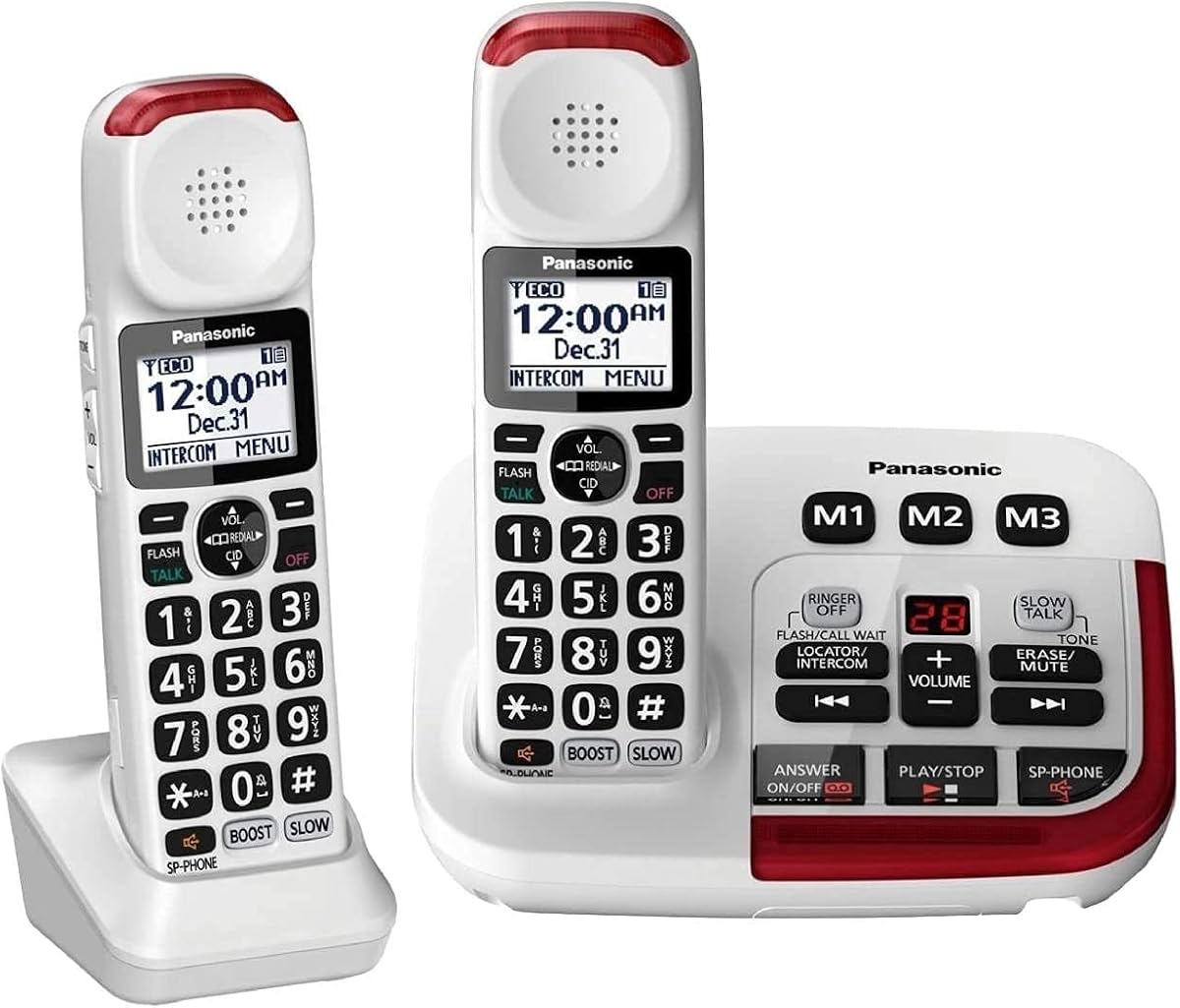
The Panasonic KX-TGM420W is a premium amplified cordless system for households that want more than one accessible handset. It carries a 4.3 rating and includes two handsets, a digital answering machine, and a base unit designed to be easier to hear and see. Its strongest conversation tools combine volume, tone control, noise reduction, and a slow-speech function.
We may earn a commission when you buy through this link, at no additional cost to you.
The Volume Boost control can raise amplified caller voice volume by as much as 40dB, while six tone settings offer some latitude for users who find particular vocal frequencies difficult to distinguish. Slow Talk slows speech in real time and while checking voicemail, which can make fast or complex language easier to follow. A loud base ringer and bright red visual-ringer LEDs provide alternative ways to notice incoming calls.
Additional features make this a full household telephone rather than a single accessibility device. It includes power backup, speakerphone, talking caller ID, a talking keypad and phonebook, nine speed dials, 250-number call blocking, intercom capability, and expansion to as many as six handsets. Noise reduction can also make conversations more comfortable when background sound is present.
Buyers should consider charging and placement. The included cordless handsets depend on rechargeable batteries, while the base and system features add more controls than a basic amplified phone. Even so, this model suits users who value speech adjustment, mobility around the home, and a second handset for another family member. It is our premium pick for a flexible, feature-rich home system.
Slow Talk reduces the pace of live speech and recorded messages, giving users more time to process language. Noise Reduction suppresses background interference to make conversation more comfortable.
Two included handsets support different rooms or family members. Talking controls, call blocking, speed dials, intercom, and expansion add practical everyday value.
We may earn a commission when you buy through this link, at no additional cost to you.
The Panasonic KX-TGM450S is a single-handset amplified cordless phone with a 4.3 rating. It is particularly compelling for users who need a high caller-volume boost, as the system supports up to 50dB of amplification. Its 112dB loud visual ringer and bright red LEDs offer an additional way to notice calls when sound alone is insufficient.
We may earn a commission when you buy through this link, at no additional cost to you.
Speech intelligibility is supported by six tone settings, noise reduction, and Slow Talk. The last feature can slow the caller’s speech during a live call and when listening to messages. A large white backlit LCD, enlarged memory buttons, and a backlit keypad improve visibility, while hearing aid compatibility broadens its usefulness for users who rely on assistive listening devices.
Although only one handset is included, the telephone can expand to six handsets. It also includes power backup, speakerphone, talking caller ID, talking keypad and phonebook, nine speed dials, 250-number call blocking, and intercom functions. Those additions make it a capable general-purpose home phone, although the menu and controls may take more attention than those of a simple corded model.
This Panasonic is a strong choice for a user who wants maximum listed amplification, slow speech, and cordless mobility without paying for a two-handset bundle. It may be especially useful where room noise or missed calls are common concerns. Buyers who need a second included handset should instead consider the closely related KX-TGM420W package.
The phone combines up to 50dB of caller-volume boost with six tone levels. This lets users adjust both overall loudness and vocal character rather than relying on one fixed setting.
A bright red visual ringer and flashing indicators supplement the audible alert. The large backlit screen and enlarged controls improve reading and dialing in dim conditions.
We may earn a commission when you buy through this link, at no additional cost to you.
The VTech SN5147 is a 4.0-rated hybrid senior phone that combines a reliable corded base with one cordless handset. Its central advantage is operational resilience: the corded base works during power outages, while the cordless handset provides freedom to move around the home. It is designed with seniors and hard-of-hearing users in mind.
We may earn a commission when you buy through this link, at no additional cost to you.
Audio support includes a one-touch boost of up to 50dB and an adjustable ringer reaching 90dB. A flashing visual indicator offers an alternative way to recognize incoming calls. Full-duplex speakerphone is available on both the base and handset, making hands-free conversation possible for users who have difficulty holding a receiver.
Accessibility extends to the interface. Oversized, high-contrast buttons and an extra-large display simplify dialing and Caller ID reading. Four photo speed-dial slots make frequent contacts easier to reach, while a smart call blocker can reject up to 1,000 unwanted numbers. The 22-minute digital answering machine supports remote access and slow playback.
This model is a practical recommendation for a household that wants backup operation, one cordless extension, loud alerts, and simplified calling. The included cordless handset requires charging, and some users may need help programming photo buttons or the call blocker. For anyone prioritizing easy visual and physical access without captioning, the SN5147 offers a balanced set of features.
The wired base retains basic telephone operation when household power is unavailable. The cordless handset adds convenience without sacrificing that dependable connection.
Photo speed dialing reduces the need to remember numbers. Call blocking, slow voicemail playback, and spoken Caller ID further simplify routine phone management.
We may earn a commission when you buy through this link, at no additional cost to you.
The Clarity P300 is a straightforward corded amplified phone with a 4.0 rating. Designed for seniors and people with mild to moderate hearing loss, it concentrates on making a conventional landline easier to hear and operate. The phone amplifies incoming sound by as much as 26dB while keeping the setup uncomplicated.
We may earn a commission when you buy through this link, at no additional cost to you.
Customization includes adjustable ringer pitch as well as ringer volume, allowing users to identify a sound that is more perceptible at their particular hearing threshold. Large buttons and an enlarged handset support users with limited dexterity or vision. Because it uses a standard phone jack, the telephone requires no batteries or wireless signal for its core operation.
The bundle includes the Clarity P300, a 25-foot telephone line cord, and a user guide. That makes placement and installation more straightforward than for a multi-component cordless or captioned system. However, the P300 does not provide the advanced calling features found in several competing models in this roundup.
Choose the P300 when simplicity, affordability, and basic amplified sound matter more than mobility or captions. It is a sensible first telephone for a user who can manage a wired handset but needs a louder incoming voice and more recognizable ring. Those wanting a display, answering machine, or cordless extension should look to a more advanced alternative.
Separate ringer pitch and volume controls make it easier to find an alert that can be heard clearly. This is often more useful than simply turning the ring louder.
The standard jack connection avoids charging and wireless setup. A long included line cord gives the user flexibility in choosing where the telephone sits.
We may earn a commission when you buy through this link, at no additional cost to you.
The Uvital Big Button Phone is a 4.1-rated corded speakerphone designed around very loud alerts, accessible dialing, and minimal operating requirements. It reaches a listed 120dB ringtone and 90dB earpiece volume, with three independent volume settings. A bright red flashing LED provides another way to notice an incoming call.
We may earn a commission when you buy through this link, at no additional cost to you.
Eight one-touch speed-dial buttons can display customized family or friend photos, alongside a dedicated SOS button. This arrangement can make everyday calls easier for seniors with memory loss, poor vision, or cognitive impairment. One-touch hands-free calling also benefits people with limited mobility or difficulty holding the receiver for extended periods.
Its simplicity comes with clear boundaries. The phone is designed for PSTN landline service and does not support internet calling, answering machines, voicemail, Caller ID, or a display screen. It uses an RJ11 connection and requires no batteries or external power, which supports reliable calling but offers fewer smart features than the AT&T, VTech, and Swissvoice systems.
This Uvital is a strong option for a person who primarily needs an extremely loud ringer, large photo-dialing buttons, and a simple speakerphone. It may be particularly useful in a home, care setting, or institution where visual and physical calling cues matter. Users who need a screen or call history should select a more advanced model.
The high-output ringtone is paired with a flashing LED alert. Together they provide multiple ways to recognize a call in a noisy room or at night.
Photo speed-dial keys and a dedicated SOS key reduce the need to search for or recall a number. Hands-free operation makes prolonged conversations more comfortable.
We may earn a commission when you buy through this link, at no additional cost to you.
The AT&T CL2940 is a 4.2-rated corded phone that delivers a useful balance of amplification, visibility, and familiar home-phone features. Its Audio Assist control increases incoming sound for users with hearing difficulty, while the extra-loud ringer helps ensure calls are noticed. The handset remains connected to a standard landline, avoiding the complexity of a cordless system.
We may earn a commission when you buy through this link, at no additional cost to you.
Senior-friendly design is evident in the extra-large buttons and tiltable display. The display can present Caller ID names and numbers, and the phone stores a history of up to 50 entries for call screening. Call Waiting is included, while speakerphone provides a hands-free option for longer conversations or for users who have trouble holding the receiver.
The corded design also supports basic calling during power outages because it does not depend on household electricity for basic operation. Caller ID and Call Waiting require four AA batteries, which are not included, so buyers should plan for that small maintenance requirement. There is no built-in answering machine or captioning function.
The CL2940 is the roundup’s best budget selection because it captures the most important accessibility features without introducing a subscription requirement or complex service setup. It is well suited to a user who wants louder calls, a visible display, and dependable wired operation. Those needing captioned conversations should save up for the Hamilton CapTel instead.
Audio Assist and the adjustable ringer are built into the phone. No internet connection or captioning subscription is required for its core benefits.
The wired connection supports basic calling without AC power. A tilted screen, large buttons, and call history make the unit approachable for everyday use.
We may earn a commission when you buy through this link, at no additional cost to you.
The Clarity XLC3.4+ is a cordless amplified phone with a 3.7 rating, making it a more specialized selection in this roundup. Its headline features are DECT 6.0 technology, an extra-loud ringer, big buttons, talking Caller ID, and Digital Clarity Power. These features support a user who wants mobility without giving up a prominent incoming-call alert.
We may earn a commission when you buy through this link, at no additional cost to you.
DECT 6.0 operating at 1.9GHz is designed to provide interference-free reception and a wide range. The stated battery-life improvement of 30% is useful for a handset used throughout the home. Dual power battery support adds another layer of system flexibility, while talking Caller ID reads caller information aloud for users who may not see the display clearly.
The available product information is concise, so it is best to consider the XLC3.4+ based on its clearly identified strengths rather than assume unlisted features. It does not mention real-time captions, a photo-dialing system, an answering machine, or a specific amplification figure. The result is a more focused cordless option than the Panasonic and VTech hybrids.
This phone is most suitable for someone who values a portable handset, a loud ringer, and spoken caller information in a straightforward cordless design. Its lower rating warrants checking recent customer feedback and compatibility before purchase. Buyers who need explicit volume specifications, slow speech, or a large answering machine may prefer a model with more fully documented accessibility features.
DECT 6.0 technology is designed for interference-free reception and broad household range. The cordless format allows the user to keep the handset nearby without sitting at a fixed base.
Talking Caller ID provides an audible alternative to reading a display. Combined with the extra-loud ringer, it offers two different ways to identify incoming calls.
We may earn a commission when you buy through this link, at no additional cost to you.
The SWISSVOICE Premium 3355 is a hybrid phone for elderly and hard-of-hearing users, with a 3.4 rating. It includes a corded base, an additional cordless handset, and an answering machine. Its most distinctive accessibility feature is a set of four large photo memory buttons, including an SOS button, that make frequent contacts easier to identify.
We may earn a commission when you buy through this link, at no additional cost to you.
The regular dialing keys are also extra large, supporting users with low vision or unsteady hands. An adjustable ringer can reach up to 90dB, and the phone is hearing aid compatible. Those combined characteristics make it useful for people who rely on both stronger sound and assistive hearing devices.
Call blocking is built in, which helps reduce unwanted interruptions. The base can work with up to three additional handsets, offering expansion potential beyond the cordless unit included. Nevertheless, the supplied information does not provide a specific caller-volume amplification figure, captioning support, or detailed answering-machine specifications.
The Premium 3355 is a reasonable choice for a household seeking photo speed dialing, a loud ringer, and a corded-cordless arrangement in one system. Its low rating suggests buyers should examine current reviews carefully, particularly regarding call quality and setup. It is best for users who prioritize large physical controls over text-based communication.
Four large photo memory keys, including an SOS key, make key contacts recognizable at a glance. Enlarged dialing keys further reduce the effort required for routine calls.
The corded base and included cordless handset support different calling locations. Additional compatible handsets can extend the system as household needs change.
We may earn a commission when you buy through this link, at no additional cost to you.
The Clarity E814CC is an amplified corded-cordless combination phone with a 4.1 rating. Its format combines a fixed wired connection with cordless mobility, while the integrated answering machine adds a way to receive and review messages when no one is available. It is a versatile option for users who want more functionality than a single basic handset.
We may earn a commission when you buy through this link, at no additional cost to you.
Dual-SIM capability is another notable feature, allowing the telephone setup to work with two phone lines or services when supported by the relevant provider and line configuration. A dual-keypad arrangement provides separate controls for the corded and cordless components, helping users understand which part of the system they are operating.
The available specifications are limited to the model number 53727.000 and physical dimensions of 8.90 by 5.50 by 7.50. No precise amplification figure, ringer output, captioning function, or detailed answering-machine function is provided, so buyers should not assume features that are not stated in the product listing.
The E814CC is best for a user who values corded reliability, cordless convenience, an answering machine, and two-line flexibility. It may suit households with more demanding calling arrangements, though users should verify SIM and line compatibility before purchase. For a clearly documented amplification level and stronger visual-accessibility specifications, the VTech SN5147 is the more transparent alternative.
The corded base provides a stable connection, while the cordless component adds mobility. This mix can serve different rooms and calling preferences within one household.
Dual-SIM functionality can suit households that use more than one service, subject to provider compatibility. The answering machine adds message-taking support for users away from the phone.
We may earn a commission when you buy through this link, at no additional cost to you.
The best choice depends on the user’s hearing pattern, dexterity, home layout, telephone service, and tolerance for setup. Comparing the features below is more useful than relying on a single loudness number, because gain, ringer output, visual alerts, captions, and speech controls solve different problems.
A louder incoming voice and a louder ringing signal serve different purposes. Caller amplification helps a person understand speech after answering, while ringer volume determines whether the incoming call is noticed at all. Products in this roundup specify caller gains of up to 26dB, 40dB, or 50dB, while ringer outputs range from an extra-loud setting to listed maxima of 90dB or 120dB. Compare these figures carefully and do not treat them as interchangeable.
Choose stronger caller amplification when the main problem is difficulty understanding the person on the other end. Prioritize an adjustable ringer and visual alert when missed calls are the greater concern.
Increasing volume does not always correct every form of hearing difficulty. Some users benefit from tone controls, while others need background noise reduced before speech becomes easier to understand. Slow Talk can make fast speech or complex language more manageable by lowering the pace of live calls and voicemail.
Prioritize tone adjustment, noise reduction, or slow-speech controls when your difficulty is speech discrimination rather than simple audibility. These features are especially relevant in the Panasonic models.
Real-time captions provide a visual alternative to understanding audio. The Hamilton CapTel displays automatic or operator-assisted captions for calls and can show answering-machine messages in text. This approach may be valuable when volume, tone, and background noise still do not make conversation comfortable.
Choose a captioned telephone when visual communication is essential or when speech changes too quickly to follow. Confirm internet, registration, residency, and service requirements before buying.
A corded phone is simple, reliable, and often usable for basic calls during a power outage. A cordless handset provides mobility but requires charging and a powered base. Hybrid systems combine the two, often including a corded base and one or more cordless handsets, but they occupy more space and involve more setup.
Choose corded for simplicity and outage readiness, cordless for freedom around the home, and hybrid for the broadest combination of convenience and fallback operation.
Accessibility may involve vision, motor control, or the inability to rely on an audible ringer alone. Large high-contrast buttons, tiltable screens, photo speed dials, red LED visual ringers, and flashing indicators can make a phone easier to operate. A screen is useful for identifying callers, but a photo button can be even more direct for a frequently called family member.
Prioritize oversized controls, high-contrast displays, and at least one visual incoming-call alert. Photo dialing is worth considering for users with memory or vision challenges.
The best hearing impaired phone should also work well between calls. Features such as speakerphone, talking Caller ID, a talking keypad, speed dials, call blocking, intercom, and expansion can reduce everyday frustration. The supplied models range from a minimal wired telephone to systems with answering machines, multiple handsets, and call filtering.
Choose based on household routine rather than feature count. A user overwhelmed by many options may benefit more from a simple phone and a few photo-dial keys than a large multi-function system.
Not every amplified phone works the same way. The Uvital model is restricted to PSTN service and omits Caller ID, voicemail, an answering machine, and a display. The Hamilton CapTel needs high-speed internet, electrical power, and sometimes separate telephone service. Cordless models require compatible telephone service, a powered base, and charging.
Confirm line type, internet availability, service eligibility, and power requirements before ordering. Checking these details prevents choosing an attractive phone that cannot provide its advertised features.
Begin by placing the phone where the user can comfortably reach the handset, keypad, display, and any visual alert. For a corded model, connect the line cord securely and keep it away from trip hazards. Cordless models should be placed where the handset can reach its base to recharge, while hybrid systems need enough room for both components.
Next, configure the most important accessibility settings. Test several ringer volumes, tone options, amplification levels, and visual indicators under realistic conditions. Program frequently called numbers, install photo buttons where applicable, set the clock if the display is used for Caller ID, and adjust text or caption size. Allow extra time to compare each setting with a family member or support person.
Care for the system by keeping it dry, dust-free, and away from excessive heat. Follow the manufacturer’s instructions for battery replacement, rechargeable battery care, answering-machine memory, and service registration. Test the phone and visual alert periodically, especially after moving the furniture or changing internet or telephone service.
The easiest model depends on the user’s specific limitations. The AT&T CL2940 favors users who want a familiar corded design, large controls, a visible display, and straightforward amplification, while the Uvital phone is exceptionally simple with eight photo-dial buttons and a dedicated SOS key. The best approach is to prioritize the assistance that addresses the greatest daily difficulty.
Most of the corded and cordless models in this guide are designed for conventional landline service. The Uvital is specifically restricted to PSTN service, while the Hamilton CapTel also requires high-speed internet and may require telephone service. Check the product requirements and confirm your provider before installation.
Volume boost generally increases the loudness of what the user hears during a call or through the earpiece. Amplification may also be described in decibels, but its practical result depends on the telephone circuitry and the user’s hearing needs. Additional tone control, noise reduction, and slow speech can sometimes improve intelligibility more effectively than maximum volume alone.
A captioned phone is better when visual reading is needed because it displays conversation text in addition to sound. An amplified phone may be sufficient for mild difficulty and is often simpler to use. The Hamilton CapTel is the leading captioned choice here, while several other products concentrate on amplified audio, tone adjustment, and slower speech.
The AT&T CL2940 and the VTech SN5147 have corded bases designed to support basic calling without household AC power. Caller ID and other electronic functions may still require batteries or external power, so users should confirm exactly which features remain available. A separate battery backup may be advisable for users who depend on every phone function.
Look for a flashing visual ringer or LED indicator in addition to an adjustable audible ringtone. The VTech SN5147, Uvital Big Button Phone, AT&T CL2940, and Panasonic models all provide visual-alert features. Placement also matters because the light should be visible from another room or from under a pillow, depending on the user’s needs.
Large buttons and photo speed dialing can make calling easier by reducing the need to remember and enter a full number. The Uvital and SWISSVOICE Premium 3355 emphasize photo buttons, with the Uvital also providing a dedicated SOS key. Families should still create a contact list and practice a simple calling routine for maximum benefit.
Choose corded for a simple, stable connection and easier basic operation, particularly where outage access matters. Choose cordless if the ability to move around the home is important, and hybrid if both benefits are needed. Cordless users should account for battery charging, while corded models may offer fewer location choices.
The Hamilton CapTel 2400iSPNBT is the most accessibility-focused overall recommendation because real-time captions, a large touchscreen, amplified sound, and captioned voicemail work together. The Panasonic KX-TGM420W is the premium system choice for two included handsets, slow speech, noise reduction, and extensive household features. For a straightforward lower-cost purchase, the AT&T CL2940 provides amplification, a large display, and dependable corded calling.
Prioritize the problem you need the phone to solve. Users who cannot follow speech may need captions, slow speech, or noise reduction. Users who miss rings need a very loud ringer and visual alert. Those with memory, vision, or dexterity challenges may benefit most from photo buttons, large controls, and a tiltable display. A hybrid system is ideal when mobility and outage-ready calling are both important.
Before purchasing, confirm service compatibility, internet requirements, registration rules, included components, and the functions needed during an outage. Product prices and availability change, so review the current listing and recent customer feedback at the time of purchase. The right phone is the one that makes everyday communication reliably easier for the intended user.