10 Best High Gain Gmrs Antenna (October 2026) Expert Guide
Written by admin · Updated October 2026
A high-gain GMRS antenna can make a substantial difference when ordinary handheld coverage fades around hills, buildings, or dense vegetation. The right model improves signal strength, supports dependable base-station or mobile operation, and gives your radio a more effective link across the 462–467 MHz GMRS band.
We compared ten antennas using their published gain, frequency range, impedance, connector type, power handling, mounting arrangement, construction, and intended use. The list includes base antennas, spring-mounted vehicle whips, a magnetic mobile antenna, and a compact magnetic-mount option for handhelds.
Each review explains the product's strongest traits, practical limitations, and ideal installation. Ratings reflect the listed customer feedback, while technical claims come from the available product information. Features, availability, and prices can change, so verify current listings before buying.
Top 3 Picks for Best High Gain Gmrs Antenna
Best Budget
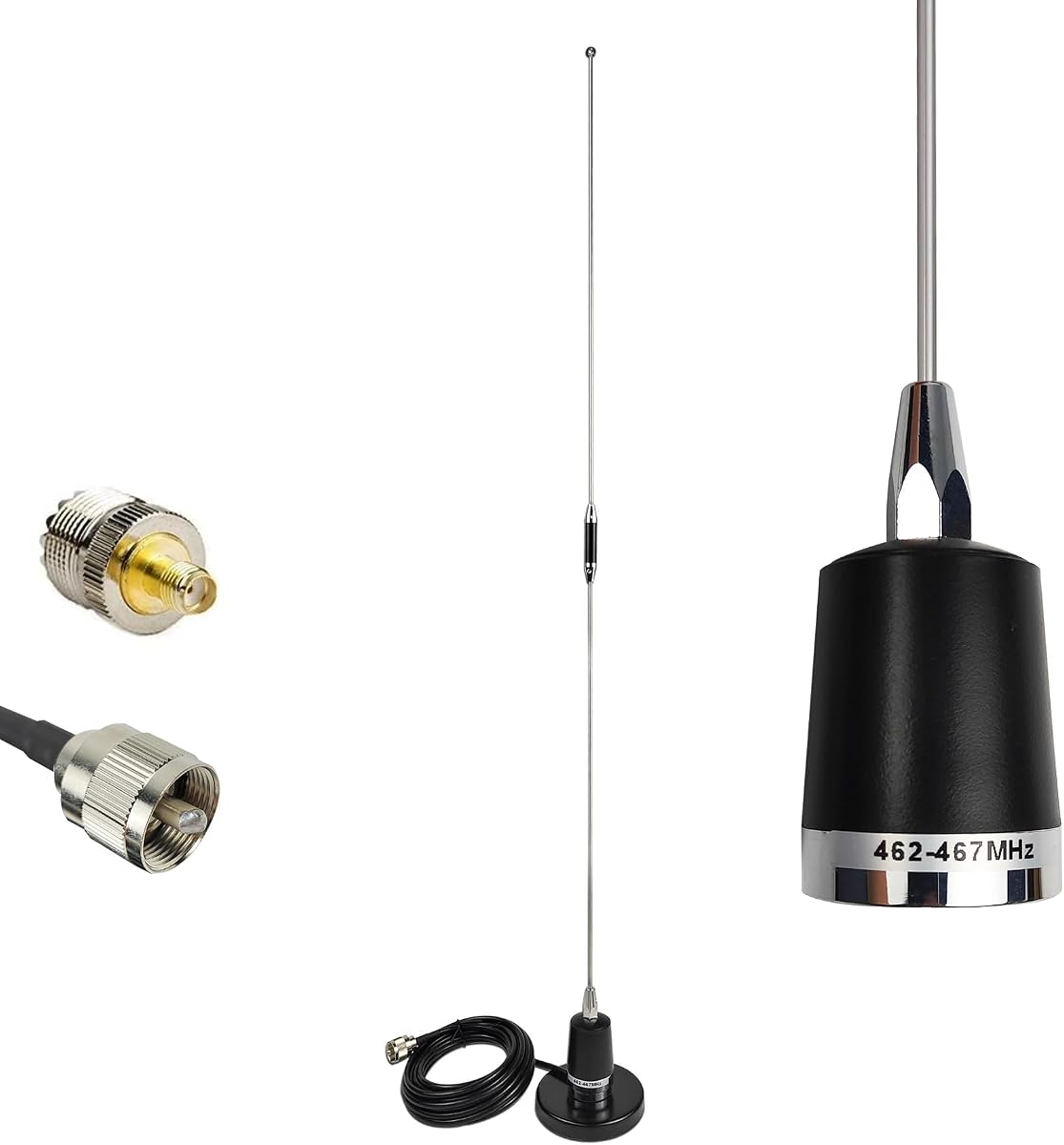
Authentic Genuine Nagoya UT-72G Super Loading Coil 19-Inch Magnetic Mount (Heavy Duty) GMRS (462MHz) Antenna PL-259, Includes Additional SMA Male & Female Adaptors for GMRS Handheld Radios
GMRS Base Antenna 462-467MHz with 32ft Cable – High Gain 7.5dBi Fiberglass Base Station Antenna for GMRS Repeater & Mobile Radio, UHF Female (SO-239) Connector
As an Amazon Associate we earn from qualifying purchases.
Top 10 Best High Gain Gmrs Antenna in 2026 Compared
The table below compares all ten antennas by their most important published characteristics. It highlights differences among mobile whips, base-station models, mounting systems, gain, and connector compatibility so buyers can identify the most appropriate design for their radio and installation.
The GMRS Base Antenna 462-467MHz with 32ft Cable earns a 4.9 rating and stands out as the most complete high-gain option in this guide. It is built around a 7.5 dBi fiberglass antenna designed for GMRS base stations, repeaters, and mobile operations, making it a versatile choice for fixed or elevated installations.
Pros
Strong published customer rating
Low listed VSWR
Complete installation kit
Fiberglass outdoor construction
Broad GMRS equipment compatibility
Cons
Longer installation footprint
Requires suitable mounting point
We may earn a commission when you buy through this link, at no additional cost to you.
Its strongest technical advantage is the stated VSWR of less than 1.3. A lower standing-wave ratio generally supports more efficient power transfer and fewer reflected signals. The included 32-foot SL16 cable, SO-239 antenna connector, PL259-to-SMA female adapter, mounting hardware, and screws give buyers the principal components needed for a practical installation without requiring a separate accessory hunt.
The fiberglass construction is another meaningful strength. It is described as capable of enduring heavy rain, strong winds, and extreme temperatures, which suits outdoor base-station use. Its 462–467 MHz tuning also matches the GMRS band and gives it broad relevance for community repeaters, mobile radios, and recreational communication systems. The trade-off is that a 32-foot cable and elevated base antenna require more planning than a compact magnetic setup.
This is the strongest all-around recommendation for a buyer who wants high gain, low VSWR, and a broad accessory package. Choose it when you have a suitable mast or elevated mounting position and need dependable service for a base station or repeater. Verify connector compatibility with your radio, allow room for the full cable, and follow local operating rules for GMRS transmissions.
Efficient Signal Transfer
The listed VSWR below 1.3 is particularly attractive for installations where efficient transfer and stable communication matter. It complements the 7.5 dBi gain design without relying on an unnecessarily complicated antenna system.
Everything Needed at Installation
The long coaxial lead, adapter, mounting hardware, and screws create a more convenient package than a bare antenna. Buyers should still confirm that their radio uses a compatible connector and that the selected mounting location provides adequate clearance.
The Midland MXTA26 is a compact 6 dB mobile whip with a 1.5-inch base diameter and a 4.7 rating. It is designed for Midland radios used in off-road, RV, overlanding, and 4WD touring applications, as well as farm and emergency communication. Its small mounting footprint makes it appealing where a full base station would be impractical.
Pros
Compact base diameter
Strong customer rating
Mobile-friendly design
Suited to off-road travel
Useful for farm communication
Cons
Intended for Midland systems
Less suitable as a home base
We may earn a commission when you buy through this link, at no additional cost to you.
The antenna's principal benefit is straightforward: it adds more directional efficiency and signal strength than a typical short rubber-duck antenna without requiring a tall fixed installation. That makes it relevant to travelers who want better mobile coverage while moving between rural roads, open countryside, and areas where ordinary handheld reception becomes inconsistent.
Its compact size is also a meaningful advantage. A smaller base is easier to accommodate on limited roof space, around racks, or near other vehicle accessories. The trade-off is that this is specifically a Midland-oriented MicroMobile product rather than a universal base-station platform. It is also less compelling for users who need a broad connector ecosystem or a permanent elevated installation.
Buyers with compatible Midland mobile equipment should consider the MXTA26 when straightforward mobile gain matters more than elaborate installation flexibility. Confirm radio compatibility, mount the whip securely, and keep the antenna oriented vertically. It is a practical choice for overlanding, RV travel, farm work, and emergency-prepared vehicle kits.
Space-Saving Mobile Upgrade
The 1.5-inch base diameter helps the antenna fit into crowded vehicle environments. That makes it easier to add useful gain without dedicating a large section of roof or bumper space to the installation.
Built for Travel
The stated use cases center on off-road travel, RV touring, farming, and emergency communication. Buyers in these environments often value dependable mobile performance and a compact antenna over fixed-installation flexibility.
The BRC HP-500 is the highest-gain antenna in the group, with a listed 11.7 dB rating and a 4.5 customer score. Supporting the 460–470 MHz GMRS frequency range, 50-ohm impedance, and up to 200 watts, it is aimed at serious base-station, repeater, or elevated communication installations where the highest available gain is the priority.
Pros
Highest published gain
High power capacity
Broad GMRS band coverage
Standard SO-239 connector
Substantial antenna height
Cons
Larger installation requirement
Not ideal for temporary mounting
We may earn a commission when you buy through this link, at no additional cost to you.
The antenna measures 17.5 feet, or approximately 5.2 meters, and has a radial length of 7.4 inches. Its size makes the HP-500 a fixed-installation solution rather than a convenient vehicle antenna. Nevertheless, that larger structure is consistent with the strong gain figure and makes it a logical premium choice for operators who can mount it at a suitable height and maintain adequate clearance.
The SO-239 connector is widely used with UHF radio equipment, and the 200-watt maximum power input provides ample headroom for higher-output radio systems. Its 460–470 MHz range closely matches the GMRS segment, though buyers should confirm their equipment's exact tuning and connector requirements. The main drawback is installation complexity: a tall antenna needs a stable support, safe routing of the feed line, and attention to nearby obstructions.
The HP-500 is recommended for users who want the highest gain listed in this comparison and have a permanent elevated site. It suits demanding base-station, repeater, and community-communication configurations more than temporary mobile use. Pair it with a compatible radio, appropriate coaxial cable, secure mounting hardware, and correct grounding for the installation.
Maximum Published Gain
At 11.7 dB, the HP-500 leads the group by a clear margin. That advantage is most useful where a stable elevated position can be established and the installation is intended to remain in service.
High-Power Station Capability
The listed 200-watt limit and 50-ohm impedance make the antenna suitable for robust radio installations. Equipment compatibility still needs to be checked before purchase.
The GR100 7.5 dBi Fiberglass GMRS Base Antenna has a 4.5 rating and combines 7.5 dBi of gain with a VSWR below 1.3. Designed as a ground-plane antenna with low-elevation omnidirectional radiation, it is positioned for compact base stations, community communications, camping, and vehicle applications where useful coverage is needed without the largest fixed-installation footprint.
Pros
Low listed VSWR
Strong seven-point-five gain
Omnidirectional radiation pattern
Weather-resistant fiberglass
Works on shorter masts
Cons
PL-259 connector may need adaptation
Elevation still influences performance
We may earn a commission when you buy through this link, at no additional cost to you.
The low-elevation radiation characteristic makes this model interesting for installations on shorter masts. Instead of concentrating all of its energy toward a very low horizon angle, the antenna is described as providing better coverage in nearer surroundings. That can be helpful at campsites, farms, neighborhood repeater sites, and other locations where nearby users are important.
Fiberglass construction provides a durable housing intended to withstand rain, wind, and temperature extremes. The stated 462–467 MHz range and low VSWR support efficient operation across the GMRS band, while the PL-259 connector offers a recognizable option for compatible radio systems. The main practical caveat is connector matching, since some radios use SMA or another interface and therefore need an appropriate adapter.
The GR100 is best for buyers who prioritize efficient 7.5 dBi gain, low VSWR, and a ground-plane-style installation without committing to the tallest antenna in the list. It is particularly suitable for short-mast and moderate-height locations. Buyers should confirm the required connector, secure the antenna vertically, and position it away from large metal obstructions that could disturb the standing-wave ratio.
Coverage for Shorter Masts
The low-elevation omnidirectional radiation pattern is the defining feature. It can provide useful near-field coverage where mounting on a tall tower would be unnecessary or difficult.
Efficient Fiberglass Construction
Combining a 7.5 dBi rating with VSWR below 1.3 gives the GR100 a technically efficient foundation. The weather-resistant fiberglass body is suited to long-term outdoor use.
The Retevis GMRS Mobile Radio Antenna has a 4.4 rating, 7.2 dBi gain, and coverage across 462–467 MHz. It uses a three-section fiberglass construction connected by a copper rod, combining a 50-ohm impedance with VSWR below 1.5 and maximum power input of 200 watts. It is aimed at mobile-radio and repeater applications that need more gain than a typical handheld accessory.
Pros
Wide bandwidth claim
Heavy-duty fiberglass body
Copper rod connection
Alloy connector
High power capacity
Cons
Lower score than leaders
Affected by nearby obstructions
We may earn a commission when you buy through this link, at no additional cost to you.
One of its more compelling details is the heavy-duty fiberglass body, which is described as improving outdoor working life. The copper connection is intended to reduce power loss, while the alloy connector provides the physical radio interface. The stated wide bandwidth and low VSWR make this antenna relevant for users operating across the licensed GMRS frequency range.
The product information specifically notes that tall buildings and environments with many metal obstacles can affect the standing-wave ratio. That warning is important because gain alone does not determine real-world performance. Antenna position, nearby structures, cable quality, radio output, terrain, and interference all influence the result. A clear elevated location offers more potential than a compromised roof or crowded indoor installation.
This Retevis antenna is a sound choice for base or elevated mobile-radio installations that need solid gain and durable materials without moving to the largest antenna. It is less attractive for buyers prioritizing the lowest VSWR or a fully bundled cable kit. Confirm the connector, provide a stable mounting point, and avoid areas crowded with large metal structures whenever possible.
Low-Loss Internal Connection
The listed copper rod connection is intended to reduce power loss within the antenna assembly. Combined with 50-ohm impedance, it supports efficient transfer into the radio system.
Durable Three-Section Body
The fiberglass sections create a weather-resistant structure for extended outdoor use. Their segmented design also makes the antenna easier to transport and assemble for temporary communications sites.
The Nagoya UT-72G is a 19-inch magnetic-mount antenna with a 4.6 rating. Its loading coil, PL-259 connector, strong magnetic base, heavy-duty cable, and included male and female SMA adapters create a convenient package for upgrading a GMRS handheld, mobile radio, or compatible communications setup without permanent drilling.
Pros
Quick magnetic installation
Adapters included for handhelds
Compact nineteen-inch length
Weatherproof construction
Useful loading-coil design
Cons
Requires a metal ground plane
Not a permanent base antenna
We may earn a commission when you buy through this link, at no additional cost to you.
Its tightly wrapped loading coil is intended to improve UHF reception and extend effective range. Because the entire antenna is only 19 inches long, it is much easier to move between vehicles or temporary operating positions than a tall base antenna. The rare-earth magnetic base provides a secure attachment to a suitable metal surface, and the stainless-steel antenna body adds durable construction.
Performance still depends on installation. The product information explicitly states that the antenna requires a metal ground plane for optimal results, and a magnetic base can perform differently on vehicles with composite panels, complex roof coatings, or uneven surfaces. A large, flat metal area is generally preferable. The included adapters improve compatibility, though users should confirm whether the radio requires the PL-259, SMA male, or SMA female connection.
The UT-72G is our best budget and portable selection for buyers who want meaningful gain without a permanent mast. It is especially useful for a handheld carried in a vehicle, weekend communications, travel, and temporary field use. Mount it on the largest available metal surface, keep the whip vertical, and route the cable away from sharp edges and moving components.
Portable Magnetic Convenience
The strong magnetic base allows the antenna to move with the operator. This is ideal for users who switch between vehicles or need a temporary elevated location without assembling a fixed support.
Handheld Connection Flexibility
Including both SMA male and female adapters makes the package particularly useful for handheld users. Buyers should identify their radio's connector before installation and avoid unnecessary adapters that could add loss or complicate the setup.
The Retevis MR300 is a 48.2-inch fiberglass mobile whip with 6.5 dB gain and a 4.5 rating. It operates across 462–467 MHz with VSWR of 1.5 or lower, 50-ohm impedance, vertical polarization, and a 50-watt power rating, making it a substantial vehicle option for GMRS users who want more height and gain than a magnetic mount.
Pros
Absorbs vehicle vibration
Long fiberglass whip
Broad radio compatibility
Includes bracket and fasteners
Corrosion-resistant body
Cons
Long whip needs clearance
Connector matching is required
We may earn a commission when you buy through this link, at no additional cost to you.
Its flexible spring base is the defining practical feature. The spring allows the whip to bend away when the vehicle encounters vibration, reducing shock loading and helping the antenna remain upright. A 16-foot RG-58U cable, mounting bracket, and U-bolt are included, giving the installer a more complete mobile package than a basic antenna-only option.
The fiberglass construction is described as corrosion resistant, which is valuable for outdoor vehicle use where rain, road grime, and changing weather are unavoidable. The listed compatibility includes several Midland and Retevis mobile radios, transceivers, and repeaters. Buyers should still confirm the radio's connector and mounting requirements because a long whip is only useful if it can be installed without striking branches, garages, or other obstructions.
The MR300 is a strong choice for off-road, overlanding, and mobile users who want a permanently mounted antenna with vibration accommodation. Its drawbacks are the long profile, which requires careful clearance, and the fact that the included installation pieces still need to be matched to the vehicle. Use the supplied bolts and bracket, avoid sharp cable edges, and verify the entire radio-to-antenna connection.
Vibration-Resistant Mounting
The spring base flexes under movement and helps reduce mechanical stress on the antenna. This makes the whip better suited to rough roads than a rigidly mounted shaft.
Useful Height and Gain
The 48.2-inch body and 6.5 dBi gain give the radio more vertical separation from many nearby obstructions. Proper clearance and vertical orientation remain essential for predictable results.
The 6.5dBi Spring Mobile Antenna combines a 4.6 rating with a fiberglass whip, heavy-duty spring base, mounting bracket, 16.4-foot RG-58U cable, and PL-259 connector. Designed for GMRS repeaters, amateur-radio equipment, off-road vehicles, and car radios, it offers a balanced package for users who want a substantial mobile upgrade and a complete set of installation hardware.
Pros
Broad installation package
Flexible heavy-duty spring
Weather-resistant fiberglass
Suitable for off-road vehicles
Includes FME-to-PL259 adapter
Cons
Vehicle installation required
Adapter adds another connection
We may earn a commission when you buy through this link, at no additional cost to you.
The spring base buffers the antenna against the vibration encountered while driving. Its elasticity helps the whip flex rather than transmit every shock directly into the mount, while also helping maintain vertical orientation. This is particularly valuable on uneven roads where a rigid antenna could experience repeated mechanical stress.
The included mounting components go beyond the antenna itself. Buyers receive fixing screws, a bracket, a spring base with cable, and an FME-to-PL259 adapter. That assortment simplifies the physical installation, although the radio and antenna connector should be checked before assembly. The fiberglass body is described as resistant to corrosion, wind, rain, vibration, and collision, supporting use in harsh outdoor environments.
This antenna is a good match for off-road operators, touring drivers, and mobile-radio users who prefer a bolted installation over a magnetic one. It also makes sense for users operating a GMRS repeater from a vehicle. The trade-off is permanent mounting and the need to plan clearance, grounding, cable routing, and connector transitions. The spring helps with vibration but cannot solve a poorly planned installation.
Hardware Included for Installation
The bracket, fasteners, spring, cable, and adapter cover the main mechanical requirements. This reduces the chance of discovering a missing piece only after the vehicle is ready for installation.
Protection on Rough Roads
The spring base absorbs movement and helps maintain vertical alignment. Combined with the fiberglass body, it supports stable operation in vibration-prone and wet environments.
The GMRS NMO Antenna has a 4.9 rating, 6.5 dBi gain, and a pre-tuned design for 462–467 MHz. Its NMO magnetic base, 13-foot RG58 cable, PL-259 connector, and SO-239-to-SMA female adapter create a flexible mobile package for compatible GMRS radios, high-power mobile equipment, and repeater setups.
Pros
Strong customer rating
Pre-tuned GMRS range
Low listed VSWR
Secure NMO magnetic base
Broad adapter compatibility
Cons
Magnetic mount is removable
Metal ground plane still matters
We may earn a commission when you buy through this link, at no additional cost to you.
The NMO mount is a recognized mobile-radio configuration and provides a secure way to attach the antenna to a suitable metal surface. The 3.54-inch base offers a broader platform than a very small puck magnet, which can improve stability. The stated 150-watt power rating also gives the antenna more capacity than many basic mobile accessories.
The antenna is tuned specifically for the GMRS band, and its VSWR of less than 1.5 is intended to limit reflected power and maintain signal integrity. The removable mounting arrangement makes the system attractive for people who need to move it between vehicles. However, the metal mounting surface serves as the antenna's ground plane, and its shape, size, and location can affect performance.
This NMO antenna is a strong recommendation for users who want a high customer rating, 6.5 dBi gain, and the flexibility of a magnetic mobile installation. It works particularly well for high-power radios and repeater operations, provided the radio and connector arrangement are compatible. Mount it on a large, flat metal area, keep it upright, and secure the cable before travel.
Strong Mobile Power Handling
The listed 150-watt limit provides useful capacity for higher-output mobile radios. Users should still ensure that the radio, feed line, connectors, and antenna form a compatible system.
Reconfigurable Installation
The magnetic NMO base allows the antenna to be removed and relocated. This is convenient for multiple vehicles, temporary repeater work, and users who do not want permanent mounting holes.
The HYSHIKRA 8.5dBi GMRS Outdoor Base Antenna has a 4.3 rating, 8.5 dBi gain, and broad compatibility with mobile radios and base transceivers from Motorola, Icom, Kenwood, Midland, and Yaesu. Its 462–467 MHz operation, 200-watt maximum power rating, and SO-239 female connector make it a flexible choice for a range of permanent or semi-permanent communication systems.
Pros
High published gain
Broad radio-brand compatibility
Two-hundred-watt capacity
Three-part portable design
Bracket included
Cons
Lowest rating in comparison
Outdoor setup needs care
We may earn a commission when you buy through this link, at no additional cost to you.
The three-part fiberglass design separates into manageable sections for transport and assembly. Its stated length is 66 inches in the specifications, while the product title also references an 86-inch dimension, so buyers should consult the current listing and packaging for the exact configuration. An antenna bracket is included, providing a basic foundation for mounting the antenna securely.
At 8.5 dBi, the antenna offers more published gain than the common 6.5 dBi mobile whips and sits above several 7 dBi base options. The fiberglass body is suited to outdoor use, while the 200-watt rating accommodates demanding radio configurations. The principal trade-off is the lowest customer rating in this particular group, which should be considered alongside the otherwise broad feature set.
This antenna is recommended for users who need 8.5 dBi gain, a 200-watt rating, and compatibility across several major radio brands. It works well for base stations, outdoor mobile installations, and community communications where elevated placement is possible. Confirm the connector and physical length with the radio supplier, mount the antenna vertically, and provide a stable bracket and suitable grounding.
Broad Equipment Compatibility
The stated support for several established mobile-radio brands makes this option less dependent on one ecosystem. Connector compatibility remains the decisive detail, as radio models within the same brand can use different interfaces.
Portable Three-Part Construction
The segmented fiberglass design eases transport and setup. It is a practical attribute for temporary communication deployments, although assembled height and bracket support still need to be considered.
We may earn a commission when you buy through this link, at no additional cost to you.
Buying Guide – How to Choose the Best High Gain Gmrs Antenna
Choosing a high-gain GMRS antenna requires matching the antenna's design, frequency range, gain, connector, and mounting method to your radio and operating environment. The most important distinctions are whether you need a portable mobile setup, a fixed base station, or a vehicle-mounted system, plus whether the installation can support the antenna's full height.
Base Station or Mobile Use
A base antenna is designed to remain in one elevated location, while a mobile antenna is intended to move with a radio, vehicle, or temporary setup. Fixed products generally offer more height, stronger gain figures, and permanent mounting choices, whereas mobile models emphasize quick installation, flexible mounting, and a smaller footprint.
Gain and Coverage
Gain describes how efficiently an antenna concentrates energy in a direction compared with another reference antenna. It does not create more radio power or guarantee a specific distance, but a higher-gain antenna can improve signal strength in favorable directions when mounted high enough. Real coverage also depends on terrain, buildings, vegetation, interference, radio output, and antenna height.
Frequency and VSWR
The antenna must cover the 462–467 MHz GMRS band. Most models in this guide do so, while the BRC HP-500 uses a broader 460–470 MHz range. VSWR indicates how closely the antenna and feed system match the radio. Lower values, such as the listed VSWR below 1.3, generally support more efficient transfer and fewer reflected signals.
Connector Compatibility
Common connectors in this group include PL-259, SO-239, NMO, SMA, and FME. The radio's connector, the cable fitting, and any adapter must form a correct connection. An adapter can make an installation possible, but every added interface should be installed well and kept dry. Purchasing the native connector can simplify the setup and reduce avoidable connection points.
Mounting Location and Height
Height is one of the most influential practical variables in antenna performance. Mobile whips work best when they extend above nearby obstacles, while base antennas benefit from a clear, elevated position. Magnetic mounts need a broad metal ground plane, and spring-mounted antennas need enough clearance to flex without contacting branches, roofs, or garages.
Construction and Weather Resistance
Most of the fiberglass antennas are marketed for outdoor environments where rain, wind, temperature changes, and corrosion are concerns. Fiberglass is lightweight and weather resistant, but the connector, cable entry, mounts, and fasteners also need protection. Magnetic and spring bases may be easy to move, yet exposed hardware and cables still require secure routing.
Power Handling
Power handling matters when the antenna will be connected to a higher-output mobile radio or repeater. The listed limits range from 50 watts for the Retevis MR300 to 200 watts for several base models, while the NMO mobile antenna is listed at 150 watts. Matching the antenna to the radio's maximum output and duty cycle helps avoid stressing the antenna or feed system.
Cable and Included Accessories
Cable length affects installation flexibility and potential loss, particularly at UHF frequencies. Products include leads ranging from 13 feet to 32 feet, with some providing brackets, bolts, adapters, and connectors. A complete kit can reduce setup friction, but component quality, connector type, and correct radio compatibility remain more important than the number of loose parts in the box.
How to Use and Care for Your High Gain Gmrs Antenna
Begin by confirming that the antenna covers the frequencies and power level used by your radio. Check the antenna, cable, adapters, and radio connector for compatibility, then assemble the mounting hardware. Position the antenna vertically and secure every fastener. For magnetic models, select the largest available flat metal surface; for fixed models, use a stable support and follow local grounding requirements.
Keep the antenna as clear as practical of metal obstructions, branches, roof structures, and other antennas. Route the coaxial cable away from sharp edges, pinch points, hot components, and moving vehicle parts. On a magnetic base, inspect the surface for dirt, wax, loose powder coating, or uneven panels because these can reduce stability and alter the ground-plane relationship.
For ongoing care, inspect the mount, connectors, and cable after severe weather or off-road travel. Clean the magnetic base and mating surface, check bolts for looseness, and look for damaged insulation or water intrusion. If performance changes, test the radio with a known-good antenna, inspect cable connections, and then reevaluate placement. Avoid transmitting without a properly connected antenna, and comply with all applicable GMRS operating rules.
Frequently Asked Questions
Is a higher-gain GMRS antenna always better?
No. Higher gain can improve signal strength when the antenna is correctly positioned and has a clear area, but it does not increase radio power or guarantee a specific range. Height, terrain, buildings, vegetation, interference, cable quality, and mounting all influence results. A properly placed 6.5 dBi mobile antenna may outperform an 11.7 dBi base antenna installed in a poor location.
What is the difference between a GMRS base antenna and a mobile antenna?
A base antenna is intended for a stable, elevated installation and usually has more height and a higher gain. A mobile antenna is designed for a vehicle, handheld radio, or temporary position and normally uses a spring, bracket, or magnetic base. Choose according to how the radio will be used rather than selecting only by the gain number.
Do I need an adapter for my GMRS radio?
That depends on the connector fitted to your radio. The antennas in this guide use combinations of PL-259, SO-239, NMO, SMA, and FME connections. Some packages include appropriate adapters, while others require a separate purchase. Confirm both the radio connector and cable end before installation, and use a correctly sized, securely fitted adapter when one is necessary.
Where should I mount a magnetic GMRS antenna?
Choose the largest, flattest metal surface available and mount the antenna as vertically as possible. Avoid painted surfaces, trim, roof racks, and areas where the cable might be pinched. The metal surface acts as the antenna's ground plane, so a small or uneven surface can reduce performance. Check the mount after driving and before relying on the installation for a critical communication.
What does low VSWR mean for a GMRS antenna?
VSWR measures how closely the antenna system matches the expected radio impedance. A lower value, such as the below-1.3 figure listed for two of the base antennas, generally indicates more efficient power transfer and less reflected energy. Actual performance still depends on the complete radio, cable, connector, antenna, and installation.
Are spring-mounted antennas better than magnetic mounts?
A spring-mounted antenna is usually better for a permanent vehicle installation because it is more secure and flexes under vibration. A magnetic mount is more convenient when portability matters or drilling is undesirable. A magnetic system needs a suitable metal ground plane, while a permanent mount needs correct bracket placement and secure cable routing.
Can a high-gain antenna improve a handheld radio?
Yes, if the handheld is connected to a compatible external antenna and the system is used from a suitable location. A high-mounted external whip can provide better reception than an internal rubber-duck antenna, particularly in a vehicle. The radio's connector, accessory-port limitations, and required adapters must be checked first.
How much coax cable should I use with a GMRS antenna?
Use enough cable to reach the radio while keeping the run as short and clean as practical. The products in this guide use approximately 13 to 32 feet of RG-58-type coax, and the longer systems are intended to make elevated placement possible. Avoid unnecessary slack, sharp bends, and coiled excess cable, and secure both ends against moisture and movement.
Final Thoughts on Choosing the Best High Gain Gmrs Antenna
The GMRS Base Antenna 462-467MHz with 32ft Cable is the strongest all-around choice because it combines 7.5 dBi gain, a listed VSWR below 1.3, durable fiberglass construction, and a broad installation kit. The BRC HP-500 leads in raw gain, while the Nagoya UT-72G is the practical choice for portable or budget-conscious mobile use.
Prioritize the installation before focusing on the largest gain figure. A tall antenna in a poor location can underperform a shorter antenna mounted with excellent clearance. Match the frequency band, connector, cable, power rating, and mounting style to your radio, and account for weather, ground-plane requirements, obstructions, and the possibility of moving the system between vehicles.
Finally, check the current listing, included accessories, connector specifications, and price before ordering. Product bundles, included adaptors, and availability can change, and GMRS operation must comply with current licensing, equipment, and transmission rules. A careful compatibility check is the best starting point for a high-gain antenna installation that serves your communication needs.