
QWORK Mini Heat Gun
4.5Editor score
300W focused heating
Reaches 390°F temperature
Retractable tabletop stand
Pencil-style portable grip
Discover the best heat gun for shrink tubing, with ten options compared for temperature control, airflow, safety, nozzles, and ease of use.
A heat gun for shrink tubing should deliver focused, controlled heat without overheating nearby components or creating an unsafe workspace. The right tool combines an appropriate temperature range, useful airflow control, nozzle options, and a stable design that suits both delicate electronics work and larger repair projects.
This guide compares ten heat guns using their stated power, temperature settings, airflow, safety features, included accessories, and intended applications. It covers compact tools for detailed work, variable-temperature models for versatile use, and feature-rich professional options for users who want precise control and convenient storage.
Each review explains where a particular model stands out, what trade-offs to consider, and which type of user may benefit most. Product availability, ratings, included accessories, and prices can change over time, so check the current listing before making a final purchase decision.
4.5Editor score

4.7Editor score
4.8Editor score
The table below compares all ten heat guns across their principal power, temperature, airflow, and accessory features, making it easier to identify the right balance of control, portability, and performance.


The SEEKONE 350W Mini Heat Gun is a compact option for shrink tubing tasks where portability and focused airflow matter more than maximum power. Its two selectable temperatures—500°F and 842°F—provide enough variation for many small repair and craft jobs, while its 4.6 rating reflects generally favorable user feedback.
We may earn a commission when you buy through this link, at no additional cost to you.
Its most appealing feature is the narrow-focusing nozzle, which helps direct heated air toward a specific wire, splice, or tube. That makes the tool more suitable for confined electronics work than a broad airflow tool. The retractable stand also provides a stable hands-free position, while the lightweight body should be easy to maneuver around a workbench.
The principal limitation is its 350W power rating. It will heat faster than many miniature hot-air tools, but it does not offer the rapid recovery or broad heat range associated with 1800W models. The two fixed settings also provide less opportunity to dial in a precise temperature when different tubing or nearby materials have different heat tolerances.
This model is a sensible choice for hobbyists, electronics technicians, and crafters who regularly work on small components and need a heat gun that can reach awkward spaces. For frequent heavy-duty shrink wrapping or large assemblies, one of the variable-temperature full-size options is likely more flexible.
The included concentrating nozzle keeps the hot-air stream relatively narrow, helping the user target a small section of tubing. This is particularly useful around wires, connectors, and components that could be affected by a wider blast of heat.
The retractable stand lets you set the gun down while the cable shrinks around the work. That reduces the need to hold the tool at an exact angle and can make repetitive bench work more consistent.
We may earn a commission when you buy through this link, at no additional cost to you.
The SEEKONE 1800W Heat Gun offers one of the broadest combinations of heat and airflow in this roundup. Its variable range extends from 122°F to 1202°F, allowing the user to choose gentler heat for delicate tubing or higher output for demanding shrink-wrap jobs. It carries a 4.6 rating.
We may earn a commission when you buy through this link, at no additional cost to you.
Power is a major strength. The stated 1800W output is suitable for quickly working heat into adhesive-backed tubing, vinyl, and electrical insulation. Two airflow modes provide another layer of control, with the listed ranges reaching 500L/min in the higher mode. Four nozzle attachments broaden the available heat patterns.
Its adjustment system is less direct than an LCD-based model. Temperature is selected with a black dial, while airflow is controlled through a switch on the handle. This is still more flexible than a tool with two preset temperatures, but it may take practice to learn the combinations that work best for each material.
Choose this gun if you expect to use it beyond shrink tubing. It is equally suited to 3D-print post-processing, PVC work, electronics repair, paint removal, and other household heating tasks. It may be more than a small specialist tool needs, but it is a versatile option for a shared workshop.
Independent temperature and airflow controls allow the user to shape the tool's behavior instead of accepting a single preset. That flexibility is valuable when moving from lightweight tubing to thicker insulation or vinyl wrapping.
The included deflector, two concentrators, and reflector nozzle support focused, narrow, or dispersed airflow. This lets you select a pattern that suits the size and position of the shrink tube rather than working with one fixed stream.
We may earn a commission when you buy through this link, at no additional cost to you.
The SEEKONE 1800W Dual-Setting Heat Gun combines substantial power with a straightforward two-mode design. Its 752°F and 1112°F choices give users a meaningful jump in intensity, and the 4.7 rating indicates strong reception among users. It is well suited to larger shrink jobs and repeated workshop use.
We may earn a commission when you buy through this link, at no additional cost to you.
The tool delivers up to 500L/min of airflow in its high mode, which should provide forceful heating for adhesive tubing and thicker wrap materials. A TPE-covered handle improves grip security, while the integrated stand and hanging hook make storage and cooling straightforward. Its UL certification also adds a notable credential.
The main limitation is granularity. Unlike a continuously variable gun, this model offers only two temperature choices. Some jobs may require an intermediate level to avoid softening a connector or stressing nearby plastic. The manufacturer also notes that initial smoke and a burning odor can occur while the heating core's anti-rust coating is removed.
Buyers who want easy high-output heating without navigating many controls will appreciate this option. It is a strong fit for crafters and repairers who know their materials and want dependable low-or-high performance, while users needing fine tuning should favor a variable-temperature model.
The 1800W rating and 500L/min high-mode airflow make this a practical choice when a small wire connection is not the only goal. It can also serve heat-shrink wrap, embossing, and other higher-output craft applications.
The non-slip TPE handle, integrated vertical stand, and hanging hook support both active use and organized storage. These practical details reduce the need for separate accessories during routine bench work.
We may earn a commission when you buy through this link, at no additional cost to you.
The SEEKONE 1800W Compact Heat Gun is the strongest all-around choice in this guide. It combines stepless temperature adjustment, two airflow settings, compact dimensions, and four nozzles, giving it the flexibility needed for both delicate shrink tubing and broader workshop tasks. Its 4.7 rating supports its strong overall showing.
We may earn a commission when you buy through this link, at no additional cost to you.
The 122–1202°F adjustment range is the key advantage for shrink tubing. Users can begin at a lower setting and increase heat gradually, which is useful when the safe working temperature is not known precisely. Airflow can be set between 300L/min and 500L/min, allowing focused treatment of small sections or faster coverage of larger areas.
Its compact body is stated to be 20 percent smaller than traditional models on the market. That saves storage space without sacrificing the 1800W output or ceramic heating element. The tradeoff is that many advanced features require deliberate adjustment rather than a single simple switch, so first-time users should start conservatively.
This is the recommendation for most buyers who want one heat gun capable of handling electronics, cables, vinyl, crafts, and household repairs. Choose it over the mini options when you need quicker heating and greater control, and over simpler full-size tools when fine temperature selection matters.
Stepless adjustment lets you increase heat in small increments instead of jumping between widely separated presets. That control is valuable when shrinking tubing around a sensitive connection or working beside plastic components with a lower heat tolerance.
The smaller housing is designed to improve carrying and storage while retaining 1800W output. It therefore offers a useful middle ground between a precision mini tool and a larger workshop heat gun.
We may earn a commission when you buy through this link, at no additional cost to you.
The QWORK Mini Heat Gun is an approachable option for beginners and occasional users who need to shrink small pieces of tubing. Its 300W power heats to 390°F, enough for focused detail work on lightweight materials, and it has a 4.5 rating. The compact design is the main attraction.
We may earn a commission when you buy through this link, at no additional cost to you.
A pencil-style grip provides precise control, while the retractable stainless steel stand makes the gun stable during tabletop use. The stated operating guidance calls for three to five centimeters of clearance and no more than ten minutes of use at one time. These details position it as a light-duty craft tool rather than a continuous industrial heat source.
The maximum temperature is the clearest constraint. Some tubing, connectors, or wraps may benefit from higher heat, and the QWORK cannot provide that range. Its 300W output may also take longer to recover when cooling a larger piece of material. For electronic leads and small craft components, however, the lower heat can be safer.
This is a budget-conscious choice for hobbyists, students, and occasional repairers. It is particularly attractive when a full-size heat gun would be excessive or inconvenient to store. Users with demanding materials or frequent professional workloads should choose a more powerful variable-temperature model.
The 390°F maximum focuses attention on small workpieces such as lightweight wire insulation, craft pieces, and epoxy repairs. A lower-temperature tool can also reduce the risk of accidentally warping nearby delicate parts.
The lightweight body and integrated retractable stand make this model convenient for small desks, craft areas, and portable kits. It avoids the bulk of a full-size gun while still providing directed hot air.
We may earn a commission when you buy through this link, at no additional cost to you.
The Wagner Spraytech HT1000 Kit is a well-rounded household heat gun for users who prefer simple settings and a helpful set of nozzles. Its 750°F and 1000°F choices cover common shrink-tubing tasks, while the 4.6 rating indicates a favorable reception.
We may earn a commission when you buy through this link, at no additional cost to you.
Three included nozzles widen the range of possible heat patterns. An edge protector nozzle is useful when heat must be directed away from delicate surfaces, a flare nozzle distributes heat over a long narrow area, and a concentrator produces a small focused stream. That selection makes the kit adaptable to different connector sizes without requiring separate attachments.
Safety and convenience are handled through an integrated stand and an ETL listing to applicable UL and CSA safety standards. The corrosion-resistant nozzle also supports regular use. Compared with variable-temperature models, though, the two fixed settings offer less ability to find an exact middle ground for delicate assemblies.
The HT1000 is a strong fit for home maintenance, electronics, and general craft work. Choose it when you value straightforward operation, recognizable safety standards, and useful included accessories. It is less compelling for a specialist who wants continuous temperature adjustment, but it remains a practical and versatile heat gun.
The edge protector, flare nozzle, and concentrator cover several common needs. Focused airflow suits small splices, while broader distribution can help cover longer sleeves more evenly.
Beyond shrink tubing, the listed applications include thawing pipes, removing flooring, shrinking wrap, heating PVC, and removing paint. That broad use makes the kit practical for a shared household tool collection.
We may earn a commission when you buy through this link, at no additional cost to you.
The ROMECH Heat Gun balances powerful output with a broad 120–1200°F adjustment range. Its 1500W rating, fast-heating claim, and two selectable airflow levels make it well suited to shrink connectors, cable insulation, craft materials, and vinyl wrap. The product carries a 4.6 rating.
We may earn a commission when you buy through this link, at no additional cost to you.
Variable temperature allows more precise selection than the dual-setting tools in this list. Airflow can move between 66 and 132 gallons per minute, giving users a way to adapt the tool to concentrated or more expansive heating. Four included nozzles add further pattern flexibility.
Its component specification is reassuring for a workshop tool: an UL-certified power cord, ceramic frames, a nickel-chromium heating coil, a polycarbonate blower fan, and mica plates. Overload protection is included, and the self-standing design leaves both hands available. The lack of a digital display means less immediate feedback than the DEWALT model.
This gun is a good match for builders, repairers, and crafters who want broad control but do not require a premium display. It handles more demanding material than a mini heat gun and provides a more nuanced temperature range than many simpler household models.
Two airflow outputs let you adapt the gun's reach and intensity, while the wide temperature adjustment supports different material thicknesses. This combination is useful for moving between small electrical connectors and larger wrap jobs.
The stated components and overload protection emphasize durability and reliability. A self-standing body also keeps the gun stable when both hands are needed to position tubing or hold a wire.
We may earn a commission when you buy through this link, at no additional cost to you.
The BLACK+DECKER HG1300 combines a 4.8 rating with a straightforward design for common household and craft applications. Its 1350W output and dual 750°F or 1000°F settings are suitable for many standard shrink-tubing jobs, particularly when a simple two-level control is preferable.
We may earn a commission when you buy through this link, at no additional cost to you.
The three-position side handle is the model’s most distinctive feature. It lets users change the grip angle for better access around a work surface, which can improve control when heating a splice from different directions. The lightweight, compact body also reduces fatigue during repeated use, and the corded format provides continuous runtime.
A built-in stand provides a safe place to cool the tool, and the included glass protect nozzle helps manage the hot-air outlet. The tradeoff is that the two fixed temperatures cannot match the fine-grained control of continuously variable or LCD-equipped heat guns.
This model is a good choice for everyday users who value a comfortable grip, simple operation, and a high-rated established design. It works well for routine cable maintenance, crafts, and household heating tasks. For delicate electronics requiring exact temperature matching, consider one of the variable-control alternatives.
The three-position side handle lets the user rotate the tool to suit the angle of the work. This is helpful when a standard top grip would require an awkward wrist position.
The 750°F and 1000°F choices cover many common heat-shrink applications without making the controls complicated. The 1350W rating provides a useful middle ground between mini tools and the highest-output models.
We may earn a commission when you buy through this link, at no additional cost to you.
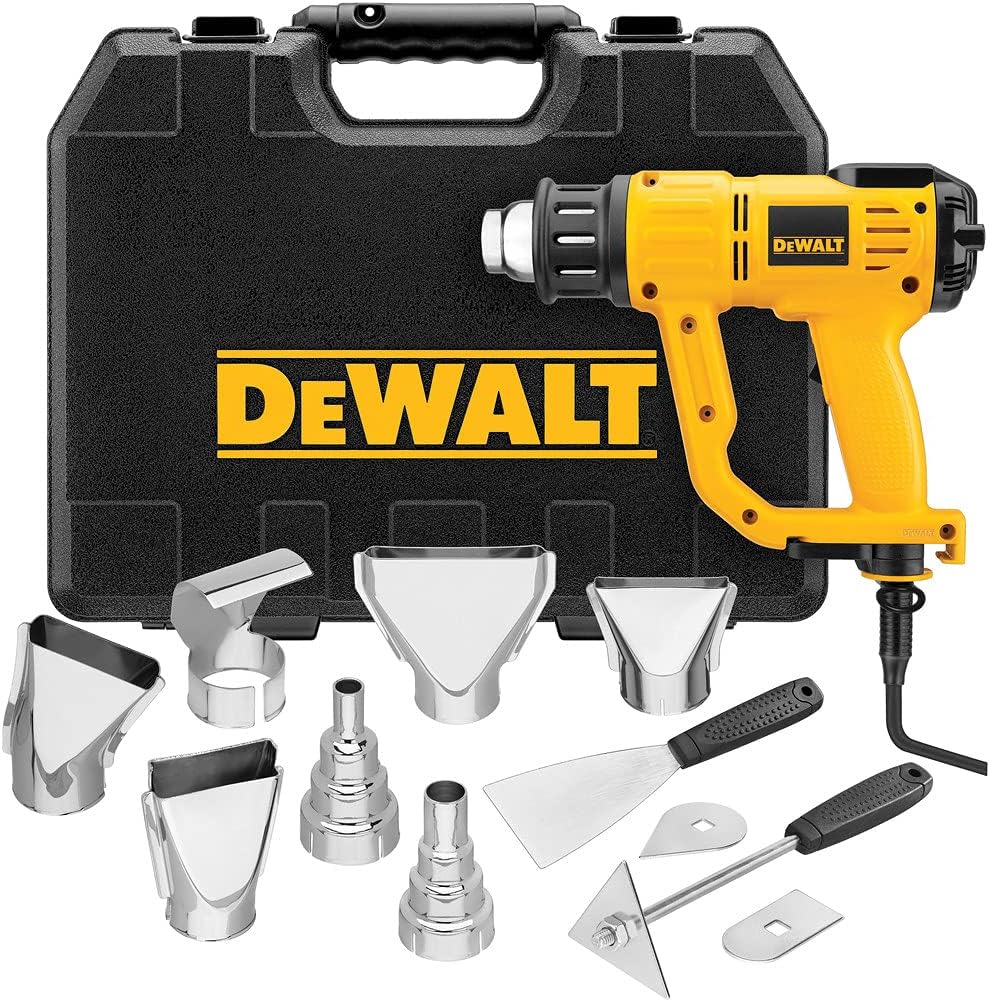
The DEWALT Classic D26960K stands out as the most premium-oriented heat gun in the roundup because of its LCD display and 50-degree temperature increments. It has a 4.8 rating and offers the most visible control interface among the listed products, making it attractive for precise shrink-tubing work.
We may earn a commission when you buy through this link, at no additional cost to you.
The display reduces uncertainty by showing the selected temperature rather than requiring users to infer it from a dial. Adjusting in 50-degree steps is not infinitely precise, but it is meaningfully finer than moving between only two fixed settings. The tool also includes built-in overload protection to shut down the heating element if it overheats.
Physical design is a major strength. The innovative kickstand improves stability and helps prevent tip-over, while the hang ring supports convenient storage. A cord protector reduces wear at the housing connection, and the ergonomic grip is designed for extended use. At 2.3 pounds, it is also relatively compact for its feature set.
This premium choice is suited to installers, maintenance professionals, serious hobbyists, and anyone who performs many heat-shrink tasks. The hard case and accessory kit make it especially useful for organized tool storage. Those who only need occasional small repairs may find a less expensive model more than adequate.
The LCD display shows the chosen heat setting, helping you match the airflow to the material instead of estimating from a physical dial. This is particularly helpful during repeated work where consistency matters.
The included hard case and accessory kit are valuable for professionals who transport tools. A hang ring and protected cord complement the case by supporting storage and everyday durability.
We may earn a commission when you buy through this link, at no additional cost to you.
The Weller 6966C is a compact industrial heat gun with a 250W power rating and a straightforward three-way control. Its 4.7 rating suggests favorable user satisfaction, while the hi-off-cool switch and grounded cord support controlled use in an industrial or workshop setting.
We may earn a commission when you buy through this link, at no additional cost to you.
The dedicated cool position is particularly notable because it allows the airflow to continue after the heat is switched off. That can help cool the tool and the workpiece after shrinking, which is useful when moving immediately to another task. The six-foot cord provides more reach than many compact heat guns, and the three-wire grounded plug is designed for appropriate power connections.
The product data provides limited information beyond the wattage and switch configuration. There is no listed temperature range, accessory set, or airflow figure, so buyers cannot compare those specifications as precisely as they can with several other models in this guide.
This tool is most appropriate for users seeking a simple, industrial-style heat source with a dedicated cooling mode, particularly in a professional workshop with suitable electrical infrastructure. It is less suitable for beginners who want precise heat-shrink guidance or for large jobs that call for higher output.
The cool switch position keeps airflow operating without the high heat setting. This makes it easier to cool a completed connection or the tool itself before the next task.
A grounded three-wire plug and six-foot cord suit a professional environment where a secure connection and extended reach are important. Users should follow the manufacturer's instructions when integrating the tool into a workshop power setup.
We may earn a commission when you buy through this link, at no additional cost to you.
The most important buying factors are usable temperature control, airflow direction, power, safety features, and the size of the projects you expect to handle. Consider the tubing material, nearby components, and required workspace before choosing a model.
Prioritize variable or finely adjustable temperature control for precision work. Fixed dual settings are easier to learn but provide less room to find a safe middle ground.
Choose 1500W to 1800W for broad project flexibility. A 250W to 350W mini gun is sufficient for many small hobby tasks.
Look for multiple airflow settings and suitable nozzles. Precise work benefits from a focused stream; larger sleeves benefit from greater volume.
Choose at least one concentrating and one dispersing nozzle. The right shape prevents accidental damage while improving coverage.
Look for overheat protection and a stable built-in stand. Follow the stated clearance and cooldown instructions exactly.
Choose a mini model for portability and a full-size model for versatility. Check cord reach and storage accessories before buying.
Test the handle position if possible and prioritize simple controls. An LCD is helpful for repeated professional work.
Match output to the largest planned job. Avoid paying for excessive power if all work is small and delicate.
Prepare the work before heating. Slide the tubing onto the wire, splice, or connector and confirm that it is correctly positioned. Clear flammable material from the area, secure the workpiece so it cannot roll, and inspect the nozzle for obstructions. A small piece of leftover tubing can help you identify the appropriate heat range before working on a finished assembly.
Start with a lower setting or a moderate airflow and keep the nozzle moving rather than holding it over one point. Feed the hot air around the circumference of the tubing until it contracts evenly and bonds to the underlying surface. For variable-temperature tools, increase heat gradually if needed. For dual-setting models, move to the higher setting only when the material and nearby components can safely tolerate it.
After the tubing has shrunk, allow the connection to cool before handling or energizing it. Switch to the cool setting if your tool provides one, set the heat gun on its stand, and let the nozzle cool naturally. Keep the air outlet open, clean the nozzle only after cooling, avoid contact with water, and store the tool with its cord protected and its hot end unobstructed.
The correct temperature depends on the tubing manufacturer and the material surrounding the connection. Begin at a moderate setting and increase it gradually while moving the heat gun, watching for even contraction without discoloration, bubbling, or damage to nearby plastic. Variable-temperature models are particularly useful because they make small adjustments easier.
Yes, a mini heat gun can shrink lightweight tubing around small wires and connectors. Models such as the QWORK and SEEKONE mini gun are best suited to localized, delicate tasks. Their lower output may be slower or inadequate for thick insulation, large sleeves, adhesive-backed materials, or repeated professional workloads.
Yes. Continuous movement distributes heat more evenly and reduces the risk of scorching one area. Keep the nozzle moving around the circumference rather than concentrating it on a single point. Maintain the recommended clearance and use a lower airflow or temperature when nearby materials are sensitive.
More wattage can provide faster heating and stronger recovery, but it is not automatically safer or more precise. Small connections may be best handled by a focused, lower-output tool, while larger sleeves benefit from more power. Choose a model whose temperature and airflow controls let you match its output to the material.
A concentrator nozzle is generally the most useful choice for small connectors because it narrows the hot-air stream around a precise area. A flatter or deflector nozzle can help with longer sleeves or when you need to spread heat over a wider section. Avoid resting the nozzle against the work, which can create an overheated spot.
Heating can soften many types of tubing, but removal may damage the wire insulation, connector, or nearby components. It is safer to cut carefully along the length of old tubing or use an appropriate removal method designed for the application. A heat gun should be used cautiously because softened material can still remain hot enough to cause burns.
Yes. Switch off the heat and, where available, use the cool setting while the tool remains upright and unobstructed. Let the nozzle cool completely before putting it in a case or attaching any accessory. Storing a hot tool can damage the case, cord, plastic housing, or nearby materials.
Use the lowest effective temperature, select a focused airflow pattern, and keep the tool moving. Protect adjacent components with a heat-resistant barrier and disconnect power when the work permits it. Avoid heating connectors or solder joints longer than necessary, and allow the assembly to cool before reassembly.
The SEEKONE 1800W Compact Heat Gun is the strongest overall choice because it combines a broad 122–1202°F range, stepless adjustment, two airflow speeds, four nozzles, and a manageable size. The QWORK Mini Heat Gun is the best budget pick for small, lightweight jobs, while the DEWALT D26960K earns the premium recommendation for its LCD display, refined increments, storage case, and stable professional design.
Prioritize the level of control your materials require. Fine variable adjustment is valuable around sensitive electronics, a focused nozzle helps prevent damage, and adequate airflow is necessary for thicker or longer sleeves. If you expect frequent work, prioritize repeatable settings, comfortable handling, overheat protection, and accessories that support different heat patterns.
Finally, check the current listing, included components, warranty information, and price before purchasing. Product configurations and availability can change, and current customer feedback may offer useful details beyond the stated specifications. Choose the heat gun that matches your project scale, workspace, and need for precision rather than selecting solely by wattage.