
FS-TFC 5-Stage RO System
4.2Editor score
Five-stage reverse osmosis
100 GPD rated capacity
Four replacement filters included
This expert guide compares 10 cheap under sink RO systems on filtration, capacity, installation, certification, maintenance, design, and value to help you
A cheap under sink RO system can provide convenient reverse osmosis filtration for drinking, cooking, tea, coffee, and refrigerator or ice-maker connections without taking up valuable countertop space. The best affordable models balance contaminant reduction, useful flow capacity, straightforward installation, manageable maintenance, and a physical design suited to the cabinet beneath your sink.
This guide compares ten real under sink RO systems using the information supplied for each product. We examine filtration claims and certifications, rated daily production, tank or tankless construction, installation requirements, faucet options, filter replacement, space needs, and notable conveniences such as leak detection, smart alerts, and quick-connect fittings.
Each review explains the strongest reasons to consider a particular model, along with trade-offs that shoppers should understand before buying. Our top picks represent the strongest options for different priorities, including overall value, feature-rich filtration, and budget-conscious performance. Product prices and availability can change, so confirm current listing details before ordering.
4.2Editor score
4.6Editor score
4.6Editor score
This side-by-side overview highlights the major differences among the ten featured systems, including their filtration approach, production capacity, physical configuration, and most important installation considerations.


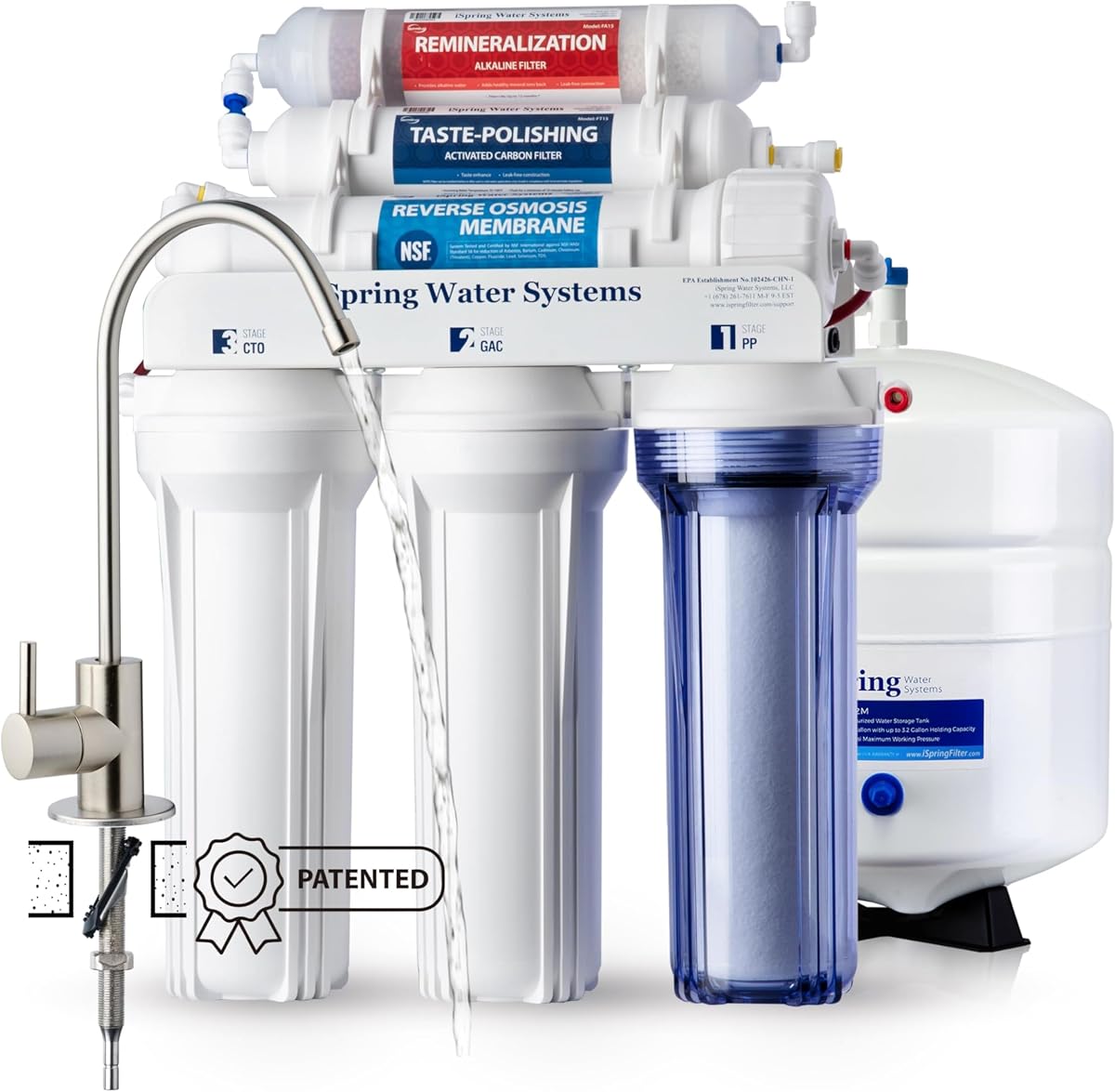
The iSpring RCC7AK-BN is a six-stage, 75 GPD under sink reverse osmosis system with a 4.6 rating. It stands out for combining full-system NSF 58 certification with an alkaline mineral stage, a transparent first housing, and a patented top-mounted faucet design that makes the countertop connection more approachable.
We may earn a commission when you buy through this link, at no additional cost to you.
Its filtration claims cover a broad range of contaminants. The listed specifications include reductions of 93% to 98% for TDS, 96% to 99% for PFAS, 95% to 99% for chlorine, and more than 99% for several heavy metals and other substances. The mineral stage is designed to return potassium, calcium, and other minerals after reverse osmosis, while the visible first-stage housing helps owners notice buildup sooner.
The trade-offs are modest for shoppers who want more than basic filtration. It has more processing stages than several less expensive five-stage systems, and the available replacement filters are listed at different intervals, meaning owners should plan maintenance rather than treating the unit as maintenance-free. The 75 GPD rate also sits below the highest-capacity systems in the group.
This is a strong recommendation for households that value documented certification, broad contaminant reduction, alkaline remineralization, and easier faucet installation without giving away a storage-tank design. It is our Editor's Choice because it offers the most balanced combination of meaningful features, transparent maintenance, and straightforward operation among the reviewed systems.
The transparent first-stage filter housing gives users a direct way to observe contaminant accumulation. This visibility can make routine checks easier and help indicate when the appropriate replacement stage should be serviced.
The six-stage path combines reverse osmosis with a natural mineral AK stage. That arrangement is aimed at reducing a wide selection of contaminants while producing water with a more balanced pH and added minerals.
We may earn a commission when you buy through this link, at no additional cost to you.
The APEC Water ROES-50 is a five-stage, 50 GPD reverse osmosis system with a 4.5 rating. It focuses on a familiar tank-based design, straightforward installation, and a complete package that includes a filter set, brushed nickel faucet, water tank, installation kit, and instructions.
We may earn a commission when you buy through this link, at no additional cost to you.
The product information says the stages are designed to reduce arsenic, chlorine, lead, fluoride, heavy metals, PFAs, microplastics, and more than 1,000 impurities, with overall impurity reduction stated as up to 99.99%. Quick-connect fittings and color-coded tubing make the plumbing layout easier to identify, while the manufacturer recommends replacing filters every 6 to 24 months depending on incoming water quality.
Its main limitation is flow capacity. At 50 GPD, it offers less rated production than the 75, 100, 220, 450, and 600 GPD alternatives in the guide. The included storage tank also requires more cabinet room than a tankless design. Buyers wanting the simplest configuration may still find those compromises acceptable for routine household drinking and cooking.
Choose the ROES-50 if you prefer a conventional five-stage system with all core components included and want a relatively uncomplicated setup. It is a practical fit for smaller households or users whose main goal is straightforward reverse osmosis filtration rather than maximum production speed.
The system arrives with a faucet, tank, filter set, installation accessories, and instructions. This reduces the need to identify compatible components separately, making it convenient for first-time under sink RO buyers.
Color-coded tubing and quick connections make it easier to distinguish the major water lines. Clear instructions support a DIY approach, although the included storage tank and faucet still require adequate planning.
We may earn a commission when you buy through this link, at no additional cost to you.
The Express Water ROALK10D is a 10-stage alkaline under sink RO system with a 4.5 rating and 100 GPD rated production. Its major appeal is the combination of multiple filtration stages, Active Mineral Technology, leak detection, and an expandable layout that can accept additional filtration attachments.
We may earn a commission when you buy through this link, at no additional cost to you.
The system is described as reducing up to 99.99% of lead, chlorine, fluoride, nitrates, calcium, arsenic, bacteria, and other contaminants. Its alkaline stage adds calcium, potassium, magnesium, and other minerals. A particularly useful safety feature is the emergency leak stop detector, which shuts off water flow when unwanted moisture is detected.
Customization introduces a trade-off. More stages and optional attachments can make the setup more involved than a basic five-stage system, and the storage tank still consumes cabinet space. Owners also need to follow the flushing and replacement guidance for the complete filter arrangement to maintain performance.
The ROALK10D is a compelling choice for users who want more than basic RO, especially anyone interested in alkaline remineralization or adding UV or deionization filtration later. It is also attractive to households seeking proactive leak protection. For uncomplicated filtration alone, a five-stage system may be more than needed.
The built-in emergency leak stop detector can shut off flow when it detects moisture. That added protection may be especially useful in cabinets containing flooring, cleaning products, or other items that should not be exposed to water.
Quick-connect fittings and a customizable configuration allow the system to work with optional UV or deionization attachments. This makes the ROALK10D more adaptable than a fixed-layout basic model.
We may earn a commission when you buy through this link, at no additional cost to you.
The PureDrop RTW5 is a five-stage reverse osmosis system with a 4.4 rating. It emphasizes quieter tank refills, a patented top-mounted oval-nut faucet design, modular filter changes, and compatibility with refrigerator and ice-maker water lines.
We may earn a commission when you buy through this link, at no additional cost to you.
The filtration claims include up to 99% reduction of PFAS, lead, arsenic, chlorine, heavy metals, and TDS, with SGS testing against NSF/ANSI 58 standards. Its acoustic dampening tank housing is intended to reduce the sound of refills, which can be useful in open kitchens or during quiet late-night use.
The product data does not provide a rated GPD figure, making direct capacity comparisons more difficult. It also retains a storage tank, even though the refill is quieter than a conventional setup. The three included extra pre-filters and modular replacement design may help control ongoing maintenance and extend membrane life.
PureDrop is best suited to households that value quieter operation, convenient refrigerator connection, and a faucet design that can be installed from above the countertop. It is particularly attractive for apartments, rentals, recreational vehicles, and tight cabinet spaces, as noted in the supplied information.
The system uses an acoustic dampening housing around the tank to reduce refill noise. That consideration is easy to overlook but meaningful in homes where the kitchen cabinet sits close to living or work areas.
Standard quarter-inch quick-connect fittings and refrigerator adapters expand the system's use. Compatible refrigerators and ice makers can draw from the purified supply, provided the household's plumbing layout supports the connection.
We may earn a commission when you buy through this link, at no additional cost to you.
The FS-TFC five-stage RO system has a 4.2 rating but delivers a notably high stated capacity of 100 GPD. It is compact, operates without electricity, and includes four replacement filters, giving it a value-oriented profile for households that want useful production without paying for the highest-capacity tankless models.
We may earn a commission when you buy through this link, at no additional cost to you.
The listed performance claims include 99.999% reduction against more than 1,000 contaminants, including chlorine, taste and odor compounds, VOCs, fluoride, arsenic, lead, nitrates, and heavy metals. At a tested standard water pressure of 60 psi, the system is described as producing 18 liters per hour, or a 200 ml cup in approximately five seconds.
The system uses a conventional one-to-one pure-to-drain ratio rather than the two-to-one ratio found on several premium alternatives. That means it can use more water during filtration, a meaningful operating consideration where water conservation matters. Its rating is also the lowest among the ten featured products, although ratings should be considered alongside certifications, capacity, included accessories, and design.
This is our Best Budget pick because it combines a 100 GPD rating, broad claimed contaminant reduction, four extra filters, and a tool-free installation proposition. It is a strong choice for a family seeking substantial daily output and included replacement supplies without requiring an electrical outlet or a tankless configuration.
A 100 GPD rating and stated 18-liter hourly flow make this system more compelling for simultaneous drinking, cooking, and washing needs than lower-output alternatives. Actual performance can depend on feed-water conditions and household pressure.
Four replacement filters are included, which can reduce the immediate need to purchase a full maintenance set. Their usefulness still depends on incoming water quality, usage, and adherence to the manufacturer's replacement schedule.
We may earn a commission when you buy through this link, at no additional cost to you.
The Waterdrop T3-C is an eight-stage, 450 GPD tankless RO system with a 4.5 rating. It combines high production with automatic flushing, smart filter alerts, LED faucet lighting, and an all-in-one cartridge designed to simplify replacement.
We may earn a commission when you buy through this link, at no additional cost to you.
The system uses a 0.0001-micron RO membrane and is described as reducing heavy metals, chlorine, PFOA, and PFOS. A 0.0001-micron membrane is a very fine filtration stage, while the product's third-party laboratory testing provides additional context for its performance claims.
Unlike purely passive RO units, the T3-C needs electricity and a faucet installation that requires drilling the countertop. It also uses continuous automatic flushing, which is a design choice that may suit some users but could conflict with those seeking a minimal water-using configuration. The tankless layout saves cabinet space by eliminating a separate storage tank.
Choose the T3-C when high flow, automatic operation, and quick cartridge replacement matter more than avoiding power. It is particularly suitable for larger households or offices that want purified water available throughout the day and value a compact footprint with no conventional tank.
The 450 GPD rating and tankless design are intended to keep purified water available without a bulky reservoir. This can be advantageous where cabinet space is limited or immediate flow is more important than a completely passive system.
Smart alerts indicate when filters need attention, while the all-in-one cartridge allows replacement in seconds. These features reduce the need to dismantle housings or handle several separate filter components during a service.
We may earn a commission when you buy through this link, at no additional cost to you.
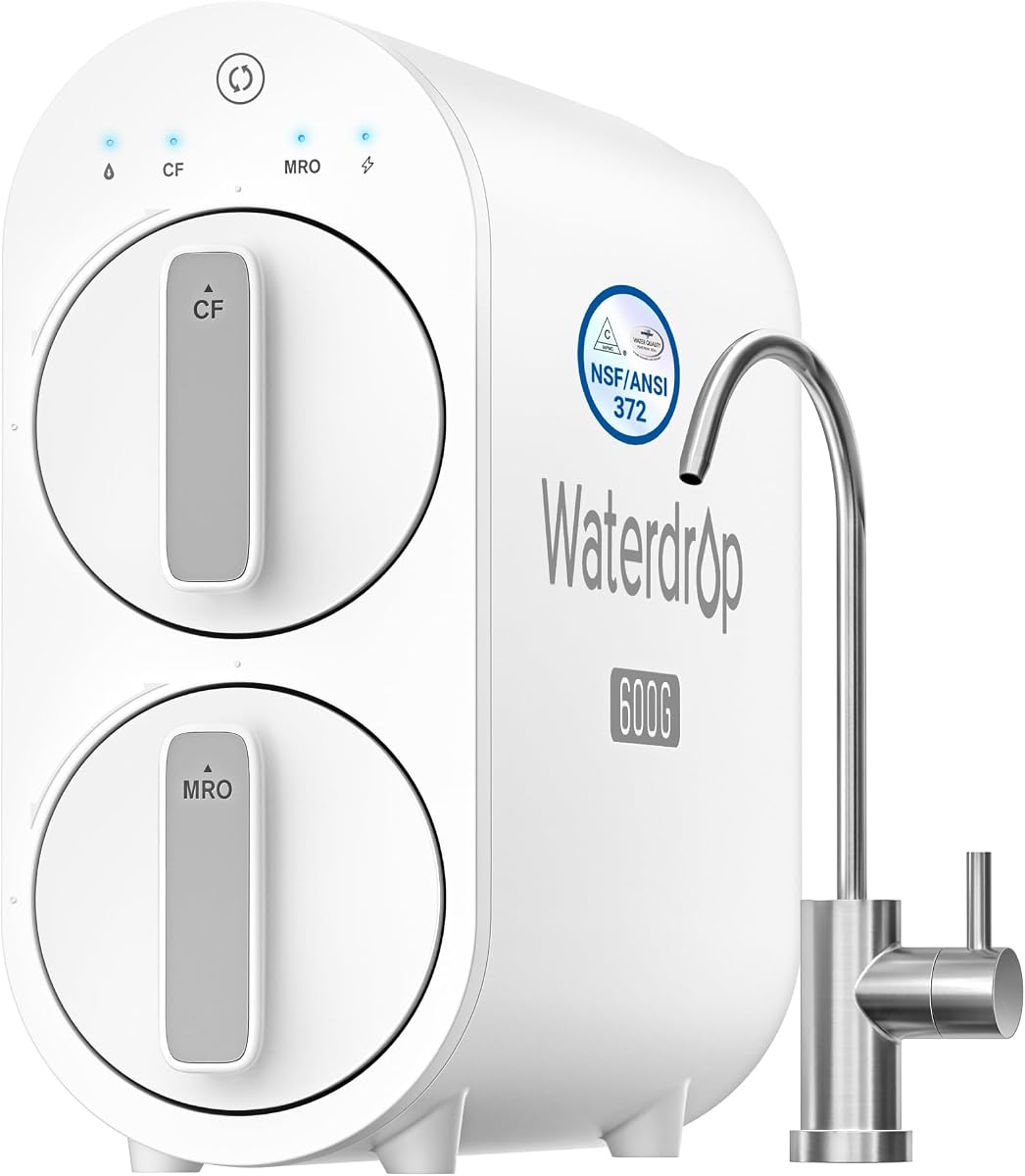
The Waterdrop G2P600 is a seven-stage, 600 GPD tankless under sink system with a 4.6 rating. It leads the comparison in stated production capacity and pairs that output with a two-to-one pure-to-drain ratio, a slim tankless profile, and unusually straightforward filter changes.
We may earn a commission when you buy through this link, at no additional cost to you.
The system is NSF/ANSI 372 certified for lead-free materials. According to the product information, it can fill a 200 ml cup in eight seconds and is positioned for households, families, and companies that require a fast and steady supply of filtered water. Two filters are included, with replacements found by searching for G2P600.
High capacity does not eliminate normal operating considerations. The supplied information mentions water pressure requirements, and a tankless system's real-world flow can depend on the household's incoming pressure and plumbing. The two-to-one ratio is more water-conscious than a one-to-one model, but the system still produces wastewater that can potentially be directed to suitable household uses.
The G2P600 earns our Best Premium designation because it combines the highest rated capacity in the guide with efficient drainage, quick tool-free maintenance, filter life indicators, and a space-conscious tankless design. It is a particularly compelling option for high-demand households and offices that can support a higher-capacity installation.
A 600 GPD rating is the highest among the featured systems. Pairing that production potential with a tankless layout makes it easier to serve frequent drinking, cooking, and produce-washing needs without allocating space to a reservoir.
The twist-and-pull design allows filters to be changed in seconds without moving the unit or using tools. Filter life indicators add another layer of convenience by alerting users when service is approaching.
We may earn a commission when you buy through this link, at no additional cost to you.
The VonWater V2-600N is a compact, 600 GPD tankless RO system with a 4.4 rating. It combines seven-stage PC and reverse osmosis filtration, a two-to-one pure-to-drain ratio, and a narrow body intended to preserve cabinet storage space.
We may earn a commission when you buy through this link, at no additional cost to you.
The filtration information claims up to 99% reduction of TDS, PFAS, fluoride, and heavy metals, with third-party testing and NSF/ANSI 372 certification for lead-free materials. At 0.42 GPM, the unit is described as filling an 8-ounce cup in seconds, making it suitable for kitchens and larger households.
Installation is more involved than a basic drill-free faucet arrangement. The product requires one countertop hole for the faucet, a second hole beneath the sink for the drain pipe, and an electrical outlet. It also requires compatible plumbing rather than every one-half- to three-eighth-inch compression setup, so measuring the cabinet is essential.
The V2-600N is a good fit for buyers who want the highest output tier and a narrow footprint but are willing to plan for electrical and drilling requirements. Its integrated waterway design and tool-free filter replacement add convenience, while the tankless format avoids the cabinet space occupied by a storage tank.
At 13.9 by 4.9 by 16.2 inches, the system is designed for narrow cabinet layouts. Eliminating a storage tank can free room for other plumbing accessories or household supplies while helping avoid stagnant tank water.
Two drilled holes and an electrical outlet are required, along with compatible supply piping. Checking cabinet dimensions and plumbing before purchase can prevent the system from being physically incompatible with the available space.
We may earn a commission when you buy through this link, at no additional cost to you.
The Geekpure five-stage RO system offers 75 GPD production, a 2.8-gallon storage tank, and an unusually generous supply of included filters. Its 4.4 rating reflects a conventional design that emphasizes component availability, clearly stated operating conditions, and guided DIY installation.
We may earn a commission when you buy through this link, at no additional cost to you.
The system is described as reducing arsenic, lead, fluoride, cadmium, and heavy metals through a membrane rated down to 0.0001 micron. The product data also specifies feed pressure, temperature, pH, chlorine tolerance, maximum TDS, and pipe sizes, helping buyers confirm whether their water and plumbing fit the system before ordering.
Owners must flush the filters for approximately 30 minutes and should not use the first two tanks of water produced. The supplied guide also recommends allowing one to two hours for installation and flushing. Those steps make the first setup more involved, but they are clearly stated. The 2.8-gallon tank adds cabinet weight and occupies space.
Geekpure is a practical choice for users who want a 75 GPD conventional system and appreciate having seven extra filters included. The broad list of replacement-filter ASINs may help with future service planning, though buyers should confirm compatibility and current availability before relying on any specific part.
Published pressure, temperature, pH, chlorine, TDS, and pipe-size requirements make this model easier to evaluate before purchase. Buyers can compare those figures with local water conditions and the available cabinet plumbing.
The package contains 12 filter pieces in total, including seven extra filters. This substantial starting supply can make the initial ownership experience more convenient and reduce immediate accessory shopping.
We may earn a commission when you buy through this link, at no additional cost to you.
The Waterdrop T3-T is a seven-stage, 220 GPD tankless reverse osmosis system with a 4.5 rating. It combines fast production, mineral remineralization, a two-to-one pure-to-drain ratio, compact dimensions, and smartphone-based filter reminders.
We may earn a commission when you buy through this link, at no additional cost to you.
Its filtration stage is SGS tested against NSF/ANSI 58 standards and addresses a long list of contaminants, including nitrate, nitrite, fluoride, arsenic, cadmium, chromium, lead, mercury, copper, barium, selenium, PFOA, PFOS, TDS, chloroform, and total coliforms. The system also uses NSF/ANSI 372 certified lead-free materials and adds potassium, calcium, sodium, and magnesium after purification.
The faucet requires a countertop hole, and buyers should confirm that the available plumbing can support the tankless configuration. Although the unit is compact at 12.6 by 6.1 by 14.69 inches and avoids a conventional tank, the 220 GPD output still exceeds the needs of some smaller households. Its all-in-one filters and NFC reminders simplify maintenance.
Choose the T3-T if you want a middle ground between basic 75 GPD systems and very high-output 450 or 600 GPD models. It is especially appealing for users who value remineralized water, compact tankless construction, and water-conserving operation without giving up a relatively fast rated flow.
The remineralization stage introduces potassium, calcium, sodium, and magnesium to the purified water. That feature is designed to improve taste and provide a more balanced drinking experience compared with unmineralized reverse osmosis output.
NFC technology allows users to tap a phone for replacement reminders. This reduces reliance on memory and can help keep the listed six-, twelve-, and twenty-four-month filter intervals organized.
We may earn a commission when you buy through this link, at no additional cost to you.
The right affordable under sink RO system depends on cabinet space, household water use, plumbing, maintenance preferences, and the balance of filtration features you value. Use the following factors to narrow the field before comparing final options.
Production capacity indicates the system's stated daily output, but it should not be treated as a guaranteed household flow rate. The reviewed products range from 50 GPD to 600 GPD, with some systems reporting a specific cup-filling time or hourly flow. Higher ratings can better accommodate simultaneous drinking, cooking, refrigerator, and ice-maker demand, while lower ratings may be sufficient for light use.
Choose a capacity that matches demand, not merely the largest headline figure.
A storage tank holds purified water for later use, reducing the need to wait for each new cup, but it takes up cabinet space and adds weight. Tankless systems produce water on demand and can save substantial space, though flow may depend more directly on incoming pressure and plumbing. Several of the highest-capacity products in this guide use tankless designs.
Prioritize a tank for simplicity or a tankless system for space and immediate flow.
Five-stage systems are common, while the list also includes six-, seven-, eight-, and ten-stage configurations. More stages do not automatically mean better results; certification and specific contaminant claims are more useful comparison points. Look for NSF/ANSI 58 performance standards, NSF/ANSI 372 lead-free material certification, or clearly identified third-party testing, depending on your priorities.
Prioritize documented performance over stage count alone.
Some systems install with a top-mounted faucet and require less under-counter work, while others need countertop drilling, a separate drain hole, an electrical outlet, or a particular pipe size. Measure the cabinet, locate a suitable outlet, and check available plumbing before purchasing. Quick-connect fittings and color-coded tubing can make a compatible installation easier.
Verify every connection requirement before ordering.
A low purchase cost can be offset by frequent filter changes, and some budget models offset that concern by including extra filters. Compare stated replacement intervals, included components, and the availability of compatible cartridges. Reminder systems, visible housings, and tool-free all-in-one cartridges can make routine maintenance more convenient.
Factor the full maintenance cycle into the total value.
Reverse osmosis produces a stream of rejected water, so the pure-to-drain ratio matters. The reviewed range includes a one-to-one model and several two-to-one tankless systems. A higher ratio generally indicates less rejected water for each cup produced, although actual use also depends on feed conditions, flushing behavior, and how the system is operated.
Look for a higher ratio when water conservation is important.
A dedicated faucet makes purified water convenient at the sink, but some installations require drilling and may not be reversible easily. Refrigerator adapters, ice-maker connections, and compatible pipe sizes can add value. Top-mount faucets may simplify installation, while integrated LED lighting and electronic controls can improve daily convenience.
Choose faucet options that fit both plumbing and household routines.
Leak detection, automatic flushing, filter reminders, tankless construction, warranty coverage, and technical support can reduce uncertainty. Compare the supplied support terms and warranty conditions carefully. A product with straightforward instructions and accessible replacement parts may be easier to maintain than one with elaborate features that are not needed.
Favor dependable service features over unnecessary complexity.
Begin by reviewing the manual, identifying every connection, checking the cabinet space, and confirming the required plumbing, drilling, and electrical provisions. Flush and sanitize the system according to its instructions before regular use. Many manufacturers also advise waiting for the first produced water to run through all stages, and some specify that the initial tankful should not be consumed.
Use the dedicated faucet for drinking, cooking, tea, coffee, and other tasks that benefit from reverse osmosis water. If connecting a refrigerator or ice maker, follow the supplied adapters and verify that the secondary line cannot create a pressure problem. Do not modify the drain arrangement beyond what the manufacturer permits, particularly with automatic flushing or tankless systems.
Create a maintenance schedule based on the stated filter intervals, cartridge indicators, smart reminders, and visible condition of the housings. Replace cartridges as directed, flush or sanitize according to the instructions, and clean the faucet and accessible components when needed. Recycle or dispose of used filters as recommended, and contact the manufacturer's support team when flow, pressure, leaks, or installation questions arise.
A five-stage system can provide effective reverse osmosis filtration for many households, and several five-stage products in this guide also include useful features such as a storage tank, top-mounted faucet, extra filters, or refrigerator adapters. The important comparison is the specific contaminant reduction, certification, capacity, maintenance, and installation design. More stages are not automatically better if the extra stages do not serve a useful purpose for your water and household needs.
Capacity should reflect how much purified water the household expects to use and whether a refrigerator or ice maker will draw from the system. Lower-output units are generally more practical for modest daily use, while higher-output systems offer more flexibility for cooking, entertaining, and frequent refills. Rated GPD is also affected by pressure and operating conditions, so it should be treated as a comparison reference rather than a guaranteed daily delivery amount.
Tankless systems generally free cabinet space and can provide immediate flow, while tank-based systems store finished water for later use. Tankless performance can depend more heavily on incoming pressure and plumbing, and some require electricity, automatic flushing, countertop drilling, or a second drain hole. A tank remains convenient for users who want a stored supply and a more traditional installation.
It depends on the model and the current sink arrangement. Some systems use a top-mounted faucet design intended to simplify installation, while the supplied information for other products explicitly states that countertop drilling is required. Always follow the installation guide, check whether the sink already has a suitable hole, and consider whether the faucet or sink will need to be altered.
A two-to-one ratio means the system produces roughly two units of purified water for every unit of rejected water used during the process. It is generally more water-efficient than the one-to-one ratio offered by one of the reviewed budget systems. The exact amount of water used can vary, so the ratio is best used as a relative efficiency indicator rather than a guarantee for every installation.
Replacement timing depends on the filter, incoming water quality, amount of use, and the manufacturer's instructions. The featured systems list cartridge lives ranging from approximately six months for some pre-filters to twenty-four months for certain reverse osmosis filters. Visible housings, filter indicators, and smart reminders can help track the schedule, but the supplied guidance should always take priority.
Many under sink RO systems can feed a compatible refrigerator or ice maker, but only when the included or specified fittings match the appliance's water line. The PureDrop RTW5 explicitly includes refrigerator adapters, and several other systems use common quarter-inch connections. Confirm both the RO outlet and appliance requirements before installation to avoid incompatible plumbing or unnecessary modifications.
The systems in this guide are designed for household drinking and cooking, with mineral stages in certain models intended to return selected minerals after purification. Individual needs can vary, and people with specific health or dietary concerns may wish to consult a qualified professional. For general household use, compare the system's documented filtration performance, local water conditions, and ongoing maintenance requirements.
The iSpring RCC7AK-BN is the most balanced overall choice, combining six-stage filtration, mineral remineralization, NSF 58 certification, and a transparent first housing. The FS-TFC system stands out as the budget pick because of its 100 GPD capacity and four included replacement filters, while the Waterdrop G2P600 is the premium option for buyers seeking 600 GPD output, tankless construction, and quick filter changes.
Before choosing, prioritize the details that affect daily use: cabinet dimensions, required drilling, electrical needs, storage-tank preference, production rate, drain ratio, and filter availability. A lower-cost system can still be a good value if it fits your plumbing and maintenance habits, while a high-output model offers little advantage if household demand is modest.
Finally, confirm the current product listing, included components, certification details, replacement schedule, and installation requirements at the time of purchase. Product prices, configurations, and seller information can change, and current details are essential when selecting a cheap under sink RO system that will meet your household's needs.