
Cell Phone Booster for Home & Multi-Room, Up to 7000Sq. Ft
4.8Editor score
Up to 7000-square-foot coverage
Two indoor antennas included
Automatic gain control
Discover the best cell phone signal boosters for mountain areas, with expert comparisons of coverage, carrier support, 5G compatibility, and installation needs.
Mountain cabins, remote work sites, and winding forest roads can leave cellular service frustratingly inconsistent. A suitable signal booster can improve calls, texts, navigation, and data where a usable outdoor signal already exists, but antenna type, gain, carrier bands, and installation conditions matter more than a broad coverage claim.
We compared all ten boosters using the supplied specifications, including stated indoor coverage, supported frequencies, maximum gain, carrier compatibility, 5G support, antenna configuration, and installation guidance. The list covers both fixed home systems and rugged vehicle-oriented models, with attention to realistic use in terrain where towers are distant or obstructed.
Each review identifies the product's strongest use case, practical limitations, and suitability for mountain living or travel. Ratings and specifications reflect the provided product data, while prices can change at any time, so check the current listing before choosing a model based on cost.
4.8Editor score

4.9Editor score

4.2Editor score
The table below compares all ten systems by their intended environment, stated coverage or gain, band support, and major installation feature. Because mountain signal conditions vary sharply by location, the most important distinction is whether you need a fixed cabin system or a vehicle-oriented setup.




The HiBoost Home Office Booster has a 4.3 rating and combines an outdoor directional antenna, an LCD signal display, app-based installation guidance, and support for major U.S. carriers. Its stated indoor reach is up to 2,000 square feet, making it a practical fixed installation for a mountain cabin, home office, or small work area rather than a whole homestead.
We may earn a commission when you buy through this link, at no additional cost to you.
A major strength is its combination of broad band support and installation aids. The system supports bands 12, 13, 17, 5, 2, 25, and 4, while Automatic Gain Control adjusts amplification as the incoming signal changes. The color LCD displays real-time signal strength, and the HiBoost Signal Supervisor app can help locate a better position for the exterior antenna.
The directional antenna can capture a signal from a more distant base station than an omnidirectional alternative, which may help in a valley or behind terrain. However, the product still requires at least one bar at the outdoor antenna location. Its smaller coverage claim also means that very large homes, metal buildings, and cabins with several thick interior walls may perform better with a higher-output system.
This booster is best for a user who values clear installation feedback, carrier flexibility, and useful features over maximum floor coverage. It is a strong recommendation for a smaller mountain residence or office where the outdoor antenna can be mounted in a clear location and the available signal is weak but present.
The LCD and app are especially helpful where signal changes with weather, terrain, and antenna position. They provide practical feedback instead of leaving the installer to judge performance solely by the phone display.
Support for major carriers and several low- and mid-frequency bands broadens the chance of useful reception. Users should still verify their phone's bands and the carrier's service in the area.
We may earn a commission when you buy through this link, at no additional cost to you.
This multi-room booster has a 4.8 rating and is one of the most capable home systems in the roundup on paper. It supports 3G, 4G LTE, and 5G service, works with U.S. and Canadian carriers, and is described as covering as much as 7,000 square feet with 70 dB of gain. Two indoor antennas make it a logical choice for larger mountain homes.
We may earn a commission when you buy through this link, at no additional cost to you.
The inclusion of both Automatic Gain Control and self-oscillation elimination is useful in rural and mountainous settings. Automatic Gain Control responds to changing incoming signal, while self-oscillation elimination is intended to reduce interference within the system. The two indoor antennas can distribute improved service through a larger interior rather than concentrating it in a single room.
The main limitation is that maximum coverage is not guaranteed. As with the other home boosters, performance depends on outdoor signal, antenna placement, building construction, and cable layout. The product does not offer the explicit app-based installation system advertised by the HiBoost Hero, and the supplied details do not mention a color LCD or remote monitoring.
Buyers seeking broad multi-room coverage and a high maximum gain will find this model compelling. It is particularly appropriate for a multi-level cabin, farmhouse, or rural residence where several rooms need service, provided an outdoor antenna can be positioned to receive a usable signal.
Two indoor antennas offer more placement flexibility than a single whip or panel. They can help reduce dead zones in long cabins, upstairs bedrooms, and home offices.
Automatic Gain Control can help maintain stable operation as received signal varies. Antenna placement remains critical, however, because the system cannot create a usable signal from nothing.
We may earn a commission when you buy through this link, at no additional cost to you.
The 5000-Square-Foot Home Booster carries a 4.9 rating and offers a balanced combination of gain, stated coverage, and installation guidance. It supports 5G and 4G LTE voice, text, and data across major North American carriers, with maximum gain of 65 dB and maximum output of 17 dBm.
We may earn a commission when you buy through this link, at no additional cost to you.
Its coverage guidance is unusually transparent. The listed estimates range from about 800 square feet with one or two exterior bars to approximately 3,000 square feet with three or four bars and as much as 5,000 square feet with five bars. This framework helps mountain buyers set realistic expectations and emphasizes that outdoor reception is the starting point.
Installation requires an outdoor log-periodic antenna and approximately 32 feet of separation between the outdoor and indoor antennas. That separation can improve the system by reducing interference, but it may be challenging on a small cabin property. The guidance also says to keep power off while installing or adjusting antennas, which is sensible for avoiding startup problems.
This is the strongest all-around recommendation for a fixed mountain home because it balances meaningful gain, substantial potential indoor coverage, broad carrier compatibility, and realistic installation information. It is suitable for users who want dependable service across a medium-to-large residence and can provide an appropriate outdoor mounting point.
The bar-based coverage estimates are valuable for comparing claims. They make clear that stronger outdoor reception produces a larger usable indoor area and help buyers avoid assuming every installation reaches the maximum.
The stated process centers on placing the outdoor antenna, maintaining roughly 32 feet of separation, and positioning the indoor component. That simplicity suits first-time installers who want clear physical guidance.
We may earn a commission when you buy through this link, at no additional cost to you.
The HiBoost Off-Road Vehicle Booster is built for travelers rather than stationary homes. Its 4.2 rating reflects a different buying decision: instead of maximizing floor coverage, it prioritizes cellular reliability on remote trails, in mountains, and across deserts where the vehicle continually changes position.
We may earn a commission when you buy through this link, at no additional cost to you.
Its rotating mount allows the external antenna to fold for garages, parking structures, and low-clearance areas, reducing the risk of damage that fixed roof-mounted equipment can face. A rugged metal booster and protective silicone cover add resilience against bumps, scratches, and outdoor conditions. The system supports 4G LTE and 5G and is compatible with major carriers including AT&T, Verizon, and T-Mobile.
The supplied specifications do not state maximum gain or a fixed indoor area, so the product should be evaluated on its intended mobile use rather than compared directly with the square-foot claims of home systems. A vehicle installation also requires careful attention to cable routing, grounding where applicable, and local regulations governing booster operation.
This is the pick for overlanders, off-road travelers, and mountain drivers who need connectivity while moving through coverage gaps. It is less obviously suited to someone wanting to improve service throughout a fixed cabin unless the vehicle can be parked close to the occupied area.
The folding antenna mount and protective cover address common trail and low-clearance concerns. These physical protections are particularly relevant where the route includes rough roads, dense branches, and frequent stops.
The companion app provides signal detection, installation guidance, and setup assistance. For a complex vehicle installation, that support can make positioning the external antenna more accessible.
We may earn a commission when you buy through this link, at no additional cost to you.
The weBoost Drive Reach Overland is a dedicated vehicle booster with a 4.2 rating. It combines a booster, tough outdoor antenna, and versatile mounting bracket, giving mobile users an integrated package for off-road travel and areas where cellular towers are sparse.
We may earn a commission when you buy through this link, at no additional cost to you.
Maximum gain is listed at 50 dB, and the unit supports 5G and 4G LTE. It is compatible with Verizon, AT&T, T-Mobile, and U.S. Cellular, covering the major national carriers named in the supplied information. The product is FCC approved, with FCC ID PWO460061 listed in the product data.
Compared with a home booster, the key difference is deployment. The package is intended for a vehicle and includes a mounting bracket rather than an indoor coverage strategy. It does not promise a fixed square-foot area, and actual results depend on the nearest tower, antenna orientation, vehicle layout, and local installation rules.
This system is best for off-road enthusiasts and mountain travelers who want a recognizable all-carrier mobile solution with a two-year warranty. U.S.-based support through an app, chat, phone, or email adds convenience for users who want assistance before tackling an unfamiliar vehicle installation.
The included booster, outdoor antenna, and bracket are designed as an overlanding package. That integrated approach may be more convenient than assembling separate vehicle components.
Compatibility with four major carriers reduces the chance that a traveler will need to choose equipment based solely on their provider. Users should still confirm local coverage and supported service.
We may earn a commission when you buy through this link, at no additional cost to you.
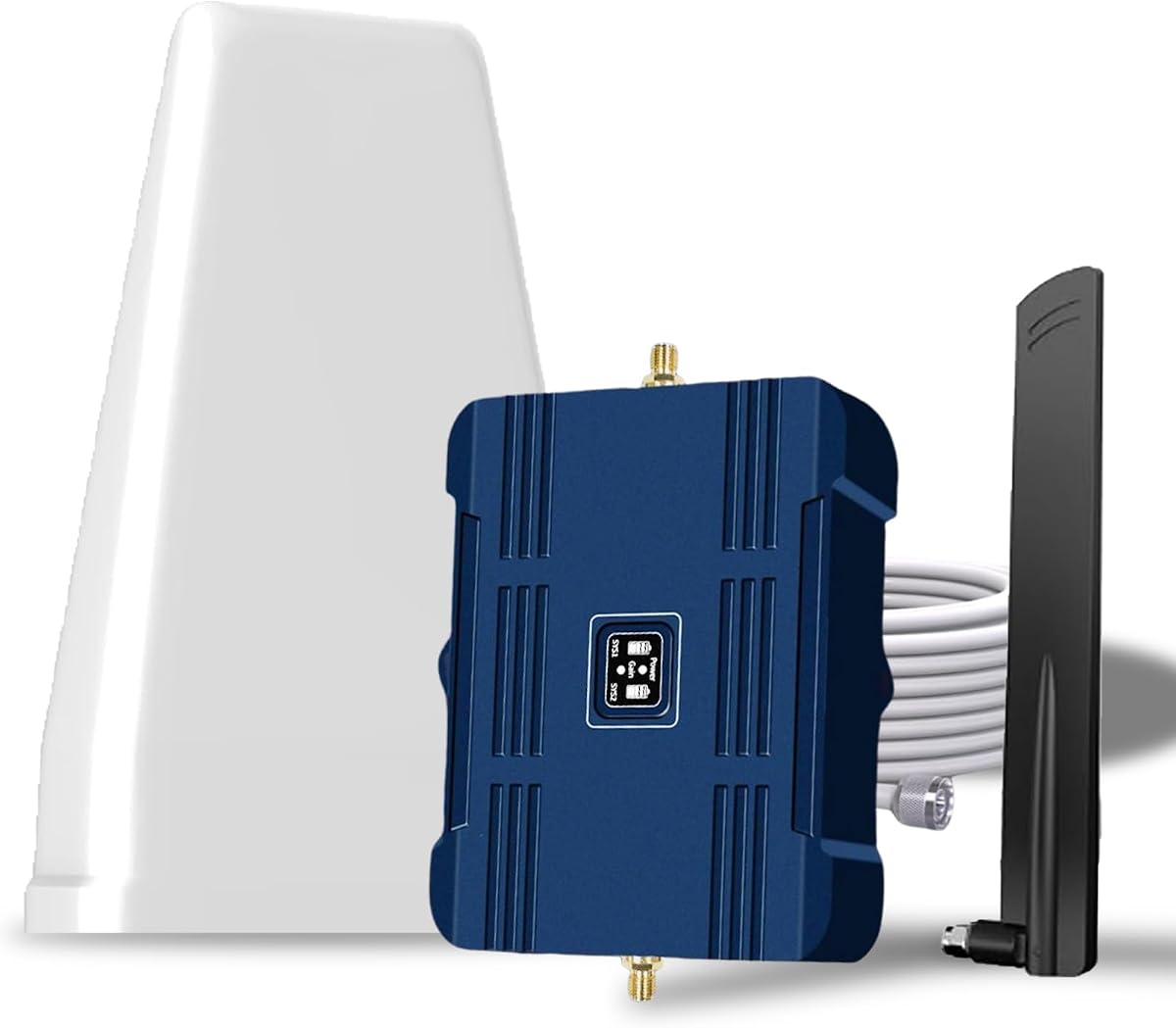
This blue 7,000-square-foot home booster has a 4.2 rating and is aimed at rural homes needing service across three to five rooms. Its 70 dB maximum gain, 17 dBm maximum output, and two indoor panel antennas distinguish it from systems intended only for a single desk or room.
We may earn a commission when you buy through this link, at no additional cost to you.
The panel antennas are useful in a long or multi-level mountain house because they can direct service into different areas. The product supports 5G and 4G LTE voice, text, and data across major North American carriers, and the supplied information notes compatibility with Verizon's 5G Nationwide data signals.
As with the similarly rated 7,000-square-foot system, actual coverage is tied to outdoor reception. The estimates are approximately 800 square feet at one or two bars, 3,000 square feet at three or four bars, and 7,000 square feet at five bars. Installation calls for an outdoor log-periodic antenna and about 32 feet between the external and indoor antennas.
Choose this model when a cabin or rural home has several rooms to serve and two indoor panel antennas provide the desired distribution. Its trade-offs are the need for careful antenna separation and the fact that a large maximum coverage figure only applies when the outside signal is already strong.
The two panel antennas can be positioned to serve separate living areas more deliberately than a single compact indoor antenna. Their directional nature rewards thoughtful placement.
A stated 70 dB maximum gain makes the system suitable for challenging rural layouts. The practical result still depends on exterior signal, construction materials, and cable placement.
We may earn a commission when you buy through this link, at no additional cost to you.
The light-blue Multi-Room Band-Selective Booster has a 4.8 rating and is designed to improve cellular service in homes, offices, garages, farms, remote areas, warehouses, and metal buildings. Its stated indoor range is approximately 3,000 to 7,000 square feet depending on outdoor signal.
We may earn a commission when you buy through this link, at no additional cost to you.
The system supports bands 5, 12, 13, and 17, along with 5G and 4G LTE data. These lower-frequency bands can be important in mountainous terrain because they are often used for broader geographic coverage. Automatic Gain Control adjusts the system according to the detected incoming signal, and multiple devices can be supported at once.
The narrower band list is the main consideration. Buyers whose phones or local carrier network rely on other supported bands should check compatibility before purchase. The product also advises checking the outdoor signal first and aims for at least one or two bars, which reinforces the need to assess the mountain site before installing.
This booster is a good fit for a multi-room rural home where a compatible carrier uses the listed bands and broad coverage matters more than the widest possible frequency list. The stated absence of subscriptions, registration, and hidden fees also makes ownership relatively straightforward.
Bands 5, 12, 13, and 17 are commonly associated with wider cellular reach. That focus can be valuable in mountain valleys where a distant tower's lower-frequency signal is the most accessible option.
Automatic Gain Control reduces the need for repeated manual adjustment. The stated absence of registration, subscriptions, or hidden fees keeps the ownership model uncomplicated.
We may earn a commission when you buy through this link, at no additional cost to you.
The Hiboost Hero has a 4.4 rating and is a feature-focused home system with up to 65 dB of gain and stated coverage of 3,000 square feet. It supports 5G, 4G LTE, 5G, and 4G LTE voice, text, and data, making it appropriate for a cabin, home office, garage, farm building, or other weak-signal location.
We may earn a commission when you buy through this link, at no additional cost to you.
Its standout feature is the installation ecosystem. The Hiboost app remotely monitors the system and helps position a high-gain directional outdoor antenna. One-on-one live technical support provides step-by-step visual and phone guidance, while the supplied information says most users can complete the guided process within about two hours.
Two indoor antenna choices offer different mounting approaches. The panel antenna can cover a larger area, while the compact whip antenna suits mobile or temporary applications. The trade-off is the 3,000-square-foot ceiling, which is lower than that of the 7,000-square-foot alternatives, and the need to mount an outdoor antenna and route cable.
This is a particularly attractive choice for a mountain property where the outdoor antenna's direction is uncertain. The support and monitoring tools help optimize a system that is very sensitive to placement, making them valuable for buyers who want guided rather than purely manual setup.
Mountain installations often involve moving an antenna by small amounts to find a useful signal. The app and live support make that iterative process easier to manage.
The included panel and whip options accommodate both fixed-room and portable needs. This flexibility also lets an installer position the internal component away from metal or electronic interference.
We may earn a commission when you buy through this link, at no additional cost to you.
This multi-room booster has a perfect 5.0 rating in the supplied data and shares a high-output design with other 7,000-square-foot systems. It supports 5G, 4G LTE, and 3G data across major North American carriers, with maximum gain of 70 dB and maximum output of 17 dBm.
We may earn a commission when you buy through this link, at no additional cost to you.
The target use is a three-to-five-room home or office in a rural or remote area. Its estimated indoor coverage scales with exterior reception: roughly 800 square feet with one or two bars, 3,000 square feet with three or four bars, and 7,000 square feet with five bars. That transparent progression makes it easier to identify whether the specifications fit a particular site.
The installation instructions call for an outdoor log-periodic antenna, approximately 32 feet of separation between the external and indoor antennas, and power to remain off during antenna adjustments. These requirements may demand more space than a compact urban apartment allows, but they are manageable at many mountain properties.
The combination of a 5.0 rating, high stated gain, and broad carrier support makes this a leading fixed-home option. It is best recommended for buyers with a larger residence and strong enough outdoor reception to benefit from the system's maximum capability.
Its 5.0 rating is the highest listed among the ten products. That is a positive indicator, though the installation prerequisites and outdoor signal requirements remain decisive.
The 70 dB gain and 7,000-square-foot maximum fit a substantial home with several affected rooms. Achieving the upper figure requires approximately five exterior bars.
We may earn a commission when you buy through this link, at no additional cost to you.
The Smart LCD Home Booster has a 3.8 rating and distinguishes itself through a large color display that shows operating status and the gain across five frequency bands in real time. It is compatible with major U.S. carriers and supports multiple users and devices at the same time.
We may earn a commission when you buy through this link, at no additional cost to you.
Its coverage information is unusually specific. The stated ranges are approximately 400 to 1,300 square feet with one or two outdoor bars, 1,300 to 2,500 square feet with three or four bars, and 2,500 to 5,000 square feet with a full signal. The installation point must provide at least -110 dBm, which helps buyers determine whether the system is suitable before installing.
The five listed bands are 12/17, 13, 5, 4/66, and 2/25, supporting 5G, 4G LTE, and 3G service. However, the lower 3.8 rating is the most visible drawback in the group, and buyers should consider additional customer feedback. Roof installation of the outdoor antenna may also require one or two people.
This system suits a buyer who values transparent setup data more than app-based guidance. The LCD makes it possible to compare antenna positions, while the included indoor whip antenna keeps the internal setup simple. It is best for homes with moderate exterior signal and a practical way to mount the external antenna safely.
The color display shows gain information for all five frequency bands. That level of detail is useful for technicians and for owners who want immediate feedback during antenna placement.
The stated square-foot ranges make the outdoor signal the central planning variable. This is honest and useful for remote sites where an installer may be working from several possible mounting points.
We may earn a commission when you buy through this link, at no additional cost to you.
The right mountain-area booster depends on where the equipment will be used, what signal reaches the property, and which cellular bands operate nearby. Compare vehicle and home systems separately, then match antenna design and gain to the installation environment.
A booster receives an existing signal through an external antenna and redistributes it indoors. Products in this roundup generally require at least one or two bars, one system recommends at least -110 dBm, and one specifies -100 to -120 dBm. Check signal at the intended outdoor position before purchasing, because a high-gain amplifier cannot compensate for no usable signal.
Prioritize a product that states its expected coverage at different bar levels. This makes the maximum square-foot claim easier to apply to a real mountain property.
Fixed home systems emphasize indoor area, multiple indoor antennas, and coverage across rooms. Vehicle systems emphasize rugged components, folding mounts, and connectivity while moving. A mountain resident should normally prioritize a home installation, while an overlander or remote worker traveling between locations should favor a vehicle-ready package.
Do not treat a vehicle booster's in-cabin benefit as equivalent to a home system serving an entire house. Installation goals and antenna placement requirements differ.
All U.S. carriers is useful only if the booster also supports the bands used by the local network and the user's phone. The listed systems support combinations of bands 2, 4, 5, 12, 13, 17, 25, and 66, with some models limited to only bands 5, 12, 13, and 17. Check the carrier's coverage map and confirm the relevant band before installation.
Lower-frequency bands can be particularly useful for broad rural coverage. Frequency support should therefore be matched to local network conditions, not judged only by the number of bands on the box.
Several products support 5G, but the supplied information repeatedly notes that much deployed 5G operates through Dynamic Spectrum Sharing on existing 4G bands. Compatibility therefore depends on local carrier deployment, the supported frequencies, and the user's device. A product labeled 5G-compatible does not guarantee standalone 5G everywhere.
For mountain areas, confirm that the relevant service exists on the bands the booster supports. A well-placed 4G LTE system may remain more useful than a system whose advertised 5G capability is not active locally.
Maximum gain indicates amplification potential, while stated indoor coverage provides a more useful planning figure. Systems here range from 65 to 70 dB and claim maximum areas from 2,000 to 7,000 square feet. Those figures are not guarantees because exterior signal, building materials, cable length, antenna direction, and internal layout all affect results.
Use gain to compare capability, but use the bar-based coverage ranges to estimate fit. For very large homes, 5,000 to 7,000 square feet and multiple indoor antennas are more realistic starting points than a compact system.
Outdoor antennas should capture the best available signal, while indoor antennas distribute it where it is needed. Directional and log-periodic antennas can favor a known tower direction, whereas panel antennas can target interior rooms. Multiple indoor antennas may improve consistency across a long cabin but require more planning and cabling.
Mountain terrain makes outdoor direction especially important. A higher or clearer mounting point can outperform a more powerful amplifier mounted in a poor location.
Look for a system that provides clear separation requirements, signal readings, and troubleshooting guidance. LCD displays are useful for comparing positions, while apps and live support can help optimize a directional antenna. The supplied guides commonly recommend around 32 feet between outdoor and indoor antennas and powering off during adjustments.
Mountain buyers should account for cable routing, roof safety, weather protection, and access before purchasing. A technically strong product cannot compensate for an unsafe or poorly positioned installation.
Choose equipment described as FCC approved or FCC and IC certified, and follow the manufacturer's operating instructions. Several products also offer a two- or three-year warranty, while one listing mentions a 30-day money-back period. These support terms can add confidence, but they do not replace responsible installation or realistic expectations.
Confirm whether registration or carrier notification is required for the exact model and location. The supplied data varies, so following the current product instructions and applicable regulations is essential.
Begin by testing the cellular signal at the intended outdoor antenna location before installation. Record the carrier, bar level, and relevant phone band, then compare those readings with the manufacturer's coverage requirements. If no usable signal is available, reposition the test location or consider a different solution because no booster can amplify a completely absent cellular signal.
Install the external antenna where it has a clear view toward the relevant tower and remains protected from avoidable impacts. Keep the booster powered off while connecting or adjusting antennas, follow the stated separation requirements, and route cable in a way that prevents strain, pinching, moisture exposure, and accidental disconnection. Position indoor antennas in occupied rooms and away from large metal objects when possible.
After power-up, compare signal readings before and after the system is active. Use the LCD, app, or phone status display to test several locations, then make small antenna adjustments rather than moving equipment repeatedly. Clean exposed components as recommended, inspect connections and mounting hardware, and recheck performance during different weather conditions or when the carrier network changes.
No. A booster receives an existing cellular signal, amplifies it, and redistributes it through indoor antennas. Every product in this roundup needs some usable signal at the outdoor antenna location. If your site has no detectable service, changing the antenna's position or consulting a carrier about coverage may be necessary.
The listed systems generally recommend at least one or two bars, equivalent to a weak but usable signal. The Smart LCD Home Booster specifies at least -110 dBm, while the Hiboost Hero gives an approximate -100 to -120 dBm range. Measure at the actual outdoor mounting point because readings taken inside can be misleading.
No. The booster must support the frequencies used by the local carrier, and 5G must actually be deployed on those bands. Much current 5G uses Dynamic Spectrum Sharing within existing 4G bands. Confirm local service and compatible phone bands before relying on a product's 5G label.
Choose a home booster for a cabin, farmhouse, or stationary remote office, especially when several rooms need improved service. Choose a vehicle-oriented system for travel on mountain roads, off-road routes, or work conducted from a truck or overland vehicle. Their antennas, mounting systems, and coverage goals are different.
Several products in this roundup specify about 32 feet between the outdoor log-periodic antenna and the indoor antenna. That separation can reduce interference and improve system behavior. Follow the exact instructions supplied with the selected model, and prioritize the manufacturer's requirement if it differs from general guidance.
Metal walls and roofs can severely reduce indoor signal, so an outdoor antenna and carefully placed indoor unit are important. Some products specifically list garages, warehouses, and metal buildings among suitable environments. The stated indoor coverage may be lower than the maximum because the building itself interferes with radio signals.
No single unit is automatically compatible with every phone, carrier, and band combination. The products here support major U.S. carriers and several common bands, but buyers should verify the phone's supported frequencies and the carrier's local network. Some models support fewer bands than others, making compatibility particularly important.
It depends on the property, roof access, antenna mounting, cable length, and local rules. Some listings include app guidance or live support, and simpler systems may be installable with the provided manual. Professional help is prudent when working at height, running long outdoor cables, grounding the system, or selecting a difficult antenna position.
The 5000-Square-Foot Home Booster is the strongest all-around fixed-home recommendation because it combines a 4.9 rating, 65 dB gain, clear signal-based coverage expectations, and broad carrier support. For buyers prioritizing larger interiors and two indoor antennas, either 7,000-square-foot multi-room system offers more stated capacity, while the HiBoost Home Office model stands out for its LCD and app-guided setup.
For travel rather than a permanent residence, the HiBoost Off-Road Vehicle Booster and weBoost Drive Reach Overland are better matched to mountain roads and off-road conditions. Prioritize the outdoor signal first, then match the supported bands, coverage expectation, antenna system, and installation environment. No booster can compensate for a location with no usable signal at the antenna.
Finally, check the current listing, customer feedback, warranty terms, and installation requirements before ordering, because prices and product details can change. A realistic signal survey and careful placement will usually matter more than the largest headline coverage number.