
TopTes TS-501B
4.5Editor score
Backlit 2.25-inch display
30–130 dB range
Carry case included
Our Decibel Meter guide compares 10 leading models for accuracy, displays, weighting modes, data logging, portability, and practical noise checks at home and
A decibel meter turns an invisible environmental factor into a readable sound-pressure level, helping you identify whether a refrigerator, appliance, speaker, construction site, or neighboring activity is unusually loud. The most useful models combine a legible display with suitable accuracy, A/C weighting, fast and slow response settings, and controls that remain easy to operate in everyday environments.
We compared ten meters using the specifications and feature details supplied for each model, paying close attention to measurement range, stated accuracy, frequency coverage, weighting modes, response speed, recording functions, display quality, power source, portability, and included accessories. The list covers handheld options for homes, offices, workshops, classrooms, vehicles, and music-related tasks, as well as a data-logging model for computer analysis.
Each review explains the product's strongest capabilities, practical limitations, and most suitable user. A meter's rating and feature set are useful indicators, but actual results can vary with placement, wind, reflections, and the source being measured. Prices and promotions change frequently, so confirm the current listing and included accessories before purchasing.
4.5Editor score

4.7Editor score

4.2Editor score
The table below compares the ten shortlisted decibel meters by measurement capability, display, special functions, and intended use, making it easier to identify the right model for quick household checks or more demanding monitoring.


The orange TopTes TS-501B is a well-rounded handheld meter with a 4.5 rating, a stated 30–130 dB range, and ±1.5 dB accuracy. Its most immediately useful feature is the 2.25-inch backlit LCD, which provides a larger, more legible readout than the compact four-digit screens found on many similarly capable instruments. It is designed for general noise checks in homes, offices, workshops, schools, vehicles, and factories.
We may earn a commission when you buy through this link, at no additional cost to you.
A/C weighting gives users a choice between a mode intended to approximate lower-level environmental perception and one suited to stronger mechanical sound. MAX/MIN functions record high and low values over a selected interval, while data hold freezes the current reading for easier inspection. A non-slip housing, automatic power-off function, low-battery warning, and included three AAA batteries make it straightforward to begin using.
The main limitation is that it remains a point-in-time instrument rather than a full analysis platform. It has no onboard data logger, computer connection, graph export, or adjustable alarm system. Users who need a documented timeline will have to note readings manually. The 30–8000 Hz frequency span is also more limited than the broad analysis functions offered by specialized acoustic instruments.
This is a strong choice for renters, homeowners, music listeners, and workers who want a readable, dependable meter without advanced setup. It offers enough precision and recording control for comparing appliances, tracing intermittent noise, and checking speaker output, while the carry case adds portability. For most non-laboratory users, it is the most balanced option in the roundup.
The 2.25-inch screen makes the meter approachable even for first-time users. A long press controls the backlight, making the reading visible in dim rooms without requiring users to cup their hands around the display.
MAX/MIN tracking helps capture short peaks that may disappear too quickly to read, while the data-hold function preserves a selected value. These controls are particularly helpful when investigating changing household or workplace noise.
We may earn a commission when you buy through this link, at no additional cost to you.
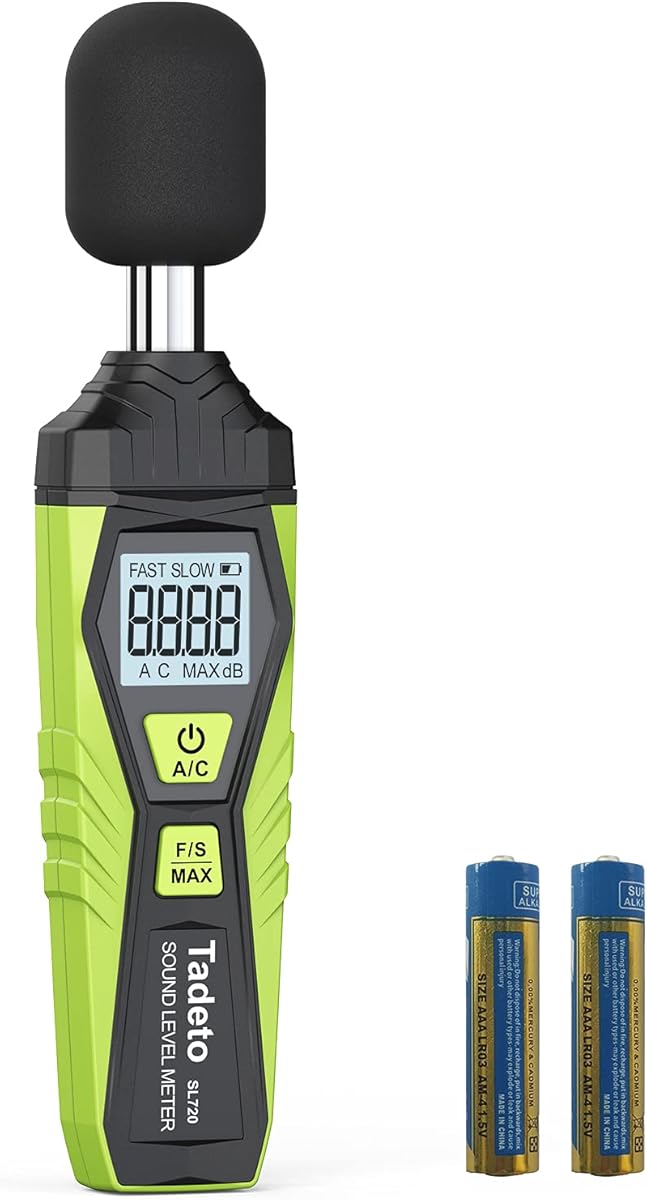
The Tadeto Portable SPL Meter combines a 4.5 rating with a straightforward feature set for checking ambient and mechanical noise. It covers 30–130 dB, displays readings to 0.1 dB, and offers A/C weighting so it can be used for general environmental checks as well as stronger motor and machinery sounds.
We may earn a commission when you buy through this link, at no additional cost to you.
Its fast response uses a 0.125-second time constant, while slow mode uses a one-second constant. That distinction lets users switch between quickly changing conditions and relatively stable noise. The backlit four-digit LCD, low-voltage warning, MAX and data-hold functions, and lightweight housing support repeated field use without complicated setup.
The stated ±2.0 dB accuracy is less tight than the ±1.5 dB figure listed for many competitors, so it is better suited to general comparison than fine acoustic analysis. The supplied information also does not describe a frequency-response range, an SONE mode, an adjustable alarm, or computer connectivity. Those omissions may matter to specialists but are rarely important for basic home and workplace checks.
Choose this meter when portability, quick setup, and a clear readout matter more than advanced documentation. It is a practical option for checking a baby room, appliance, car, office, classroom, construction environment, or audio system. Users comparing small differences between similar sources should consider a model with a tighter stated accuracy tolerance.
Fast mode reacts in 0.125 seconds, making it useful for traffic or other noise that changes quickly. Slow mode averages over a longer period and is better suited to consistent environmental or industrial sound.
The lightweight body is easy to carry from room to room or between a home and workplace. A backlit display preserves visibility in darker locations, while the low-battery icon provides a simple prompt for maintenance.
We may earn a commission when you buy through this link, at no additional cost to you.
The DURFICST Sound Level Meter is our Editor's Choice because it brings together a 4.6 rating, a stated ±1.5 dB accuracy, and a particularly approachable color display. Its 30–130 dB range and 0.1 dB resolution suit both household and workplace monitoring, while the 31.5 Hz–8 kHz frequency response provides a useful foundation for general sound checks.
We may earn a commission when you buy through this link, at no additional cost to you.
A/C weighting covers environmental and mechanical noise, and the additional SONE unit offers a way to express perceived loudness in addition to sound-pressure level. FAST and SLOW response settings accommodate changing and steady sources. Maximum/minimum recording, data hold, a windbreak ball, a soft rubber wrap, a cloth carrying case, and a handheld form factor make this a well-rounded field instrument.
The color display is attractive and easy to scan, though it is not a substitute for advanced analysis software. There is no documented computer connection, export capability, or long-term data logging. SONE readings may also seem excessive if the main goal is a familiar dB number, and outdoor use still requires attention to wind and placement consistency.
This model is a strong fit for people who want a more polished everyday instrument without moving into logger territory. It is especially useful for comparing music, appliances, room ambience, toys, office equipment, and industrial sources. For users who need detailed timelines rather than handheld readings, the DANOPLUS model is the better direction.
The dB mode is familiar and appropriate for general noise intensity, while SONE can help users judge perceived loudness in music and acoustic settings. Having both available broadens the meter's usefulness without changing the core controls.
A soft rubber outer wrap improves grip and comfort, while the carrying case supports transport. The windbreak ball helps shield the microphone from direct air movement during outdoor measurements.
We may earn a commission when you buy through this link, at no additional cost to you.
The Goldeep SL750A holds the highest listed rating in this group at 4.7 and pairs it with a 30–130 dB range and ±1.5 dB stated accuracy. It is designed as a general-purpose portable meter for homes, traffic areas, offices, schools, industrial settings, musical instruments, and nearby activities.
We may earn a commission when you buy through this link, at no additional cost to you.
Its feature set is notably complete for a handheld model. A/C weighting supports different noise environments, dB and SONE units serve both sound-intensity and perceived-loudness measurement, and FAST/SLOW settings accommodate fluctuating or steady sound. MAX/MIN tracking captures extremes over time, while data hold freezes a reading. The anti-slip grip, windbreak ball, and clear LCD improve daily handling.
Despite those strengths, it does not include a data logger or computer export. The two AAA batteries and included manual make the initial setup simple, but users undertaking formal acoustic studies may need a calibrated instrument and documented workflow. Its stated specification should not be interpreted as formal certification for legal or occupational enforcement.
The SL750A is an attractive all-around choice for a broad audience because it includes more measurement modes without becoming difficult to understand. It works well for checking neighbor noise, household appliances, music equipment, machinery, classrooms, and traffic. Users prioritizing visual appeal, versatility, and strong customer feedback should give it special consideration.
A-weighting is presented as appropriate for environmental sound, while C-weighting targets machinery and other high-intensity sources. This makes the SL750A adaptable across common household, workplace, and industrial situations.
FAST mode responds every 0.125 seconds and SLOW mode every second, giving users two useful perspectives. MAX/MIN recording helps preserve the highest and lowest values encountered during an observation period.
We may earn a commission when you buy through this link, at no additional cost to you.
The green TopTes TS-501B shares the core strengths of the orange version but adds temperature and humidity readings, offering useful context alongside sound levels. It has a 4.5 rating, a 30–130 dB range, ±1.5 dB accuracy, and a 30–8000 Hz frequency span.
We may earn a commission when you buy through this link, at no additional cost to you.
A/C weighting, MAX/MIN measurements, and data hold cover the essential needs of a general noise meter. The 2.25-inch backlit LCD remains easy to read, while the non-slip design, automatic power-off function, low-battery warning, and three included AAA batteries support convenient use.
Its environmental readings are a convenience rather than a substitute for professional environmental monitoring. It cannot export a time series, and no adjustable threshold alarm is described. Users requiring legal evidence, automated records, or detailed analysis would need a more specialized instrument.
This version makes sense for users who want to know not only how loud a room is but also what the temperature and humidity are doing while they investigate. The supplied warranty and lifetime technical support add reassurance. It is a strong option for home, office, workshop, classroom, and vehicle checks, especially when environmental context matters.
Temperature and humidity readings can help users understand whether perceived comfort or background noise is changing alongside room conditions. The information is displayed within the same compact device used for sound checks.
The listed three-year warranty and lifetime technical support provide useful reassurance for a measurement tool. The included manual, batteries, and carry case also reduce the need for separate setup purchases.
We may earn a commission when you buy through this link, at no additional cost to you.
The RISEPRO HT-80A is a focused handheld meter with a 4.4 rating and a 30–130 dB range. It offers a stated ±1.5 dB accuracy and frequency coverage from 31.5 Hz to 4 kHz, making it suitable for routine checks involving personal, family, business, study, and industrial environments.
We may earn a commission when you buy through this link, at no additional cost to you.
Its controls center on functions users actually need: data hold, MAX/MIN recording, automatic power-off, a backlit display, and dual ranges. FAST time weighting at 125 milliseconds helps capture changing conditions, while Type A frequency weighting supports standard environmental-noise measurement. A carrying pouch and gift-box package are included.
Unlike several competitors, it does not offer C-weighting, SONE units, or a clearly documented slow-response setting. Its upper frequency limit is also lower than the 8 kHz reach listed for other meters. Those limitations reduce its flexibility when comparing high-frequency mechanical sources, detailed music output, or mixed industrial noise.
Choose the HT-80A for uncomplicated A-weighted measurements and straightforward peak tracking. It is especially attractive to beginners who want an illuminated display and familiar controls without navigating extensive menus. Users who need broader weighting choices or acoustic analysis should choose a more feature-rich model.
The feature list avoids unnecessary complexity. Data hold, maximum and minimum values, automatic shutdown, and backlighting cover the common needs of a portable sound-level tool.
The included pouch protects the meter during storage or transport, and the presentation box is a practical addition for gifting. Dual ranges make it easier to examine lower and higher sound levels.
We may earn a commission when you buy through this link, at no additional cost to you.
The DANOPLUS Data Logger is the roundup's most specialized option, with a 4.2 rating and a stated ±1.5 dB accuracy across a 30–130 dB range. It can store up to 43,000 records, display them on the unit, and export readings to a PC through an Excel file, offering capabilities that ordinary handheld meters do not provide.
We may earn a commission when you buy through this link, at no additional cost to you.
Its colored screen includes a live line chart, analog bars, date, and time information. A three-color light alarm provides low, medium, and high visual indications, with adjustable thresholds. A/C frequency weighting, FAST/SLOW response, and a DC output that represents noise as a proportional voltage further extend its usefulness in monitoring setups and connected equipment.
Its rechargeable 1500mAh battery is listed as requiring about 1.5 hours for a full charge, and the device supports Windows 7, 10, and 11. That PC requirement creates a steeper setup path than a simple handheld model. The 4.2 rating is also the lowest among the listed products, and the listed information does not specify microphone frequency range or data-logging interval.
This is the best choice for users who need evidence over time, such as monitoring equipment cycles, comparing operating conditions, or studying changing noise in a workshop or facility. The premium capability comes from logging, export, alarms, and output rather than merely a larger screen. If one-time readings are enough, a simpler meter will usually be more convenient.
The 43,000-record capacity turns the meter into a compact monitoring station. Onboard timestamps and PC export help users organize readings into a sequence rather than relying on isolated notes.
Green, yellow, and red indicators communicate changing noise conditions at a glance, while adjustable thresholds suit different environments. The DC voltage output offers a way to interface the measured value with other equipment.
We may earn a commission when you buy through this link, at no additional cost to you.
The SW-525A is designed as a wall-hanging sound-level display rather than a conventional handheld meter. It has a 4.4 rating, a stated 30–130 dB range, a large red LCD, and an alarm, making continuous observation from a convenient location its central purpose.
We may earn a commission when you buy through this link, at no additional cost to you.
A fixed installation can be useful in a workshop, office, classroom, studio, or other space where users want to monitor sound without repeatedly picking up and repositioning a device. The large display should make the reading visible across a room, while the alarm provides an immediate signal when levels cross a relevant condition.
The available product information is limited. It does not specify stated accuracy, frequency response, weighting options, response speed, power requirements, logging capacity, or computer connectivity. Buyers who need those details should verify them directly on the listing. It also lacks the portability of the battery-powered handheld models in this guide.
Choose the SW-525A when the objective is continuous, glanceable monitoring in a fixed location. It is less appropriate for comparing products, moving around a property, or conducting a formal acoustic study. The alarm and large red display form a simple monitoring concept, but buyers should confirm the complete technical and installation details before finalizing their choice.
A large red LCD reduces the effort required to check a sound level during normal activity. Its wall-hanging format keeps the device in a consistent position for ongoing observation.
The built-in alarm can notify users without requiring them to watch the display continuously. This is particularly practical in shared rooms where operating equipment regularly changes the sound environment.
We may earn a commission when you buy through this link, at no additional cost to you.
The Tadeto Alarm Model stands out with a 4.3 rating, a stated 30–130 dB range, ±1.5 dB accuracy, and five adjustable measurement ranges. It combines MAX/MIN monitoring, data hold, A/C weighting, and a large backlit LCD with both audible and visual alarms.
We may earn a commission when you buy through this link, at no additional cost to you.
The alarm system is its defining feature. Users can receive immediate sensory notification when a monitored environment becomes loud, which is more practical than continually watching the display. A/C weighting allows the same meter to approach environmental and machinery noise differently, while FAST and SLOW response settings accommodate changing and stable sources.
The listed details do not include a frequency-response range, long-term logging, export capability, or rechargeable power. A 4.3 rating is solid but not as strong as the leading products in the group. For professional acoustic analysis, users should also verify calibration details rather than relying solely on consumer-oriented meter specifications.
This model suits users who need an immediate warning, such as monitoring a workshop, family room, office, or area affected by recurring mechanical sound. It is also a solid general-purpose alternative for anyone who values selectable ranges. Users who primarily need charts, downloadable records, or a visible noise trend should favor a logger or a meter with curve display.
Audible and visual signals complement one another: sound is noticeable when users are nearby, while the light can be seen across a room. Together they make threshold monitoring less dependent on constant screen attention.
The adjustable measurement ranges provide more granularity than a single continuous range. That can be useful when moving between quiet rooms and louder equipment environments, although the supplied information does not detail each range's boundaries.
We may earn a commission when you buy through this link, at no additional cost to you.
The FNIRSI FDM-02 is a compact sound meter with a 4.4 rating and a 2-inch IPS screen. It measures 30–130 dB with a stated ±1.5 dB accuracy and includes light and dark themes, making it especially easy to read in different environments.
We may earn a commission when you buy through this link, at no additional cost to you.
Its curve mode shows 30 seconds of changing sound levels, offering a more informative view than a static number. High and low thresholds can be set, and the 30 most recent alarms can be reviewed. These features are useful for tracking short events such as appliance cycles, nearby traffic, construction, parties, or dog activity.
A/C weighting, FAST and SLOW response, a built-in condenser microphone, and the rechargeable 1500mAh battery round out the core package. Auto-off and sleep functions help manage power use. However, the limited alarm history and absence of computer export mean it is not suitable for long-duration documentation or formal trend analysis.
The FDM-02 is a compelling choice for compact home and work monitoring, particularly when users want to see how sound changes over a short interval. Its charging design avoids routine battery replacement, and the included carrying case supports portability. It is less appropriate than the DANOPLUS for large, exportable datasets.
The 30-second curve mode reveals fluctuations that a single numerical reading can conceal. It is particularly useful for comparing short operating cycles or watching a source rise and fall in real time.
The 1500mAh rechargeable battery simplifies repeated use compared with replacing disposable cells. Automatic shutdown and sleep behavior help conserve power between monitoring sessions.
We may earn a commission when you buy through this link, at no additional cost to you.
The right decibel meter depends on what you need to measure, how precisely you need to compare readings, and whether a single display is enough or a recorded timeline is essential. Consider the following factors before choosing.
Most of the listed meters cover 30–130 dB, a practical range spanning quiet domestic environments through much louder workplace and industrial conditions. A 0.1 dB display resolution gives more digits to work with, but display precision should not be confused with overall accuracy. Look for a clearly stated accuracy tolerance, such as ±1.5 dB or ±2.0 dB, and consider how that uncertainty affects comparisons between similar noise sources.
A-weighting is designed to approximate how the ear perceives lower-level environmental sound, making it a common choice for homes, offices, traffic, and general workplace checks. C-weighting is more appropriate for strong machinery, motors, and industrial sound. Meters offering both can be adapted to different sources, while a Type A-only device may be less versatile. SONE units are useful for perceived loudness but are not essential for every basic noise check.
Response speed determines how quickly the meter follows changing sound. A fast setting, commonly 0.125 seconds, is useful for traffic, impacts, appliances cycling on, and other fluctuating sources. A slow setting around one second is better for relatively steady environmental noise because it reduces distracting variation. Consider a meter that includes both when you will compare changing and stable conditions.
A backlit screen is important in dim rooms, workshops, and nighttime checks. Larger displays can be easier to read from a short distance, while color themes and curve displays make trends more intuitive. The controls should also be understandable without constant reference to the manual. Data hold, MAX/MIN tracking, and clearly labeled measurement modes are valuable for recording short peaks and stabilizing readings.
Basic meters show a live reading and may retain only the maximum and minimum values. A data logger records a timestamped sequence and can preserve far more information about changing conditions. The DANOPLUS supports up to 43,000 records, on-device viewing, PC connection, and Excel export, making it the clear option when documentation matters. Ensure the operating system, cable, and file format are compatible before purchasing a logger.
An alarm can notify you when sound crosses a selected threshold without requiring constant attention. Audible alerts are useful when you are nearby, while visual or three-color indicators work across a room and in noisy environments. Wall-mounted displays offer another approach to continuous monitoring, but they are less portable. Decide whether you need instant alerts, passive trend viewing, or simply a readable current value.
Battery-powered meters are easy to carry and work without a nearby outlet, while rechargeable models reduce ongoing battery replacement. Automatic power-off, sleep modes, and low-battery indicators improve convenience. Consider the anti-slip grip, weight, microphone wind protection, and whether a carrying case is included. A meter that feels secure in one hand and survives transport is more likely to be used consistently.
Household appliance comparisons require less than a formal acoustic study, while workplace monitoring, legal evidence, or professional diagnosis may require certified equipment and documented procedures. Consumer meters are most effective for relative comparisons, identifying likely sources, and learning how sound changes over time. Review the supplied range, accuracy, weighting, frequency response, and accessories, and avoid treating a consumer reading as a substitute for professional acoustic certification.
Before measuring, install the batteries or fully charge the device, select the appropriate A/C weighting and response mode, and allow it to stabilize according to the manufacturer's instructions. Position the microphone near the source at a consistent distance, keep it away from walls, obstructions, and the meter body, and avoid speaking directly over it. For outdoor use, use the supplied wind protection and be aware that wind can still affect the microphone.
Take several readings rather than relying on one instantaneous value. Record the measurement location, source, selected mode, date, and time alongside the result. Use data hold when a value needs to remain visible, and MAX/MIN functions when you are trying to identify peaks or the quietest point in a cycle. For trend work, keep the meter in the same position and compare like-for-like conditions.
After use, switch off the meter, remove disposable batteries if it will be stored for an extended period, and place it in its case. Wipe the exterior with a dry or lightly damp cloth, avoid pushing moisture into the microphone openings, and keep the device away from extreme heat, impact, and corrosive substances. Replace batteries promptly when the low-power indicator appears, and consult the manual for calibration, storage, and warranty service.
A 30–130 dB range covers many common household, office, classroom, workshop, and industrial sound environments. Very quiet sounds may require a meter with a lower minimum, while extremely loud industrial sources may benefit from a device designed for higher limits. Always check whether the source approaches the meter's upper boundary.
A-weighting is generally better for ordinary environmental noise and situations where human-ear sensitivity is important. C-weighting is more useful for machinery, motors, and louder mechanical sources. A meter with both modes gives you a more adaptable tool, particularly if you will compare household appliances with workshop or industrial equipment.
FAST mode updates rapidly and is better for changing noise such as traffic, impacts, or an appliance switching on and off. SLOW mode averages over a longer interval and is more useful for steady environmental or industrial sound. Using both can show both short peaks and the more stable level of a source.
A consumer meter can help document conditions informally, but it may not satisfy legal or occupational requirements. Formal cases often require a certified instrument, a defined measurement procedure, suitable placement, and records prepared by a qualified professional. Check local regulations before treating a consumer reading as official evidence.
Sound levels vary with distance, reflections, room geometry, airflow, and the operating state of the source. Moving even a short distance can place the microphone closer to a wall or farther from the source. For comparable results, keep the meter position, height, orientation, and source condition consistent.
A data logger is most useful when you need a timeline, such as records of when a refrigerator cycles on or when construction noise occurs. For a one-time appliance comparison, MAX/MIN tracking and data hold are usually sufficient. The more advanced logger options mainly benefit users who want exportable records or computer analysis.
Yes, especially for workshops, utility rooms, home theaters, and nighttime checks. A backlit screen makes the live value easier to see and can prevent errors caused by squinting or shining a light near the microphone. It is less essential in a bright room but remains a useful convenience across the category.
Use the meter's wind protection and avoid direct wind across the microphone, since air movement can raise the reading. Keep the device away from moving clothing and do not hold it close to your body. Record weather conditions and maintain a consistent distance because placement and wind can influence outdoor results.
The Goldeep SL750A is the strongest all-around choice for its high rating, A/C weighting, SONE support, and MAX/MIN tracking. The orange TopTes TS-501B offers an excellent balance of a large backlit display, useful recording controls, and included accessories, while the DURFICST color-screen model adds another polished and feature-rich handheld option. Each suits users who want immediate, readable measurements.
Prioritize the features your actual routine requires. A/C weighting, fast and slow response, and peak tracking cover most general needs; a large backlit display improves ease of use; and a logger becomes important when you need timestamps, charts, or exportable records. The SW-525A serves fixed monitoring, the Tadeto alarm model emphasizes threshold alerts, and the FNIRSI FDM-02 is convenient for short trend views and rechargeable everyday use.
Before buying, verify the current listing, technical details, power configuration, and included accessories. Customer ratings, product availability, and promotions can change, so the current page remains the best source for up-to-date information. Whichever meter you select, consistent placement and careful technique will make its readings far more useful.