
Cooler Master Q300L V1
4.5Editor score
Micro-ATX motherboard support
Five-fan cooling capacity
Flexible modular I/O
Compare 10 leading Mini Itx PC Case options for capacity, cooling, compatibility, connectivity, and design, helping you choose the right compact build.
Mini Itx PC Case designs make it possible to build a capable computer in a much smaller footprint than a conventional tower. The strongest choices balance motherboard support, graphics card clearance, cooling options, cable routing, and everyday usability without forcing builders to compromise on the components they care about most.
This guide compares ten Mini Itx PC Case models using their stated dimensions, supported hardware, cooling capabilities, front I/O, PSU requirements, and exterior design. It covers compact gaming systems, understated desktop builds, wood-accented cases, liquid-cooled systems, and bundles that include major internal components.
Each review explains who the case suits, where it offers meaningful advantages, and which hardware limitations deserve attention. The top picks represent the most useful balance of size, compatibility, and features, while product availability and prices can change, so readers should confirm current listings before purchasing.
4.5Editor score

4.7Editor score

4.7Editor score
The following comparison highlights the major differences in volume, motherboard compatibility, graphics card room, cooling support, power supply needs, and design across all ten cases.




The Cooler Master Q300L V1 is a 4.5-rated case that brings unusually generous component clearance to the compact-building category. Its ability to accept both Mini-ITX and Micro-ATX motherboards makes it more versatile than cases restricted to a single board format, while the transparent panel keeps the internals visible.
We may earn a commission when you buy through this link, at no additional cost to you.
Its most important advantage is practical hardware compatibility. The enclosure accommodates graphics cards up to 360mm, CPU coolers up to 159mm, and power supplies up to 160mm. It can also host a 240mm liquid cooler and up to five fans, giving builders more thermal options than many smaller ITX enclosures.
The trade-off is that this flexibility comes with a larger footprint. It is not as dramatically compact as an 8.1L portable case or the 11L Lian Li design, and its SFX power supply arrangement is not as specialized. Its modular I/O panel is particularly useful because it can be positioned at the front, top, or bottom on either side.
This is a strong recommendation for a first compact build, a builder who wants a longer graphics card, or anyone who values airflow and component choice over the smallest possible volume. Those pursuing an ultra-compact footprint should instead examine dedicated SFX cases with more restrictive but clearly documented dimensions.
The 360mm graphics card allowance and 160mm PSU clearance provide useful headroom for substantial desktop hardware. That makes the Q300L V1 more forgiving for builders who do not want to replace every component just to fit a compact enclosure.
Support for five fans and a 240mm liquid cooler provides multiple thermal paths. The perforated exterior further supports airflow, making this case practical for builders planning a dedicated cooling setup.
We may earn a commission when you buy through this link, at no additional cost to you.
The Cooler Master NR200 earns a 4.7 rating by balancing an 18.25L footprint with room for substantial performance hardware. It is designed exclusively for Mini-ITX motherboards but supports graphics cards up to 330mm, CPU coolers up to 165mm, and a removable bracket for 240mm or 280mm radiators.
We may earn a commission when you buy through this link, at no additional cost to you.
Its horizontal mounting layout is central to the design. Rather than forcing a long graphics card into a narrow vertical corridor, the NR200 gives it a more natural orientation. For systems using an SFX or SFX-L power supply, that arrangement can produce a clean build without sacrificing high-end GPU capacity.
The limitation is power supply compatibility. Unlike budget compact cases that accept standard ATX units, this model is built specifically for SFX hardware. It also cannot accept Micro-ATX boards, so the savings and simplicity of a standard ATX PSU are not available here.
The NR200 is the most balanced choice for a compact gaming or high-performance workstation build. It suits users who already plan to use Mini-ITX and compact power hardware, and its cooling and GPU allowances leave considerably more upgrade flexibility than the smallest cases on the market.
Horizontal GPU mounting separates the case from designs that require a riser cable for every conventional graphics card. This can simplify the build process and reduce dependence on compact riser hardware.
The removable side bracket supports 240mm or 280mm cooling solutions, while the layout accommodates as many as six fans. Together, those options help the NR200 serve demanding compact systems rather than only entry-level builds.
We may earn a commission when you buy through this link, at no additional cost to you.
The Luminum S300 is a 4.4-rated portable Mini-ITX case with an exceptionally compact 8.1L volume. Its three mesh panels, front USB-C port, integrated handle, and bundled PCIe 3.0 riser cable make it especially appealing to builders creating a compact gaming system that may also travel.
We may earn a commission when you buy through this link, at no additional cost to you.
Despite its small dimensions, the case supports graphics cards up to 305mm and SFX or SFX-L power supplies measuring 100–130mm. The riser allows the GPU to sit away from conventional motherboard positioning, and the included cable management system helps control wiring inside the tight enclosure.
The major constraint is the 60mm CPU cooler limit. That is much less accommodating than the 159mm and 165mm clearance offered by several larger cases in this guide. Users must also configure the motherboard BIOS to Gen3 when using the included PCIe 3.0 extension cable with a compatible graphics card.
Choose the S300 when portability and extreme volume reduction matter more than tower-style CPU cooler clearance. It is less suitable for a builder planning a large air cooler or expecting the bandwidth and flexibility of a modern PCIe 5.0 riser.
An 8.1L enclosure and a leather carry handle make the S300 markedly more portable than typical desk cases. The three mesh surfaces help maintain thermal exchange in a system whose internal volume leaves little room for stagnant air.
The front USB-C connection adds convenience to a very small case, while the internal management features help keep the bundled riser and SFX power leads organized. USB-C is especially useful for frequently connected accessories and external storage.
We may earn a commission when you buy through this link, at no additional cost to you.
The JONSBO TK-0 Black is a 4.6-rated Mini-ITX desktop case built around visual presentation. Its dual-curved glass side, aluminum shell, steel structure, and 16mm walnut veneer create a furniture-like appearance that differs substantially from the more utilitarian designs elsewhere in this guide.
We may earn a commission when you buy through this link, at no additional cost to you.
The separated cabinet structure divides the motherboard area from the cable and hardware compartment, making component access more organized. A removable aluminum PCI cover eases GPU installation, and the case can be placed horizontally or vertically to suit different desk arrangements or display positions.
Its hardware support is respectable but not as expansive as the Cooler Master alternatives. Graphics cards are limited to 230mm, CPU coolers to 137mm, and power supplies to SFX units up to 160mm. Storage capacity is also limited to one 3.5-inch hard drive and one 2.5-inch solid-state drive.
The TK-0 is best for builders who want a compact computer to look like part of the room rather than a conventional PC. It is particularly suitable for a visually oriented workstation or entertainment build where the GPU is moderate in size and the design matters as much as maximum expansion.
The curved glass side view and mixed aluminum, steel, and wood materials create a more decorative enclosure than most Mini ITx PC Case products. Horizontal or vertical positioning gives owners flexibility when arranging the finished system.
Separating the cabinet structure simplifies cable management and hardware organization. The removable PCI cover also improves access during installation and maintenance compared with a fully fixed internal frame.
We may earn a commission when you buy through this link, at no additional cost to you.
The Cooler Master NR200 White offers the same 4.7-rated performance foundation as the black NR200 in a light-colored finish. It retains an 18.25L volume, horizontal GPU mounting, support for graphics cards up to 330mm, CPU coolers up to 165mm, and an 18.25-liter SFX-focused layout.
We may earn a commission when you buy through this link, at no additional cost to you.
Its white exterior makes it an interesting choice for coordinated desktop setups, especially those with matching light-colored components. Beneath the appearance, the case remains focused on functional compact building, including a removable side bracket for 240mm or 280mm radiators and space for as many as six fans.
Like the standard NR200, it requires an SFX or SFX-L power supply and supports Mini-ITX motherboards only. It therefore asks owners to plan their entire component list around a compact power unit. The white finish may also require more careful cleaning to preserve its appearance.
This version is ideal when a compact system needs to coordinate with a bright or minimalist workspace. Builders who prioritize performance and cooling will find the underlying platform appealing, while those needing Micro-ATX support should consider the more flexible Q300L V1 instead.
The NR200 White avoids the common small-case trade-off of severely limiting graphics card length. Its 330mm allowance gives builders room to create a genuinely capable compact system rather than restricting GPU selection to miniature models.
The light finish distinguishes the case from the many all-black alternatives and can make a small workstation feel less industrial. It is especially effective in a home office, studio, or entertainment area where the computer remains visible.
We may earn a commission when you buy through this link, at no additional cost to you.
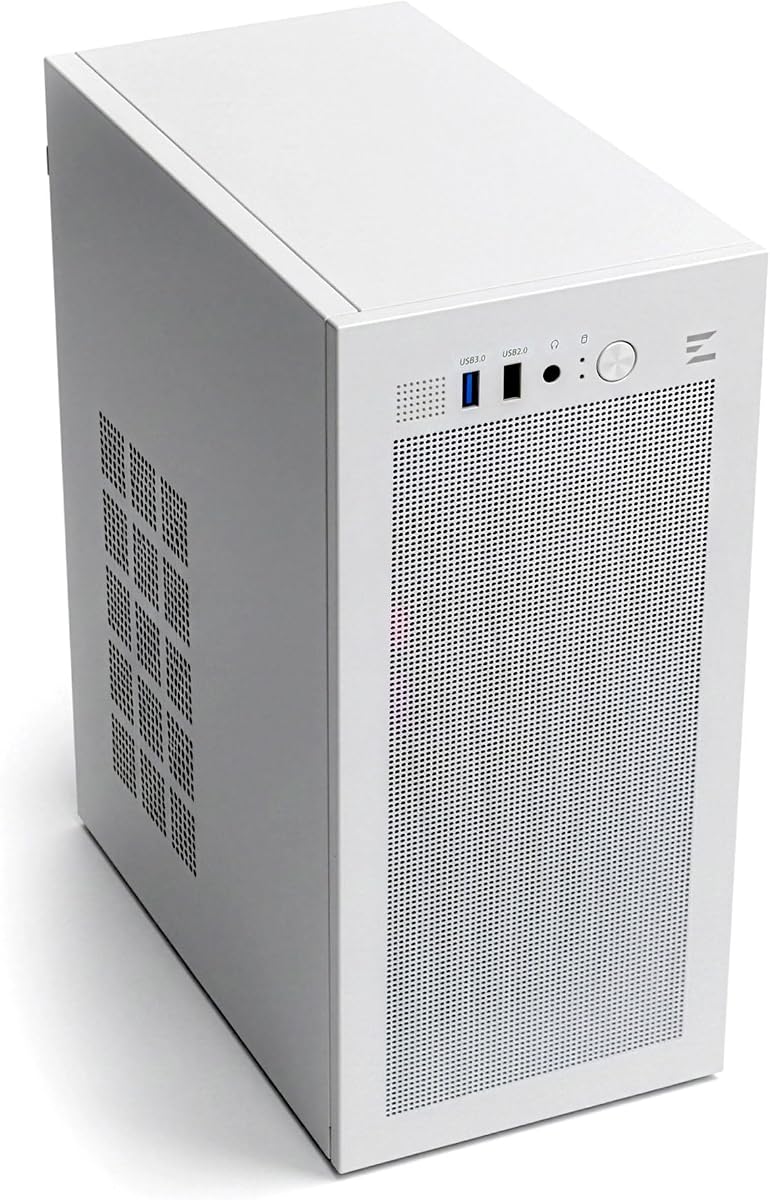
The Zalman CUBIX is a 4.5-rated compact case aimed at straightforward Mini-ITX and Micro-ATX builds. Its 17.1-liter steel enclosure is larger than the most portable models but remains compact, while compatibility with a standard ATX power supply removes a major obstacle for many first-time small-form-factor builders.
We may earn a commission when you buy through this link, at no additional cost to you.
The specification sheet is refreshingly practical. It accommodates graphics cards up to 260mm and CPU coolers up to 137mm, with a perforated front and a pre-installed 80mm fan providing the basic airflow foundation. Front connectivity includes one USB 3.0 port, one USB 2.0 port, and a 3.5mm stereo audio connection.
Its limitations are more noticeable in a premium compact build. No liquid cooling configuration is specified, and only one fan is included, so users interested in additional cooling will need to plan their own setup. The interior also offers less advanced cable-management detail than the specially engineered sandwich and separated layouts in this guide.
The CUBIX is a sensible choice for a basic office PC, home theater computer, or straightforward gaming system that benefits from a small footprint without requiring specialized SFX hardware. It is less compelling for builders who want a premium aesthetic, extensive radiator support, or extensive graphics card headroom.
ATX power supply compatibility is the CUBIX's most practical distinction. Builders can use a conventional power supply instead of hunting for a smaller SFX model, which can simplify component selection and maintenance.
The 0.8mm steel shell and restrained exterior prioritize durability over elaborate presentation. It is a case that can disappear into a workspace while still offering motherboard flexibility beyond strict Mini-ITX builds.
We may earn a commission when you buy through this link, at no additional cost to you.
The Fractal Design Terra Jade is a 4.7-rated 10.4-liter Mini-ITX case where industrial design and practical flexibility meet. Its FSC-certified solid walnut front panel, anodized aluminum panels, and 8mm-thick aluminum front give it a distinctive premium appearance intended to sit openly on a desk.
We may earn a commission when you buy through this link, at no additional cost to you.
Despite its compact volume, it supports graphics cards up to 322mm. A stepless, slidable central wall provides 30mm of internal adjustment, allowing builders to balance space around different hardware arrangements. The included PCIe 4.0 riser cable and front USB Type-C port add practical features that complement the refined exterior.
As with most dedicated ITX cases, the Terra Jade expects a compact SFX-class power supply, and its 10.4L volume leaves little room for conventional expansion. The premium materials and finish also require more care than a basic steel chassis, particularly in dusty environments.
This is the best choice in the group for a builder who wants a small computer to function as a polished piece of furniture. It balances modern connectivity, long GPU support, and flexible internals with one of the most refined exterior treatments available among these Mini ITx PC Case recommendations.
The walnut front immediately separates the Terra Jade from conventional metal cases. Combined with anodized aluminum panels, it gives the enclosure a furniture-like presence suited to a visible desktop or entertainment setup.
The slidable central wall gives users 30mm of adjustment rather than a single fixed layout. That flexibility can help accommodate different graphics cards, cooling hardware, and cable routes within the 10.4-liter frame.
We may earn a commission when you buy through this link, at no additional cost to you.
The TGDGAMER MATX Case is a 4.0-rated compact enclosure for builders who want Micro-ATX flexibility on an entry-level budget. It supports Mini-ITX and Micro-ATX motherboards, accepts a normal-size ATX power supply, and includes a perforated front panel designed to direct filtered air through the system.
We may earn a commission when you buy through this link, at no additional cost to you.
Its cooling capacity includes positions for two 120mm fans and one 80mm fan, with radiator support up to 135mm. Graphics card clearance reaches 250mm when no chassis fan occupies the front position, but drops to 225mm when one is installed there. That conditional is worth checking before finalizing a build.
The case is less refined than the other selections. It has no liquid-cooling-specific claim beyond radiator support, its front I/O includes only one USB 3.0 and one USB 2.0 port, and its overall rating is lower. The product information does not highlight a USB Type-C connection or advanced internal cable-management features.
Choose it for a practical first compact PC, particularly when reusing a standard ATX power supply matters and Micro-ATX support is desired. Builders seeking stronger materials, more refined aesthetics, Type-C connectivity, or very long graphics cards will receive a better fit elsewhere.
The combination of Micro-ATX support and standard ATX power supply compatibility lowers the barrier to entry for compact systems. It offers several useful hardware options without requiring the specialized layout of an SFX-focused enclosure.
The 250mm and 225mm graphics card limits depend on whether the front fan position is occupied. Comparing the chosen card with the intended cooling arrangement can prevent an avoidable fitment problem.
We may earn a commission when you buy through this link, at no additional cost to you.
The Lian Li A4-H2OX5 is a 4.2-rated 11-liter Mini-ITX case built around an ambitious sandwich layout. The motherboard mounts conventionally, while a triple-slot graphics card sits behind it using an included 240mm PCIe 5.0 riser cable. This arrangement allows strong hardware in a remarkably small enclosure.
We may earn a commission when you buy through this link, at no additional cost to you.
Its updated riser is designed for PCIe 2.0 through 4.0 devices while providing PCIe 5.0 bandwidth of up to 32Gb/s, offering twice the transfer rate of PCIe 4.0. Mesh panels cover the bottom, sides, and top, and the case also supports a 240mm AIO water cooler for compact performance systems.
The vertical GPU arrangement is not universal comfort. It demands careful planning around motherboard height, cooler dimensions, riser routing, and the graphics card's physical orientation. The removable SFX and SFX-L bracket and pre-routed power extension help reduce cable clutter, but assembly requires more care than a conventional tower.
The A4-H2OX5 is ideal for an enthusiast who prioritizes minimal desk volume and modern riser-based graphics support. It is especially compelling for builders already committed to SFX power, an AIO cooler, and a vertically mounted card, but less convenient for first-time compact builders.
Mounting the graphics card behind the motherboard uses space that a conventional compact layout would leave empty. That strategy enables a triple-slot card and 240mm AIO cooling within an 11-liter chassis.
The included PCIe 5.0 riser provides a current high-speed connection for a vertical GPU. A removable SFX bracket and pre-routed extension reduce the amount of space consumed by power cables.
We may earn a commission when you buy through this link, at no additional cost to you.
The Cooler Master NCORE 100 MAX is a 4.4-rated 15.7-liter Mini-ITX bundle that includes an 850W 80 Plus Gold SFX power supply, a 120mm AIO liquid cooler, and a PCIe 4.0 riser cable. It targets builders who want a coordinated compact system without sourcing every core component separately.
We may earn a commission when you buy through this link, at no additional cost to you.
Its hardware support is impressive for the size. The case accommodates Mini-ITX motherboards, vertical GPUs up to 356mm, and a custom-fit 38mm-thick 120mm radiator. The expandable frame can widen from 155mm to 172mm, providing additional room for large cards, while short custom cables help minimize clutter.
The integrated approach reduces selection work but also reduces flexibility. The vertical GPU layout requires planning, and the bundled power and cooling hardware may not match a builder's preferred components. A stand-alone case gives more freedom to customize the system independently.
The NCORE 100 MAX is a strong option for someone who wants a ready-made high-performance compact platform and values a coordinated installation. It is less appropriate for a builder who already owns SFX components, wants a horizontal graphics card, or prefers to select cooling independently.
The bundled SFX power supply, 120mm AIO cooler, and PCIe 4.0 riser cover several essential parts of a compact build. This can make the package particularly approachable for someone assembling a small high-performance system for the first time.
The 356mm GPU allowance and expandable frame are standout details in a 15.7-liter enclosure. Vertical mounting preserves the card's clearance while allowing the system to remain compact.
We may earn a commission when you buy through this link, at no additional cost to you.
The right compact case depends on motherboard format, power supply size, graphics card dimensions, cooling plan, and how prominently the finished computer will appear on your desk.
A dedicated Mini-ITX case is designed around the 170mm by 170mm motherboard standard, while a Micro-ATX-compatible model can accept a wider board and potentially offer more expansion. The Cooler Master Q300L V1, Zalman CUBIX, and TGDGAMER case support both formats. Dedicated models such as the NR200, Terra Jade, Lian Li A4-H2OX5, and NCORE 100 MAX provide a tighter layout tailored specifically to Mini-ITX.
Graphics card dimensions are among the most important constraints in a compact case. Clearance in this list ranges from 225mm in a conditional TGDGAMER configuration to 360mm in the Q300L V1. The NR200 supports 330mm, the Terra Jade supports 322mm, the NCORE 100 MAX reaches 356mm, and the S300 accepts 305mm. Always include the card's total length, connector overhang, and mounting hardware in the measurement.
Compact cases divide into designs that accept conventional ATX power supplies and those built around smaller SFX or SFX-L units. The Q300L V1, CUBIX, and TGDGAMER case accept ATX power supplies, although the available space may affect cable routing. The NR200, Terra Jade, S300, JONSBO TK-0, and A4-H2OX5 use compact SFX-class power supplies. The NCORE 100 MAX includes an 850W SFX Gold unit.
CPU cooler clearance can determine whether a case works with a quiet tower cooler or requires a low-profile air cooler or AIO. The NR200 supports up to 165mm, the Q300L V1 up to 159mm, the TK-0 and CUBIX up to 137mm, and the S300 only 60mm. For liquid cooling, the Q300L V1 supports a 240mm cooler, the NR200 accepts 240mm or 280mm radiators, and the A4-H2OX5 accommodates a 240mm AIO.
Smaller cases can free valuable desk space, but reduced volume often means tighter routing and more specialized components. The S300 is the most compact at 8.1 liters, followed by the Terra Jade at 10.4 liters and the A4-H2OX5 at 11 liters. The NR200 occupies 18.25 liters, while the CUBIX measures 17.1 liters. Portable cases with handles or versatile placement may also suit builders who expect to move the system.
Compact systems generate concentrated heat, so fan positions and radiator options matter more than they do in a roomy tower. The NR200 supports up to six fans, the Q300L V1 supports five, and the A4-H2OX5 adds mesh surfaces on its bottom, sides, and top. The CUBIX includes one 80mm fan, while the TGDGAMER case supports two 120mm and one 80mm fan. Check whether the selected fan arrangement affects GPU clearance.
Front connectors influence how comfortably a compact system can be used. The Terra Jade offers a 20Gbps USB Type-C port and the S300 includes a front USB-C connection. The CUBIX provides one USB 3.0, one USB 2.0, and a 3.5mm audio jack, while the TGDGAMER model lists one of each USB port. Consider which devices you connect most often and whether separate audio or card-reader access matters.
A case kept in plain sight should suit the room as well as the hardware inside. The Terra Jade combines walnut and anodized aluminum, the JONSBO TK-0 uses curved glass with wood veneer, and the NR200 White offers a coordinated light finish. Cases built mainly from steel, such as the CUBIX and Q300L V1, prioritize structure and practicality. Transparent or ventilated panels should also be considered alongside dust protection and cleaning needs.
Begin by assembling the system outside the case whenever practical. Install the motherboard, power supply, storage, and cooling hardware first, connect the essential internal cables, and test that the system powers on. This makes it easier to identify a component or connection problem before working in the constrained interior of a compact enclosure.
Install the power supply with the correct orientation for the case fan or fanless design. Route cables behind the motherboard tray or through the case's dedicated channels, then add the graphics card and its support hardware. In riser-based systems, connect the power extension carefully and leave enough slack for the graphics card to seat without stressing the connector.
Keep dust filters and mesh surfaces clean, especially in systems with many fans or a wood exterior. Use gentle cleaning methods, avoid excess moisture around panels and connectors, and check the case for loose screws or cables during routine maintenance. Allow adequate clearance around intake and exhaust openings so the selected cooling configuration can perform as intended.
A Mini-ITX case is built for the 170mm by 170mm Mini-ITX motherboard format and usually produces a smaller overall system. A Micro-ATX case accepts the wider Micro-ATX standard, although some models also support Mini-ITX boards. The Q300L V1, CUBIX, and TGDGAMER case offer the broader motherboard compatibility, while many dedicated ITX models accept only Mini-ITX.
Yes, if the case provides sufficient length, height, and slot clearance. The Q300L V1 supports cards up to 360mm, the NCORE 100 MAX up to 356mm, and the NR200 up to 330mm. Compact cases may also require the graphics card to be mounted vertically or connected through a riser, so check every physical dimension before ordering.
It depends on the enclosure. Many dedicated Mini-ITX cases require an SFX or SFX-L power supply, while several Micro-ATX-compatible models accept standard ATX units. The NR200, S300, TK-0, Terra Jade, and A4-H2OX5 use compact SFX-class power supplies, while the Q300L V1, CUBIX, and TGDGAMER case accept ATX power supplies.
Check the height of the exact CPU cooler you plan to use, including its heat sink and fan if they are installed as a combined unit. Clearance varies substantially across this group, from 60mm in the S300 to 165mm in the NR200. If your preferred cooler is taller than the listed limit, choose another case or a compatible low-profile alternative.
No. A riser is needed only when the case places the graphics card away from the motherboard's conventional slot position. The NR200 uses horizontal mounting without requiring the general need for a riser, while the S300, Terra Jade, A4-H2OX5, and NCORE 100 MAX include or specify riser-based arrangements. Confirm the supplied cable and motherboard BIOS compatibility before using one.
Yes, but only cases with suitable radiator placement can support one. The Q300L V1 lists support for a 240mm liquid cooler, the NR200 accepts 240mm or 280mm radiators, and the A4-H2OX5 supports a 240mm AIO. The NCORE 100 MAX includes a custom 120mm liquid cooler. Check pump, radiator, and CPU socket clearance before ordering.
The S300 is the most explicitly portable model because it has an 8.1-liter volume and an integrated top handle. The NR200, Terra Jade, and A4-H2OX5 are also compact enough for easier transport, but they lack the S300's dedicated handle. Always disconnect components and use suitable protective packaging before moving a completed system.
Verify the motherboard format, graphics card dimensions, power supply form factor, CPU cooler height, radiator placement, and required riser cable. Also confirm storage positions, front I/O needs, and the case's external measurements for your desk or entertainment unit. Compatibility claims cover the case itself, but every selected component still needs to work within the same envelope.
The Cooler Master NR200 stands out as the most balanced choice for performance-oriented compact builds, combining a small 18.25-liter footprint with long GPU support and flexible cooling. The Q300L V1 is an accessible and expandable alternative for builders who need Micro-ATX support and standard components, while the Fractal Design Terra Jade delivers the strongest premium design.
Your priority should determine the winner: choose the Q300L V1 for motherboard and hardware flexibility, the NR200 for a capable conventional Mini-ITX layout, and the Terra Jade for refined materials. Extreme volume reduction favors the S300 or A4-H2OX5, while the NCORE 100 MAX serves buyers who prefer a coordinated bundle with power, cooling, and riser hardware included.
Product listings and prices can change, so verify current specifications, included accessories, and component dimensions before purchasing. Checking the case against your exact motherboard, power supply, graphics card, CPU cooler, and cooling hardware will prevent the most common compact-build fitment problems.