
APEXEL 100x Phone Micro Lens
3.7Editor score
100x stated magnification
Automatic LED ring
Glass multi-layer optics
Case-friendly universal clip
Our Phone Microscope Lens Attachment guide compares 10 clip-on options for magnification, lighting, filters, compatibility, portability, and image quality.
A phone microscope lens attachment turns an ordinary smartphone camera into a close-up tool for revealing details on leaves, coins, fabrics, jewelry, insects, and other small subjects. A good model should combine useful magnification with even illumination, reliable focusing, broad device compatibility, and a clip that remains stable during close-range photography.
We compared the ten available attachments by their stated magnification, optical construction, working distance, lighting options, filters, battery design, weight, phone compatibility, and intended uses. The list includes dedicated high-power microscopes, multi-magnification systems, a conventional macro lens, and an adapter designed to work with an existing microscope or telescope.
Each review explains where a product is strongest, where its design creates trade-offs, and which type of user may appreciate it most. Magnification figures come from the supplied product information, and real results can vary with subject distance, lighting, camera behavior, and stabilization. Current prices and availability change frequently, so check the listing before purchasing.
3.7Editor score

4.5Editor score

3.9Editor score
The comparison below highlights each attachment's magnification range, lighting, optical features, portability, and best use case, making it easier to identify the model that matches your subjects and workflow.


The MIAO LAB 300X stands out as the most complete dedicated microscope attachment in this guide, combining a stated 300X magnification level with 12 LEDs, a 395nm UV light, a CPL filter, and a rechargeable 100mAh battery. Its 4.5 rating and broad feature set make it a strong all-around choice for close-up photography, education, collecting, and detailed inspection.
We may earn a commission when you buy through this link, at no additional cost to you.
Its strongest advantage is the combination of 13 lighting modes and an integrated polarizing filter. Different illumination settings can make surface texture, fibers, currency printing, insects, and reflective objects easier to examine, while the CPL can reduce glare and improve contrast. A 6–10mm working distance provides a practical target, and the slide-rail and modular construction should make magnification changes more convenient than handling a fixed optical path.
There are important limits to understand. The product is expressly designed for close subjects rather than distant objects, and the stated magnification should not be treated as a laboratory-grade resolution guarantee. Users should disable their phone camera's macro mode for best performance, and the clip is not compatible with the iPhone mini. A 46.5g body is portable without being as featherlight as the smallest options, while the rechargeable light avoids disposable-battery interruptions.
This is the best general recommendation for someone who wants a dedicated microscope rather than a conventional macro accessory. It is especially appealing to users who will inspect reflective objects, explore plant surfaces, or use UV illumination. The MIAO LAB 300X offers more versatility than basic LED clips and balances that expanded feature set with a manageable weight.
Thirteen lighting modes and a 395nm UV source give the attachment more ways to reveal texture than a simple fixed white light. The integrated CPL filter is particularly useful when glare from coins, gemstones, glass, plastics, and polished surfaces would otherwise obscure detail.
The recommended 6–10mm working distance places the lens very close to the subject, so steady hands, a stable surface, and a little practice will produce better results. Disable native macro mode and lock focus when the image becomes easier to maintain.
We may earn a commission when you buy through this link, at no additional cost to you.
The APEXEL 200X is a lightweight dedicated microscope with a stated 200X magnification, four layers of glass optics, six LEDs, two lighting modes, and a CPL filter. Its 3.7 rating reflects a less emphatic customer reception, but the supplied specifications make it attractive for users who value portability and uncomplicated close-up photography.
We may earn a commission when you buy through this link, at no additional cost to you.
At only 17.5g, the attachment is one of the easiest to carry in a pocket, bag, or classroom kit. The rechargeable battery supplies up to 5.5 hours of continuous operation, avoiding the need to carry spare cells. Installation takes a few straightforward steps, no dedicated app is required, and the hollow clip is designed for a broad selection of iPhone, Samsung, Google, Xiaomi, and OnePlus devices.
The trade-offs are its more limited lighting selection and the recommendation to remove the phone case before attachment. A case can shift the lens away from the camera, affect centering, or create a troublesome gap, so the case-free setup is the safer starting point. The recommended working distance is approximately 6mm, making it strictly a near-subject device. Users on recent iPhone models and Galaxy S22 or S23 Ultra models should also disable native macro functionality.
The APEXEL 200X is best for travelers, students, and casual hobbyists who need a compact microscope without a large battery system. It provides the essential tools of magnification, illumination, and glare reduction in a particularly light package. Buyers wanting more lighting modes or a broader magnification selection may prefer a modular 3-in-1 alternative.
The 17.5g weight makes this model convenient for field observation, school projects, and spontaneous inspection of collectibles. Its rechargeable light can support several hours of use without adding the bulk of a larger standalone microscope.
The product works directly with the phone camera, so users do not need to download a specialized application or learn a separate control interface. Correct camera placement, a close working distance, and careful focus adjustment remain the primary tasks.
We may earn a commission when you buy through this link, at no additional cost to you.
The APEXEL 100x is a straightforward, budget-minded entry into phone microscope photography. It uses a four-piece glass lens system with multiple coatings, includes an automatic LED ring, and offers a stated 100X magnification. Its 3.7 rating is shared with the APEXEL 200X, but this model's simpler construction and case-friendly clip make it a practical first microscope.
We may earn a commission when you buy through this link, at no additional cost to you.
The integrated clip and slide rail eliminate screws and springs, while the stated maximum opening allows use with many cases. The LED ring switches on when the lens cover is opened, reducing the number of controls that new users must learn. It works with the phone's primary camera and requires no app, making it well suited to inspecting plants, trichomes, coins, stones, skin, and other nearby details.
Its 100X figure offers less theoretical magnification than the 200X and 300X alternatives, while the light provides about two hours of use after roughly 90 minutes of charging. Cleaning requires particular care because alcohol may damage the optical coating. The stated working distance of 0.14–0.17 inches is narrow, so it is a dedicated close-up instrument rather than a general photography lens.
This is a good pick for beginners, families, and teachers who want a simple way to introduce children to microscopy without a complex device. It also suits owners of phones with protruding camera lenses, since the product guidance suggests retaining a case for convex cameras. Users needing more magnification, UV lighting, or a rechargeable battery can move up to a higher-tier model.
Opening the lens cover activates the LED ring, which removes an extra control step and helps maintain consistent illumination during close inspection. For transparent or translucent subjects, experimentation with side lighting may still provide more depth than straight-on light.
The four quality glass lenses and their multilayer coatings are a meaningful step above a basic single-plastic design. The product is still best handled gently, particularly around the front element, because solvent-based cleaning can damage the coating.
We may earn a commission when you buy through this link, at no additional cost to you.
The Phone Microscope 200X is a compact, no-app attachment with a stated 200X magnification, integrated CPL filter, and rechargeable LED illumination. Its 4.5 rating places it among the strongest customer-rated products in this guide, while its broad range of suggested uses includes coins, jewelry, plants, classroom observations, and small-object inspection.
We may earn a commission when you buy through this link, at no additional cost to you.
The polarizing element is designed to reduce glare and ghosting, helping colors appear more saturated and contrast more visible under magnification. Users can clip the device to a phone and zoom the camera to fill the screen, creating a straightforward path from installation to close-up capture. Its 17.5g weight and pocket-friendly form make it easy to carry to a classroom, workshop, outdoor activity, or collector's display.
The rechargeable battery provides more than two hours of effective use when fully charged, which is less than the continuous runtime offered by several 100mAh models. The instructions also recommend using the main camera, removing a thick case, positioning the lens close to the subject, and zooming in by 2x. As with all close-focus devices, the smallest features will be harder to resolve than broader patterns.
This is a well-rounded choice for families, educators, and casual users who want more capability than a plain macro lens without a complex multi-lens system. The 4.5 rating supports its position as a dependable all-purpose option, while the integrated filter gives it a useful edge for reflective specimens. It is less suitable for users who need UV illumination or three selectable magnification levels.
Its combination of simple attachment, direct camera operation, and glare-reducing optics suits classroom demonstrations and family exploration. Students can document plant surfaces, fabric fibers, coins, and other specimens without learning a dedicated app.
The CPL filter is particularly valuable when examining glossy coins, jewelry, glass, or smooth plastics. It can reduce harsh reflections that would otherwise conceal surface details under strong illumination.
We may earn a commission when you buy through this link, at no additional cost to you.
The APEXEL 3-in-1 is the premium multi-magnification option here, with a rotating wheel offering 40x, 80x, and 120X settings. Its 3.9 rating is supported by a technically rich design that includes fully multi-coated aviation-grade optical glass, 16 white or yellow LEDs, eight UV LEDs, a claimed 30% light-transmittance improvement, and pass-through charging.
We may earn a commission when you buy through this link, at no additional cost to you.
Three magnification levels make this model more versatile than a fixed 100X, 200X, or 300X lens. The lower settings can suit broader subjects, while 120X provides closer inspection when appropriate. Dual color temperatures allow users to shift between 5800K white and 3200K yellow illumination, and CRI 92+ is designed to provide natural-looking color. UV can help reveal fluorescence in jade textures, currency marks, and other specimens.
The device weighs 47.9g, making it heavier than the smallest clips, and its advanced controls naturally create a greater learning curve. Its 8.26–34.3mm focus range is also much broader than the 6mm or 6–10mm working distances of the high-power products. The adjustable universal clip supports phones of different thicknesses and reportedly fits with cases, while an anti-slip pad helps avoid pressing side buttons.
This model is best for serious hobbyists, teachers, jewelers, and collectors who want several magnification levels and advanced illumination in one attachment. Pass-through charging is particularly useful during extended sessions. It is worth the additional bulk for users who value UV, selectable color temperature, and optical flexibility more than minimal weight.
A rotating selector lets users move among 40x, 80x, and 120x without carrying separate attachments. This range supports tasks that demand both wider framing and increasingly close inspection.
White and yellow LEDs offer different color balances, while the UV bank can reveal fluorescence-dependent features. These modes are especially useful for currency, jade, materials analysis, and specimens that respond differently to wavelength.
We may earn a commission when you buy through this link, at no additional cost to you.
The APEXEL PhoneMicro 5 Series combines three high magnification choices—100X, 200X, and 300X—with a slide rail and modular design. Its 4.0 rating reflects a balanced feature set, while the 18 lighting modes, 395nm UV source, and integrated CPL filter give it more control than most fixed-magnification alternatives.
We may earn a commission when you buy through this link, at no additional cost to you.
Modularity is the defining benefit. Instead of committing to one viewing level, users can change lenses or settings to suit a subject and working distance of 6–10mm. The 12 bright LEDs can be adjusted across numerous modes, and the polarizing filter helps reduce glare on reflective specimens. A 100mAh rechargeable battery supports up to 5.5 hours of continuous use, which is useful for field sessions and classroom demonstrations.
The 46.5g weight is manageable, but the system is not as compact as the 17.5g APEXEL 200X. The instructions recommend removing the phone case for the best optical performance, and recent iPhone 13 or newer and Galaxy S22 or S23 Ultra users should disable native macro mode. Its numerous options may also feel excessive to a user who only needs a basic illuminated magnifier.
The PhoneMicro 5 is a strong choice for users who want high-power options without buying several separate microscopes. It works well for insects, ore, jewelry, tobacco, currency, plants, and other small subjects, particularly when glare or unusual lighting needs must be managed. Buyers should weigh the added size and controls against the flexibility they gain.
The slide rail and selectable 100X, 200X, and 300X levels make it possible to adapt to different subject sizes. This is useful when a session begins with a wider view and later moves to finer detail.
Eighteen modes, including UV, offer more ways to reveal texture than a standard white LED. The CPL is particularly helpful for coins, jewelry, glass, and other subjects whose reflective surfaces can hide the details users want to inspect.
We may earn a commission when you buy through this link, at no additional cost to you.
The APEXEL Portable 300X is a dedicated high-power attachment with a stated 300X magnification, 12 bright LEDs, 13 lighting modes, a 395nm UV light, and a CPL filter. Its 4.0 rating and broad feature set position it as a practical option for serious phone-based inspection when a single maximum magnification level is sufficient.
We may earn a commission when you buy through this link, at no additional cost to you.
The illumination system is more capable than a basic ring light. Thirteen modes allow adaptation to different surfaces, and UV can help expose details that look different under visible light. The CPL reduces unwanted reflections on coins, jewelry, ore, and other reflective materials. Installation takes five steps, requires no app, and uses a 6–10mm working distance.
Unlike the modular 3-in-1 products, this model focuses on the 300X endpoint rather than offering 100X and 200X alternatives. That simplifies the concept but leaves less flexibility when the user needs a wider view. It also weighs 46.5g and should be installed without a phone case for best performance. Recent iPhone and Galaxy models may require native macro mode to be disabled.
This attachment is well suited to collectors, educators, nature lovers, and users focused on the finest stated magnification available in the guide. Its rechargeable 100mAh battery offers up to 5.5 hours of continuous operation. If a broader working range matters more than a dedicated 300X configuration, the PhoneMicro 5 Series may be a better fit.
At 46.5g, the device remains practical for portable observation while reaching the guide's highest stated magnification. Its rechargeable light supports extended use without disposable batteries.
UV and CPL features are valuable for revealing features on currency, gemstones, insects, and polished objects. A dark background can also help when evaluating small, translucent, or high-contrast specimens.
We may earn a commission when you buy through this link, at no additional cost to you.
The Universal Phone Scope Adapter is fundamentally different from the dedicated microscope lenses. Instead of supplying its own magnification and illumination, it connects a phone to an existing telescope, microscope, binocular, monocular, or night-vision spotting scope. Its 3.7 rating and broad compatibility make it most useful to people who already own suitable optical equipment.
We may earn a commission when you buy through this link, at no additional cost to you.
The adapter supports eyepieces measuring 22–44mm in diameter, which covers many common consumer and educational scopes. Its phone-width range is 55–85mm, and the listed compatibility includes several older iPhone, Samsung Galaxy, Sony, LG, and HTC models. Soft EVA pads on the phone and eyepiece contact points help reduce the risk of scratches during mounting.
Because magnification comes from the microscope or telescope, this product does not provide a consistent standalone 100X, 200X, or 300X specification. It also has no integrated LED, so users must arrange their own illumination and may need to account for vignetting or differences between optical devices. Its 75g weight and rigid eyepiece connection may be less convenient for casual pocket use.
Choose this adapter if you own a suitable microscope or telescope and want to save images on a phone. It is a secondary tool for extending existing equipment rather than a complete microscope package. For people seeking a ready-to-clip illuminated microscope with known magnification, one of the dedicated attachments will be more straightforward.
The adapter can add phone photography to a compatible microscope, telescope, binocular, monocular, or spotting scope. This makes it useful for documenting prepared slides, distant celestial subjects, or wildlife viewed through existing optics.
The 22–44mm range covers many standard eyepieces, but measuring the barrel before ordering is essential. Phone width and case design also affect the fit, so users should verify both dimensions rather than relying only on brand compatibility.
We may earn a commission when you buy through this link, at no additional cost to you.
The Xenvo Pro Lens Kit is a broader mobile photography package rather than a dedicated 100X–300X microscope. It includes a 15x Clarus macro lens, a 0.45x TruView wide-angle lens, a grip clip, a rechargeable GlowClip LED, a lanyard, travel case, EasyClip, and cleaning cloth. Its 4.1 rating and broad accessory set make it a versatile alternative for everyday creators.
We may earn a commission when you buy through this link, at no additional cost to you.
The 15x macro lens is designed for subjects about half an inch away, making it appropriate for flowers, fabric, coins, small products, and other details that are larger than those viewed through a high-power microscope. The wide-angle lens expands the field of view for landscapes, architecture, selfies, and group shots. Coated multi-element glass is intended to reduce ghosting, reflections, flare, and vignetting.
The separate three-level warm LED can be clipped to a phone and offers softer fill illumination than a phone's built-in flash. However, it is not an integrated ring around the macro optic, and the kit has neither UV illumination nor a CPL filter. The TruGrip provides a more secure hold than a simple spring clip, while the travel case and quick-release lanyard make the complete set easier to transport.
The Xenvo kit is best for a photographer who wants one package to cover macro, wide-angle, and basic fill-light needs. It is less appropriate for users whose main goal is extreme close-up microscopy or fluorescence inspection. If those specialized capabilities matter, spend the budget on a dedicated high-power microscope instead.
The wide-angle lens makes this kit useful beyond close-up work, covering landscapes, architecture, pets, selfies, and group photography. That broader utility distinguishes it from products designed only for tiny subjects.
A protective case, lanyard, secondary clip, and cleaning cloth keep the components organized and reduce the chance of losing small pieces. The 15x magnification also preserves enough context for attractive close-up compositions rather than only isolated textures.
We may earn a commission when you buy through this link, at no additional cost to you.
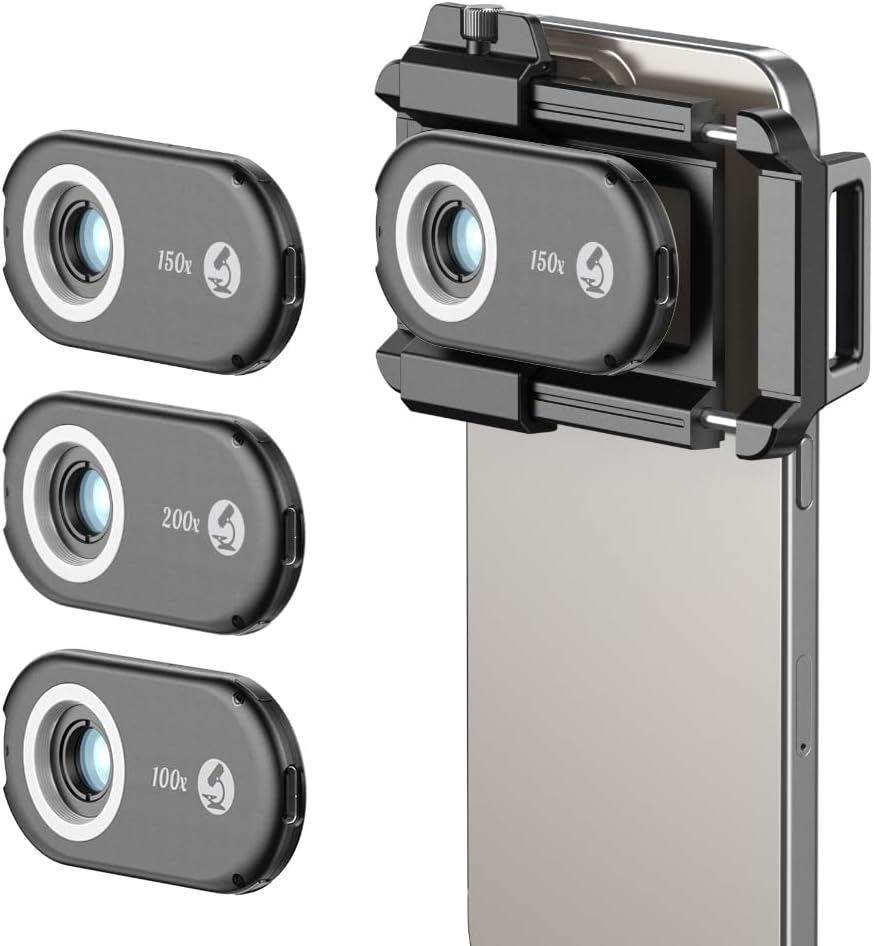
The 3-in-1 Phone Microscope offers 100x, 150x, and 200X magnification in a compact attachment with LED and UV lighting plus a CPL filter. It is also the only product in the guide explicitly described as clamping to both smartphones and tablets, making that cross-device support a meaningful point of differentiation.
We may earn a commission when you buy through this link, at no additional cost to you.
Three closely spaced magnification levels allow users to adjust the view without moving to the more widely separated 40X, 80X, and 120X tiers of the premium APEXEL wheel model. LED illumination supports routine inspection, while UV can reveal features that respond differently to ultraviolet light. The CPL filter is useful for reducing reflections and improving perceived contrast on shiny materials.
A key limitation is the absence of a listed customer rating, making it harder to compare long-term user satisfaction with the other options. The supplied information is also less detailed regarding working distance, battery life, exact materials, weight, and charging method. Those omissions do not negate the stated features, but they call for closer attention to the current listing before ordering.
This is a promising pick for someone who wants a small three-level microscope with both UV and polarized viewing and uses a tablet as well as a phone. It is especially relevant for casual collectors, educators, and nature enthusiasts. Buyers who prioritize documented battery runtime, operating weight, or established customer feedback may feel more comfortable with one of the better-reviewed models.
The 100x, 150x, and 200X levels offer a practical progression for inspecting small subjects. Fine adjustments can help users balance detail with the amount of the specimen visible in the frame.
LED provides standard visibility, UV can reveal fluorescence-related details, and the CPL helps control glare. Together they make the attachment useful for varied subjects rather than only conventional illuminated macro photography.
We may earn a commission when you buy through this link, at no additional cost to you.
Choosing a phone microscope means balancing magnification against working distance, illumination, filters, optics, portability, and device fit. The best attachment is the one that matches the scale and material of the subjects you intend to inspect.
A higher stated magnification number does not automatically mean clearer images. Resolution also depends on optical quality, camera sensor, lighting, focus stability, and how precisely the lens is positioned. Dedicated products in this guide range from 100X to 300X, while the Xenvo kit provides a more conventional 15x macro view. High-power attachments generally work only millimeters from the subject, so steady positioning becomes increasingly difficult as magnification rises.
Choose a low-to-moderate setting when framing a whole specimen or photographing subjects with recognizable patterns. Reserve 200X and 300X for isolated details such as fibers, printing, wing scales, mineral textures, or gemstone inclusions. Always follow the stated working distance because moving the lens too close can soften the image.
The quality of the glass, number of elements, and treatment of lens surfaces influence sharpness, color, contrast, and resistance to reflections. Products described as using multi-layer or fully multi-coated optical systems offer a stronger foundation than a basic resin or single-element design. The APEXEL 3-in-1 goes further with a four-group, four-element system at its highest magnification, while the APEXEL 100x uses four coated glass lenses.
Look for multi-element glass and coating information when image fidelity matters. Clean the front element with a soft cloth and avoid alcohol unless the manufacturer specifically approves it. Even good coatings can scratch or haze when cleaned with the wrong solvent, permanently reducing apparent clarity.
Close-up photography is unforgiving because phone cameras often focus on the lens rather than the subject and built-in flashes can flatten texture. A ring or integrated LED light provides steadier illumination, while multiple brightness and color modes help with reflective, translucent, or uneven surfaces. The strongest options include white and yellow LEDs, high color-rendering ratings, and UV light for fluorescence-oriented inspection.
For general use, continuous white light is the easiest starting point. Yellow light can be gentler for some subjects, and different LED angles can reveal texture. UV is valuable for currency markings, jade, and certain materials, but it should be treated as a specialized tool rather than a universal improvement.
A circular polarizing filter can reduce reflections from coins, jewelry, gemstones, glass, varnished surfaces, and plastics. This is especially helpful under bright illumination, where reflected light may wash out texture that the microscope is intended to reveal. It does not remove every reflection, and its effect can vary with the subject and light source, but it is a valuable inclusion for collectors.
Prioritize a model with a CPL filter when inspecting shiny objects. Users photographing fabric, paper, soil, or opaque specimens may receive less visible benefit and can instead prioritize more magnification levels, broad focus range, or battery life.
Rechargeable integrated lights offer a cleaner alternative to replaceable batteries and are convenient for repeated use. Several products in this guide use a 100mAh battery with a stated continuous runtime of up to 5.5 hours, while the simpler APEXEL 100x provides about two hours of LED use. The premium APEXEL 3-in-1 also supports pass-through charging, allowing operation while connected to power.
Choose based on how long sessions last and how much the device will be carried. At 17.5g, the APEXEL 200X and Phone Microscope 200X are especially easy to carry. Models near 46.5g or 47.9g remain portable but feel more substantial. Verify charging method, cable requirements, and expected runtime before buying if continuous operation is important.
A universal clip should position the microscope directly over the phone's primary camera without pressing side buttons or obstructing the lens. Clip openings range from about 2cm for the APEXEL 100x to 6.5–10cm for larger models, but a wide adjustment range does not guarantee a centered fit on every device. Camera placement, case thickness, and protruding lenses all affect alignment.
Remove thick or fitted cases when the manufacturer recommends it, and use the main camera rather than an ultra-wide or telephoto lens. Recent iPhone 13-and-newer models and Galaxy S22 or S23 Ultra models may need native macro mode disabled. Users should also check whether their device is specifically excluded, as some models are not compatible with the iPhone mini.
The intended subject should determine whether a dedicated microscope, standard macro lens, or scope adapter makes the most sense. High-power clip-on microscopes suit tiny natural and manufactured details, while a 15x macro lens provides a more familiar view of flowers, fabric, coins, and small products. An optical scope adapter is appropriate for users who already own a microscope, telescope, binocular, or spotting scope.
Consider whether a single magnification level is enough or whether a rotating 3-in-1 system is worth the added complexity. UV and CPL are most valuable for currency, minerals, jewelry, insects, and reflective materials. For classroom participation, simple setup, low weight, and no-app operation may matter more than maximum magnification.
Begin by charging the built-in light according to its instructions, then select the main rear camera on your phone. Check the clip width and camera position before tightening or sliding the attachment into place. If the manufacturer recommends removing a case, do so because a thick case can shift the lens off-axis. Confirm that the microscope does not overlap neighboring cameras or press the volume or power controls.
Place the subject on a stable surface and begin at the recommended working distance, which may be as close as 6mm for high-power models. Move the phone and subject slowly, tap to focus, and adjust lighting until surface texture is visible. Stabilizing the phone against a stand, book, table edge, or small support can reduce blur. Disable native macro mode when advised, and remember that these attachments are intended for nearby subjects rather than distant viewing.
After use, switch off the light and gently disconnect the attachment. Wipe the front lens with the included soft cloth or another clean, lint-free material, avoiding alcohol, abrasive cleaners, and contact with dirty fingers. Store the device in its case or a protected pouch, keep the clip free of dust, and recharge it before the next session. If images look hazy, check the lens and light diffuser for fingerprints or residue before adjusting camera settings.
It can reveal fine details in small specimens, but it is not equivalent to a laboratory microscope. Resolution, illumination, and working distance differ between models, and living samples may move or require a prepared slide. The higher-power products can make tiny organisms and plant structures easier to observe, but identification should rely on proper laboratory methods or expert knowledge rather than a phone image alone.
A stated 300X figure describes the device's advertised magnification rather than a guarantee of equivalent laboratory resolution. Real image quality also depends on lens coatings, camera sensor, lighting, focus, stabilization, and subject preparation. These attachments are useful for education and close inspection, but they should not replace calibrated laboratory equipment for medical diagnosis or scientific measurement.
It depends on the product and case. The APEXEL 100x is designed with a wider clip and may work with many cases, while several other models specifically recommend removing a thick case. A case can push the lens away from the camera or prevent it from centering over the primary lens, so verify the fit and alignment before an extended session.
Native macro mode may switch cameras, reposition the focus plane, or apply processing that conflicts with the external microscope. Recent iPhone 13-and-newer models and Galaxy S22 or S23 Ultra models are specifically mentioned in the product guidance. Disabling it can give the user more predictable focus and a more consistent view through the attachment.
LED light is the practical choice for most close-up work because it provides consistent visible illumination. UV adds value for subjects with fluorescence-related features, such as certain currency markings, jade textures, minerals, or specialized materials. If your interest is ordinary coins, fabric, leaves, or school specimens, LED and a CPL filter may be more useful than UV.
No. The dedicated high-power attachments listed here are designed for subjects measured in millimeters from the lens, and their product information explicitly says they are not for distant magnification. The Universal Phone Scope Adapter is the exception in function because it connects an existing telescope, microscope, binocular, or spotting scope, allowing the optical equipment to provide the distant view.
Close-focus images are sensitive to tiny movements and incorrect camera focus. Hold the phone steadily, rest it on a support, keep the lens at the specified distance, tap the subject to focus, and avoid touching the front glass. A dirty or diffused lens, a phone case that shifts the attachment, and enabled native macro mode can also contribute to softness.
No. Higher power reduces the visible area and narrows the usable working distance, making framing and stabilization more difficult. A 40x, 80x, or 100x option may capture a subject more clearly than 200X or 300X, especially when the goal is to show a recognizable pattern rather than an isolated detail.
The MIAO LAB 300X is the strongest overall choice because it combines high stated magnification with 13 lighting modes, UV, a CPL filter, and a rechargeable battery. The APEXEL 100x is the best budget starting point for simple, automatic LED illumination, while the APEXEL 3-in-1 is the premium selection for three magnification levels, dual color temperature lighting, UV, and pass-through charging.
Prioritize the subject and workflow before chasing the largest magnification number. Match the working distance to your specimens, consider whether reflective materials require a CPL filter, and check the phone-clip fit before ordering. Advanced lighting, multiple magnification levels, and battery life add value, but steadiness and correct setup remain central to clear results.
Finally, check the current listing, compatibility notes, operating instructions, and price before making a purchase. Product features and availability can change, and the supplied information may not capture every detail in the latest listing. With the right attachment and careful technique, a phone can become a useful portable microscope for learning, collecting, and exploring otherwise invisible details.