
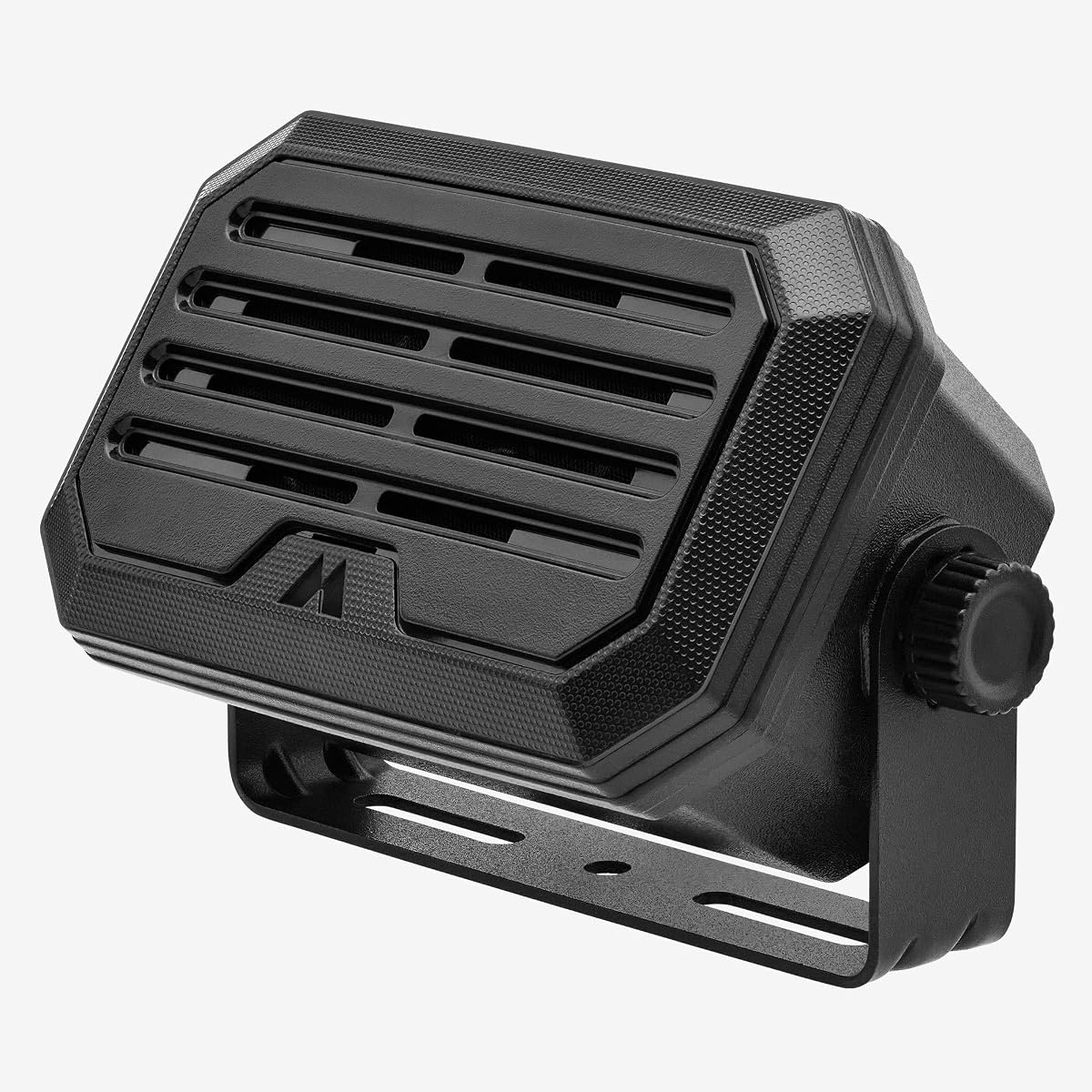
Rectangular External Communications Speaker
4.4Editor score
Compact 5-watt output
Standard 3.5mm connector
Bracket and hardware included
This Ham Radio Speaker guide compares 10 models for power, sound quality, compatibility, mounting, portability, and everyday usability.
A ham radio speaker can make a weak signal easier to understand, a noisy mobile installation more enjoyable, and a compact transceiver far more practical. The right model should not only produce enough volume but also match your radio’s impedance, connector, power requirements, and mounting situation. Good audio starts with compatibility and thoughtful placement.
This guide compares ten external communications speakers using the specifications and product details available for each model. It covers conventional 5-watt units, higher-output models, equipment-specific Yaesu and Icom speakers, waterproof options, two-packs, and designs intended for radios, scanners, and related communications equipment. The comparison emphasizes fit and function rather than marketing language alone.
Each numbered review explains the speaker’s strongest qualities, limitations, and likely buyer. The top selections represent a budget-conscious choice, an all-around recommendation, and a premium equipment-specific option, while the remaining products provide alternatives for different needs. Product specifications and prices can change, so confirm the current listing and connector details before purchasing.
4.4Editor score
4.7Editor score

4.7Editor score
The following side-by-side comparison highlights the major differences in output, impedance, connector type, cable design, and mounting approach so you can quickly identify the speaker most likely to suit your radio and operating environment.



This compact external communications speaker earns a 4.4 rating and stands out as a straightforward option for operators who want clearer radio audio without a large installation. Its five-watt rating, eight-ohm impedance, and standard 3.5mm plug make it relevant to many CB radios, amateur radios, two-way radios, and police scanners.
We may earn a commission when you buy through this link, at no additional cost to you.
The main appeal is practical versatility. At approximately 4.5 by 2.5 by 2.25 inches, it should be easier to accommodate than a full-size communications speaker. The included mounting bracket and hardware allow it to be secured in a useful listening position, while the attached cord and standard connector simplify connection to compatible equipment.
Its limitations are equally clear. Five watts is less output than the 10- and 20-watt alternatives in this guide, so it may not overcome a very noisy environment as effectively. The supplied information does not state a long cable length, which could matter if the radio is mounted some distance from the operator’s normal position. It is also a generic design rather than a model tied to one radio brand.
This is a sensible choice for a compact desk setup, scanner station, or basic mobile radio where modest output is sufficient. It also works well as a secondary speaker when a second location is needed. For buyers seeking easy placement, universal connection, and essential accessories in a small package, it remains one of the most approachable options in the roundup.
The small enclosure and supplied bracket make this speaker easy to position near a radio that has little free space. It is a good fit for a desk, shelf, or compact operating position where the radio’s built-in speaker is less convenient for prolonged listening.
A standard 3.5mm plug and eight-ohm rating make the speaker relevant to a wide range of communications equipment. Confirm your radio has a compatible external-speaker output and accepts the connector before ordering.
We may earn a commission when you buy through this link, at no additional cost to you.
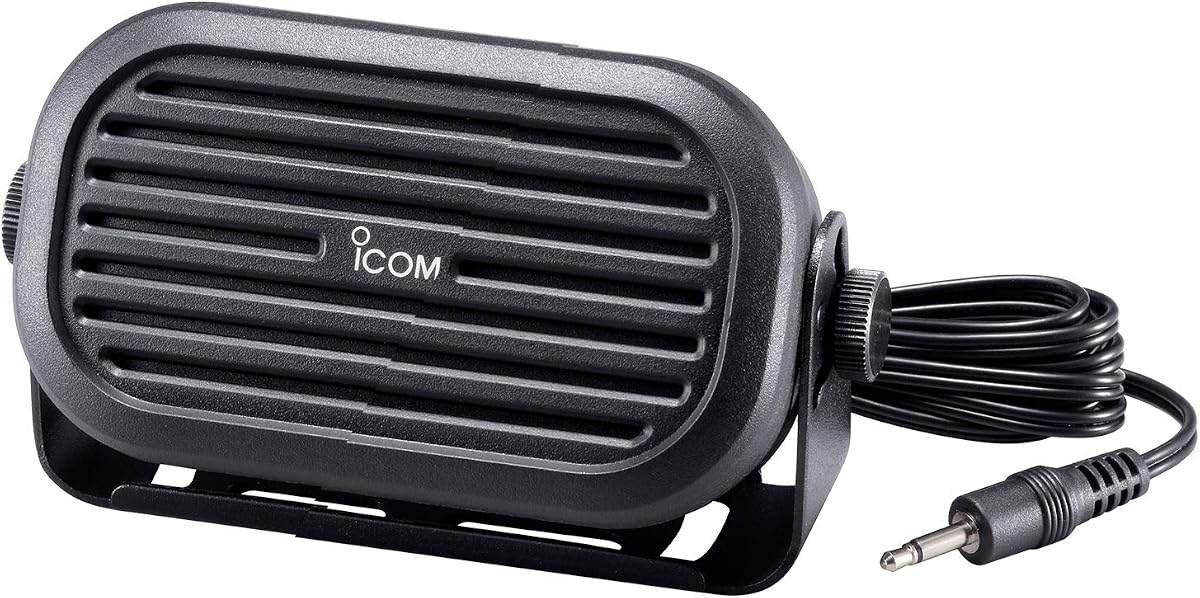
The ICOM Speaker, Hands Free has a 4.7 rating, making it one of the strongest customer-rated options in the group. It provides a five-watt external speaker with a 3.5mm speaker jack, offering a simple way to move radio audio to a more convenient position for hands-free listening.
We may earn a commission when you buy through this link, at no additional cost to you.
Its main strength is the freedom to place the speaker wherever it is most useful. The ability to mount it separately can help an operator hear a transceiver across a room, in a vehicle, or at another part of a station. A single-speaker configuration keeps the design uncomplicated, while the standard jack provides a familiar connection method.
The trade-offs are its modest five-watt output and the limited detail supplied beyond the connector and mounting capability. It does not offer a specified cable length, water resistance, frequency response, or a stated warranty. Buyers should also check the exact output arrangement on their Icom radio rather than assuming every model uses the same connector.
This speaker is most appropriate for an Icom user who wants to move audio away from the radio and does not need high output for a particularly noisy setting. It could also serve an operator who wants hands-free monitoring while working nearby. Its high rating, simple construction, and flexible placement make it a polished convenience-focused option.
Separating the speaker from the radio can improve practical listening during operating, repair, or monitoring. Position the enclosure where voices are easier to hear without reaching for volume controls on the transceiver.
The 3.5mm speaker jack and Icom branding make this most relevant to compatible Icom equipment. Verification of the radio’s output specifications remains important because connector layouts can vary by model and application.
We may earn a commission when you buy through this link, at no additional cost to you.
This QWORK 5W two-pack has a 4.4 rating and addresses a specific need that single-speaker listings often overlook: audio coverage in more than one location. Each compact enclosure measures approximately 4.5 by 2.5 by 2.25 inches, and each includes a 6.23-foot cable with a standard 3.5mm plug.
We may earn a commission when you buy through this link, at no additional cost to you.
The pair can be especially useful in a multi-position station, vehicle, or setup where one listening point is insufficient. Both speakers have an eight-ohm rating and five-watt output, while the included brackets and hardware support secure placement. Compatibility is listed for amateur radios, CB radios, two-way radios, and police scanners.
The limitation is that five watts per unit is not the strongest output available in this roundup. It also may be more equipment than one operator needs. Furthermore, two separate cables have to be routed thoughtfully, and the provided details do not state whether both units can connect to a single radio simultaneously without an appropriate splitter or switching arrangement.
This package is best for operators who want matching external speakers in separate rooms, different vehicle positions, or a primary and secondary listening area. It is also a convenient choice for someone managing more than one compatible radio. Those wanting maximum output in one position should instead consider one of the 10- or 20-watt models.
Two identical units make it easier to establish consistent listening conditions in separate locations. They can support a home station, mobile installation, or a radio position in another part of a workspace.
The 6.23-foot cables offer meaningful placement flexibility while retaining a relatively compact footprint. The length is useful for moving the speaker from the radio’s immediate vicinity without introducing a very long cable run.
We may earn a commission when you buy through this link, at no additional cost to you.
The Rectangular External Communications Speaker/CB Radio Speaker has a 4.5 rating and focuses on practical placement flexibility. Its supplied cable measures 1.8 meters, or about 71 inches, allowing the enclosure to be positioned farther from the radio than many compact alternatives.
We may earn a commission when you buy through this link, at no additional cost to you.
The product details describe a straightforward setup: mount the bracket, secure the speaker, and connect the plug to the radio. The enclosure is approximately 4.5 by 2.5 by 2.25 inches and uses an eight-ohm speaker, while the 3.5mm connector is intended for compatible CB radios, mobile radios, ham radios, and scanners.
One notable omission is a stated wattage figure. That makes it harder to compare output directly with the 5-, 10-, and 20-watt products in this guide. The long cable is useful, although a greater cable run can introduce more opportunities for interference or unwanted noise depending on the installation and environment. It also should not be confused with the ability to use two speakers simultaneously.
This model suits an operator who wants a compact speaker and needs more distance between the enclosure and radio. It is a sensible alternative for a desk or mobile arrangement where cable reach is more important than maximum rated output. Confirm compatibility and expected loudness against your radio’s specifications before making it part of a permanent installation.
A 71-inch lead makes it easier to place the speaker in a separate position from the radio. This is helpful when the transceiver sits in a corner, on a shelf, or inside a vehicle where the operator’s listening position is not directly in front.
The included bracket and screws reduce the complexity of setting up a permanent speaker location. Aim the enclosure toward the operator’s usual position and check the cable route so it remains protected from moving parts and sharp edges.
We may earn a commission when you buy through this link, at no additional cost to you.
The Midland SPKMINI 10W combines a 4.7 rating with an unusually useful combination of features. Its ten-watt output, eight-ohm impedance, standard 3.5mm connector, and IP67 protection rating make it well suited to mobile, marine, CB, GMRS, amateur-radio, and other communications setups.
We may earn a commission when you buy through this link, at no additional cost to you.
The IP67 enclosure is the standout quality. It gives the speaker a clear advantage in environments where dust, rain, splashes, or washdown may be concerns. A low-profile housing and 180-degree adjustable bracket make it practical for vehicles, equipment cases, consoles, and other constrained installations where orientation matters.
The main drawback is that it is not a purpose-built match for one transceiver. Buyers must confirm that their radio provides a suitable 3.5mm external-speaker connection and can drive an eight-ohm, ten-watt speaker. It is also larger than the simplest 5-watt units, although its environmental protection may more than compensate in exposed installations.
This is the strongest all-around recommendation for someone who needs more output than a compact indoor speaker and more durability than a basic desktop model. It is particularly suitable for mobile operators, marine listeners, and outdoor enthusiasts. Buyers wanting a dedicated match for a specific Yaesu or Icom radio can consider those purpose-built options instead.
IP67 protection makes the SPKMINI a more convincing choice for vehicle, boat, and outdoor installations. It helps protect the speaker when exposure to dust or moisture is likely, although the cable and connected radio still require appropriate protection.
The 180-degree bracket lets the operator aim the speaker toward the most useful listening area. That flexibility can make ten watts feel more effective by directing sound toward the operator instead of wasting energy across the surroundings.
We may earn a commission when you buy through this link, at no additional cost to you.
The Midland 21-406 Heavy-Duty 20W Deluxe External Speaker carries a 4.5 rating and is built around a simple priority: more output for communications environments where the radio’s built-in speaker may be inadequate. Twenty watts gives it a clear advantage over the compact five-watt alternatives.
We may earn a commission when you buy through this link, at no additional cost to you.
The heavy-duty, deluxe description suggests a speaker intended for regular mobile use rather than occasional desktop listening. Its greater output can improve intelligibility in a vehicle or other noisy setting, particularly when combined with careful mounting. Midland is also a familiar name in the broader CB and land-mobile communications category.
The supplied product data is limited compared with the more detailed entries. It does not identify the connector, impedance, cable length, frequency response, dimensions, or mounting accessories. That means a buyer should not assume it will work with a particular radio merely because the brand and wattage seem suitable.
This speaker is best for an operator seeking a robust, high-output external speaker for a compatible mobile setup. It may be especially useful when background noise is substantial and higher volume is a genuine requirement. Confirm the radio’s recommended impedance and connector before ordering, since those details are essential to a safe and functional match.
The 20-watt rating gives this model more output potential than the 5- and 10-watt speakers in the list. Higher output can improve intelligibility in a moving vehicle, workshop, or other environment where ambient noise masks weaker speech.
The product listing does not supply enough technical detail to guarantee compatibility with every radio. Check the transceiver manual for its external-speaker impedance and connector, and compare those requirements with the seller’s full specifications.
We may earn a commission when you buy through this link, at no additional cost to you.
The Uniden BC20 Bearcat has a 4.4 rating and offers one of the most technically detailed descriptions in the roundup. Its 20-watt output, four-inch driver, 300Hz-to-5kHz frequency response, and 10-foot cable make it easy to understand what the speaker is designed to deliver.
We may earn a commission when you buy through this link, at no additional cost to you.
The noise-blanker function is a noteworthy communications-oriented feature intended to reduce distracting noise. The elbow connector can also make cable routing easier in tight spaces, while the included mounting bracket and hardware support stable placement. It is presented for Uniden scanners, CB radios, and other communications receivers.
The trade-off is size. Its dimensions are approximately 4.9 inches wide by 2.7 inches deep by 4.9 inches high, making it less discreet than the smallest rectangular speakers. The attached ten-foot wire adds reach but also needs careful routing, particularly in a vehicle where loose cabling can be inconvenient or unsafe.
This model is a strong choice for scanner listeners and CB operators who want high output, a long lead, and equipment-specific communications features. It is less suitable for a cramped desk where minimal footprint is the priority. For those applications, the smaller five-watt alternatives or the SPKMINI offer a better physical fit.
The integrated noise-blanker feature targets the type of unwanted audio that can make extended scanner or CB listening tiring. It should be regarded as a communications feature rather than a substitute for good radio filtering or a correctly configured system.
A ten-foot cable gives the speaker considerable freedom from the radio, while the elbow connector reduces strain and makes routing around a dashboard or cabinet easier. Secure the wire away from controls, vents, and moving components.
We may earn a commission when you buy through this link, at no additional cost to you.
This 20W CB External Speaker has a 4.4 rating and is aimed at operators who need flexible compatibility across mobile-radio categories. The listing identifies support for mobile radios, FM radios, mobile transceivers, GMRS radios, 10-meter radios, CB radios, marine radios, DMR equipment, and ham-radio installations.
We may earn a commission when you buy through this link, at no additional cost to you.
The speaker has an eight-ohm impedance, a listed maximum power capacity of 20 watts, a frequency range of 100Hz to 8kHz, and a six-foot cable with a 3.5mm plug. Its 180-degree swivel bracket is useful in a vehicle or fixed installation because it allows the user to direct sound toward the intended listening position.
The word maximum deserves attention. A maximum rating is not necessarily the same as a continuous power-handling specification, and consumers should compare it with their radio’s output when possible. The broad compatibility language also should not replace a connector and impedance check. Radio manufacturers may use different external-speaker sockets even when their equipment otherwise appears similar.
This speaker is a good fit for a mobile setup that needs more volume than a compact five-watt model and benefits from flexible aiming. It is particularly relevant to CB, marine, and general mobile-radio users. Confirm the output requirements of your specific radio, then position the swiveled enclosure for the clearest coverage.
The 180-degree bracket makes it easier to optimize the direction of the speaker after installation. In a vehicle, this can place more sound toward the operator while reducing reflections from windows and interior surfaces.
The stated equipment range is extensive, but a 3.5mm plug alone does not guarantee compatibility. Verify the radio’s external-speaker impedance, connector type, and recommended power handling before installation.
We may earn a commission when you buy through this link, at no additional cost to you.
The Yaesu MLS-100 carries a 4.5 rating and is a purpose-built external speaker for a broad range of Yaesu transceivers. Rather than relying on a generic connector assumption, it uses a 3.5mm standard two-contact speaker plug and a four-ohm input impedance.
We may earn a commission when you buy through this link, at no additional cost to you.
Its listed ability to match the output requirements of almost all Yaesu transceivers is the central advantage for operators already invested in that equipment ecosystem. A six-and-a-half-foot audio cable offers enough reach for many installations, and the mobile speaker includes a mounting bracket for more permanent placement.
The four-ohm impedance is an important consideration. A speaker with a substantially different load may not operate correctly with every radio, and the 3.5mm plug should not be confused with a universal guarantee across all brands. Buyers should identify their exact Yaesu model and check its manual for the expected external-speaker specification.
This is a strong recommendation for Yaesu users who value a known brand match and integrated mounting hardware. It may be less appealing to users with mixed-brand equipment, although the same caution applies to any dedicated accessory. Choose it when reliable fit, expected impedance, and brand-specific design are more important than universal plug-and-play convenience.
Using an original Yaesu accessory can simplify the decision for operators who know their transceiver model. The specified four-ohm impedance and two-contact plug provide concrete details to compare with the radio manual.
The included bracket and six-and-a-half-foot lead support a practical mobile arrangement. The speaker can be placed at a comfortable listening angle while remaining connected to the transceiver without requiring the shortest possible cable.
We may earn a commission when you buy through this link, at no additional cost to you.
The Icom SP-38 has a 4.7 rating and is specifically designed for the Icom IC-7300. That focused compatibility makes it the premium choice in this roundup for an operator who wants a matching external speaker rather than a generic unit selected only by connector and wattage.
We may earn a commission when you buy through this link, at no additional cost to you.
The speaker’s substantial enclosure measures approximately 3.9 by 4.1 by 9.5 inches, or 100 by 105 by 241 millimeters, and weighs about 2.54 pounds. It includes an approximately 5.9-foot audio cable and uses an eight-ohm impedance. Those dimensions indicate a desktop-oriented external speaker intended to complement a full-size station transceiver.
Its trade-offs are specialization and physical size. It is not a sensible travel speaker, and it is of little use to someone without the specified radio. The large housing may also require dedicated shelf or desk space. As with any matched accessory, buyers should confirm that the SP-38 is the current or appropriate external speaker for their exact IC-7300 configuration.
This recommendation is made for IC-7300 owners who want a purpose-built solution, a high customer rating, and an external speaker that complements the radio’s substantial desktop design. It is less compelling for mixed-equipment users, but it offers the most focused match in the guide. Choose it when exact equipment compatibility is the top priority.
The SP-38 is designed around the IC-7300 rather than a generic connection standard. Its tall enclosure is suited to a permanent operating position where the transceiver is used for extended periods and external audio can be placed at a comfortable angle.
The eight-ohm impedance and dedicated audio lead align with the intended radio application. Users should still follow the IC-7300 manual for the correct connection point and placement recommendations.
We may earn a commission when you buy through this link, at no additional cost to you.
The best ham radio speaker is the one that matches your radio electrically, sounds clear at the required volume, and fits the intended operating environment. Consider connector type, impedance, output, mounting, and environmental protection before making a selection.
Begin with the external-speaker output on your transceiver. Many general-purpose units use a 3.5mm plug, but connector appearance alone does not prove electrical compatibility. Some radios use proprietary sockets, different contact arrangements, or a larger connector, while equipment-specific accessories may use a two-contact plug that resembles a general audio connector. Check the radio manual for the supported external-speaker impedance and the correct output jack before ordering. This is especially important for a vehicle installation, where a mismatch can make installation difficult or prevent proper operation.
Impedance describes the electrical load presented to the radio’s amplifier, and it should be compatible with the manufacturer’s guidance. Products in this guide include four-ohm, eight-ohm, and listings without a clearly stated impedance. The four-ohm Yaesu MLS-100 is designed around Yaesu applications, while several generic models use eight ohms. A speaker with a higher wattage rating can be driven by many compatible radios, but power capacity alone does not guarantee that the connector and impedance are correct. Treat the radio manual as the authoritative starting point.
The speakers reviewed here range from five watts to 20 watts. A five-watt model is usually sufficient for a quiet office or a basic desktop station, while ten or twenty watts can be helpful in a noisy vehicle, workshop, or outdoor environment. Output should not be considered in isolation. Impedance, radio amplifier quality, enclosure design, and speaker direction all influence perceived loudness and clarity. If your operating area is relatively quiet, a smaller model may be easier to place and easier to control. If you routinely operate in a noisy environment, a higher-output model deserves priority.
Communications audio is not judged in the same way as music reproduction. The useful range should reproduce speech intelligibly without making the radio sound excessively thin or harsh. The Uniden BC20 lists a 300Hz-to-5kHz response, while the 20W CB External Speaker lists 100Hz-to-8kHz. These figures are not directly comparable without considering the radio, microphone, and listening environment. A well-aligned speaker with clean radio filtering and a good operating position can be more useful than a high-output model aimed poorly or overwhelmed by reflected noise.
A mounting bracket can make a speaker easier to use consistently, particularly in a vehicle or permanent station. A fixed, directional enclosure may be preferable to a portable one, while a 180-degree swivel lets the user aim the sound after installation. Consider where you actually listen rather than simply where there is free space. The supplied bracket and hardware matter, but the best location is the one that places the speaker in front of the operator at a reasonable height. Protect attached cables from pinch points, sharp edges, heat, and moving components.
Environmental needs can narrow the field quickly. The Midland SPKMINI has an IP67 rating, making it a stronger option where dust and water are likely, such as an exposed vehicle, boat, or outdoor setup. Indoor desktop speakers do not need the same level of ingress protection, but they still benefit from stable mounting and protected cabling. A rugged name or a heavy-duty description should not be treated as a quantified protection rating. Look for a stated standard when the installation is exposed, and remember that the radio, connector, and cable may be less protected than the speaker.
Cable length determines how far the speaker can be placed from the radio. The QWORK two-pack provides 6.23-foot leads, the Uniden BC20 includes a 10-foot wire, the Yaesu MLS-100 uses a 6.5-foot cable, and the Icom SP-38 has an approximately 5.9-foot lead. The Rectangular CB Speaker offers a roughly 71-inch cable. Longer leads are useful in vehicles and larger rooms, but they require deliberate routing. Avoid creating loops near antenna systems or unnecessarily long runs, and do not allow a cable to interfere with vehicle controls or operating equipment.
A purpose-built speaker such as the Icom SP-38 for the IC-7300 or the Yaesu MLS-100 for Yaesu transceivers can simplify compatibility and provide a more cohesive installation. A universal-style model may be better for several radios sharing the same connector and impedance. The highest-rated number is not automatically the best functional match. Confirm whether one radio or several devices will use the speaker, whether equipment-specific styling matters, and whether the broader compatibility of a universal model is more valuable than a tailored connection.
Before connecting the speaker, identify the radio’s external-speaker output and consult its manual for the required impedance and connector. Power down or follow the manufacturer’s recommended connection procedure, then attach the speaker plug securely. Turn the radio volume down before powering up, select a clear channel or scanning mode, and increase volume gradually to determine an effective level without prolonged exposure to excessive sound.
Position the speaker where it can be heard clearly, preferably near the operator and aimed toward the listening position. In a vehicle, secure both the enclosure and cable so neither can interfere with controls, airbags, pedals, or the operator’s movement. At a fixed station, allow room around the rear of the speaker and follow the radio manufacturer’s ventilation guidance. A larger speaker benefits from stable support, while a bracket should be tightened enough to prevent movement without damaging the enclosure.
Keep the speaker and connector clean and dry, and inspect the cable for cuts, loose plugs, corrosion, or sharp bends. Do not open the enclosure unless the manufacturer provides instructions, because doing so can affect performance or the protection of the unit. When the speaker is not needed, reduce the radio volume before disconnecting it. For mobile or exposed use, periodically check that seals, mounting points, and the cable route remain secure.
Choose the impedance specified by the radio manufacturer for its external-speaker output. Several options in this guide use eight ohms, while the Yaesu MLS-100 uses four ohms, but compatibility should be based on your exact transceiver rather than impedance alone. Also verify the connector and whether the radio expects a conventional or equipment-specific plug. If the manual is unavailable, look up the radio model’s technical specifications before installing a new speaker.
No. A higher wattage rating provides more output capacity and can help in a noisy vehicle or workshop, but it does not automatically improve clarity in a quiet room. The radio’s amplifier, signal quality, microphone, speaker design, and placement all influence what the listener hears. A well-aligned five-watt speaker may provide more useful speech intelligibility than a higher-output model installed poorly or aimed away from the operator.
Not necessarily. A 3.5mm plug may be physically compatible while still differing in contact configuration, impedance, power handling, or connector type. Check the radio manual and compare those requirements with the speaker specifications. Purpose-built accessories are often the safest choice for a specific transceiver, while general models work best when their stated impedance and connector match the radio exactly.
Mount it near your normal listening position and aim it toward the operator. In a vehicle, choose a stable location that does not obstruct visibility, controls, airbags, or pedals, and route the cable away from moving parts. At a desk or fixed station, leave ventilation around the radio and provide the speaker with a stable support. Test the position before tightening the mounting hardware permanently.
It depends on the installation and local exposure. A model with an IP67 rating, such as the Midland SPKMINI, is better suited to dust, rain, splashes, and washdown exposure than a basic indoor speaker. Even with a protected enclosure, you should protect the connector and cable and keep the radio itself in a suitable location. Dry, sheltered vehicle installations may not require the same ingress protection.
An external speaker generally improves audio intelligibility rather than radio sensitivity or reception. It can make weak but usable signals easier to understand by providing more output and better placement than the radio’s built-in speaker. Actual reception depends on the antenna system, radio, band conditions, filtering, and interference control, none of which is created by adding a speaker.
A matched speaker can simplify electrical compatibility and provide a more cohesive installation, especially for an Icom or Yaesu radio. The Icom SP-38 is specifically intended for the IC-7300, while the Yaesu MLS-100 is designed for a wide range of Yaesu transceivers. A general-purpose speaker may be more economical when several compatible radios share one installation, provided impedance and connector requirements are confirmed.
Keep the speaker cable away from antenna feed lines and unnecessary coiled lengths, and use a clean connection at the radio. Mount the speaker where it is not directly beside high-current wiring or a power amplifier, and route the cable away from sharp edges and hot components. If noise changes when the speaker is moved, investigate electromagnetic interference or a poor ground. Separately, acoustic feedback is unlikely in most ham-radio listening setups, but excessive volume should still be avoided.
The best overall choice is the Midland SPKMINI 10W because it combines a strong customer rating, ten-watt output, adjustable mounting, broad connector compatibility, and IP67 protection. For a smaller or less expensive installation, the compact Rectangular External Communications Speaker provides useful five-watt output and standard 3.5mm connectivity. The Icom SP-38 is the premium selection for an IC-7300 owner who values an exact equipment match.
Prioritize the radio’s required impedance, connector, and output before considering size or styling. Higher-output models make the most sense in noisy mobile environments, while dedicated accessories simplify a specific station. Installation quality matters just as much as the enclosure: secure the mounting, aim the speaker toward the operator, and route its cable safely and neatly.
Specifications, availability, and prices can change, so check the current product listing before purchasing. Confirm the accessory is appropriate for the exact radio, review the seller’s latest compatibility information, and compare the complete package rather than focusing only on wattage. With those checks in place, one of these ten options can provide a more practical and enjoyable listening experience.