
300W AC 16A Dual Charger
4.7Editor score
Two independent channels
300W AC charging power
400W DC charging power
Up to 16A per channel
Discover Rc Battery Pack Charger Station options, comparing dual-channel power, battery compatibility, balance charging, connector support, safety, and
An Rc Battery Pack Charger Station should do more than refill a battery; it should match your pack chemistry, cell count, connector, and charging habits while helping maintain cell balance. The right unit can shorten turnaround time between flights or runs, protect valuable batteries, and simplify a collection of mismatched charging leads.
We compared the listed chargers by battery compatibility, available charging and discharge power, channel count, balance functions, connector coverage, safety controls, display usability, and portability. The list covers multi-chemistry balance chargers, dual-bank models, dedicated NiMH/NiCd chargers, and a compact charger aimed at smaller LiPo packs.
Each review explains where the charger fits, the features that distinguish it, and the compromises worth considering. The top picks represent strong all-around, premium, and budget-oriented choices, while the comparison table makes technical differences easier to scan. Product specifications and availability can change, so confirm details before buying.
4.7Editor score

4.7Editor score

4.4Editor score
The table below compares all ten chargers across their main channels, chemistry support, balance functions, power, and intended use, making it easier to identify the right model for a particular RC battery collection.




The Venom Power Pro Duo is a 4.6-rated dual-channel RC charger designed for hobbyists who need more flexibility than a dedicated wall charger. Its standout combination is two independent 80W charging circuits, an LCD screen, broad chemistry support, and a relatively portable two-pound frame. That makes it suitable for drones, RC cars, and mixed battery collections.
We may earn a commission when you buy through this link, at no additional cost to you.
Two ports allow different batteries to charge at the same time, which is especially useful when both packs use the same chemistry and cell count. The included alligator, Deans, EC3, EC5, JST, receiver, Tamiya, and XT60 leads reduce the need to hunt for the correct adapter. Balance charging, fast charging, discharge, cycling, storage charge, and a battery meter cover the core maintenance tasks.
Internal temperature monitoring adds a meaningful layer of protection because the charger can stop when its configured temperature level is reached. Five profile slots are fewer than those offered by some newer models, but they are sufficient for a regular lineup of one or two pack types. Its 160W combined maximum also falls short of the strongest dual models, so large packs or unusually fast turnaround may justify a higher-power alternative.
This is a compelling choice for users who value portability, multiple leads, and independent dual charging without carrying a large bench station. It is particularly useful for mixed RC hobbies where battery types and connector standards vary. Choose it when the included accessories and balanced feature set matter more than extreme charging current.
The two independent charging circuits make it possible to prepare separate packs at once, reducing idle time between outings. The LCD and selectable operating modes also make this more versatile than a basic fixed-output wall charger.
Eight supplied charging leads cover many common RC connections. This is particularly helpful for owners of cars, drones, and aircraft who may encounter different plug styles across several battery systems.
We may earn a commission when you buy through this link, at no additional cost to you.
This 4.7-rated 150W charger is the strongest general-purpose selection in the list because it combines broad battery support, useful diagnostics, AC and DC inputs, and an extensive safety package. It is designed for RC cars, drones, airplanes, helicopters, and boats, giving it wider relevance than chargers limited to one chemistry or connector family.
We may earn a commission when you buy through this link, at no additional cost to you.
It handles 1-6S LiPo, Li-ion, LiHV, and LiFe batteries, along with 1-15S NiMH or NiCd and 2-20V lead-acid packs. Automatic lithium cell detection can reduce configuration errors, while balance charging, fast charging, discharge, storage mode, cycling, and data storage support both preparation and maintenance. Twenty memory profiles are a standout for users who regularly switch between pack types.
Protection circuitry includes short-circuit, overcharge, overcurrent, overheat, low-voltage limit, automatic current limit, delta-peak detection, and capacity or time limits. Those safeguards are especially important for high-current charging, although no charger can make an incorrect battery selection completely risk-free. The included balance board and multi-charging harness are useful, but users still need to match connectors and confirm the selected chemistry.
This model is an excellent general choice for a household with several kinds of rechargeable RC packs. Its main limitation is that it charges one pack at a time, so buyers who routinely run multiple batteries may prefer a dual-channel unit. Even so, the combination of power, diagnostics, profiles, and protective features makes it our most complete all-round recommendation.
Support for lithium, nickel, and lead-acid chemistries reduces the need for separate dedicated chargers. Automatic lithium cell detection also helps reduce the chance of entering the wrong cell count.
The charger combines multiple protection layers with internal-resistance checks, capacity limits, and a battery meter. These tools help users inspect pack condition rather than merely completing a charge.
We may earn a commission when you buy through this link, at no additional cost to you.
The Universal 2-10S NiMH Charger is a 4.4-rated, chemistry-specific option for users whose batteries are primarily NiMH or NiCd. It supports packs from 2.4V through 12V and automatically reduces charging current for higher-cell configurations, offering a straightforward way to maintain a large group of entry-level RC batteries.
We may earn a commission when you buy through this link, at no additional cost to you.
Its strongest practical feature is the set of eight prewired connectors: Standard Tamiya, Mini Tamiya, JST, SM 2P, XH, Huanqi, T-Plug, and Futaba/JR receiver plug. This broad coverage can eliminate a drawer full of single-purpose wall chargers. Negative-delta V and zero-delta V auto-stop methods, negative-pulse cooling, and dead-battery activation are also included.
Short-circuit, reverse-polarity, and overcurrent protections improve safety, while the LED changes from red during charging to green when the pack is full. Its adaptive output supplies 800mA for 2-6S packs and 500mA for 7-10S packs. The limitation is absolute chemistry focus: it must not be used with LiPo, Li-ion, or LiFePO4 batteries, and it has no balance-charging function.
This charger makes sense for RC cars, helicopters, airsoft packs, and toys that use nickel chemistry, especially when connector variety matters. It is less appropriate for modern drone or high-performance LiPo fleets. For the intended battery type, however, it offers a compact, approachable, and unusually connector-rich package.
The charger reduces current as the cell count rises, providing 800mA for 2-6S packs and 500mA for 7-10S packs. Automatic shutdown helps keep the charging process from continuing after completion.
The eight prewired connectors cover many popular RC battery standards. That convenience can make the charger more useful than a simple fixed-cord wall adapter.
We may earn a commission when you buy through this link, at no additional cost to you.
The Dual 10A Balance Charger is a 4.3-rated two-channel option that supports simultaneous charging through separate channels. It offers 150W maximum AC input power, 240W through DC input, and adjustable charge currents up to 10A per channel, making it appropriate for owners who want speed and two-pack preparation in one unit.
We may earn a commission when you buy through this link, at no additional cost to you.
Compatibility is extensive: 1-6S LiPo, LiHV, Li-ion, and LiFe; 1-15S NiCD and NiMH; 2-20V lead-acid; and smart batteries are supported. Charge, balance charge, discharge, and storage modes are available, and cell voltages can be monitored and balanced during discharge. Twenty stored profiles reduce repeated configuration work for established battery sets.
A large display and button-based controls simplify mode and parameter selection, while the automatic function can identify lithium cell counts during charging or discharging. The included package is substantial, with an AC cable, XT60 and Tamiya leads, Deans adapters, crocodile clips, balance extensions, and a manual. Users must observe the stated lead order and never connect AC and DC power sources at once.
This is a strong choice for RC competitors, model-aircraft pilots, and enthusiasts who regularly alternate between pack types. It is not the most powerful option here, but its dual-channel design, DC headroom, and broad mode selection make it versatile. The controls also reward careful setup, so it suits users willing to understand battery parameters.
The charger can draw from household AC or a suitable DC source, which is useful at home, in a vehicle, or at the field. The higher DC input ceiling provides additional operating flexibility.
Twenty memory locations let users save settings for frequently used batteries. This reduces repetitive cell-count and current selection when switching between established pack types.
We may earn a commission when you buy through this link, at no additional cost to you.
The Prettyia 19-Group NiMH Charger has a 3.8 rating, making it the least favorably reviewed product in this comparison, but it offers an unusually broad connector list for a nickel-battery charger. It is intended strictly for rechargeable NiMH and NiCd packs from 2-10 cells and should never be used with LiPo batteries.
We may earn a commission when you buy through this link, at no additional cost to you.
Automatic voltage detection allows the charger to match the right current, and it shuts off when the pack reaches full charge. Overcharge, overcurrent, short-circuit, and reverse-polarity protection provide basic safeguards. The connector inventory includes Tamiya, mini Tamiya, JST, XH, Futaba/JR, Huanqi, T-Plug, EC3, banana plugs, and several smaller connector types.
Its strengths are compatibility and convenience rather than sophisticated pack maintenance. There is no balance mode, internal-resistance meter, or support for lithium chemistries, so it cannot replace a modern B6-style charger. The 3.8 rating may reflect limited performance history or customer expectations, and the long connector list can also make the package seem more complicated than necessary.
This product is best for a user with many legacy NiMH or NiCd packs and varied connector formats, particularly RC cars, helicopters, airsoft equipment, and remote-controlled toys. Buyers should select it for connector breadth and simple automatic charging rather than advanced diagnostics. Those needing LiPo support should choose one of the multi-chemistry balance chargers instead.
The wide connector selection is the defining advantage, allowing many different nickel packs to charge without sourcing separate adapters. It is especially helpful in mixed legacy RC collections.
Automatic voltage and current matching simplifies routine charging, while automatic shutdown reduces the need to monitor the process continuously. The system remains limited to NiMH and NiCd.
We may earn a commission when you buy through this link, at no additional cost to you.
This 4.5-rated 150W charger is a capable single-channel station for RC cars, drones, and general hobby batteries. It supports 1-6S LiPo, Li-ion, LiFe, and LiHV, 1-15S NiMH and NiCd, 2-20V lead-acid, and smart battery formats, giving it broad utility despite operating as a one-pack charger.
We may earn a commission when you buy through this link, at no additional cost to you.
Its AC input covers 100-240V, while DC input accepts 11-18V. The maximum output is 150W, with charge current from 0.1A to 10A and discharge current from 0.1A to 2A. A cooling fan, power switch, and 5V 2.1A USB output add practical conveniences, and the fire-resistant shell is designed for repeated hobby use.
Beyond charge and balance modes, the charger can discharge, measure battery voltage and capacity, estimate lithium internal resistance, balance individual cells, and provide digital DC power. It also permits adjustment of charge and discharge endpoint voltage. The manufacturer explicitly marks that voltage control as an expert feature, and incorrect settings could be harmful to a pack.
This is a useful all-rounder for someone who values diagnostics and adjustable behavior more than simultaneous dual-pack charging. The broad chemistry list and dual input options make it adaptable to many setups. It is best for informed users who will select the correct chemistry and cell count and will treat expert-level voltage adjustments cautiously.
The battery meter, cell-voltage display, and lithium internal-resistance check provide useful information about pack condition. These functions make it more than a simple fixed-output charger.
AC and DC inputs, a cooling fan, a USB port, and adjustable terminal voltage broaden how the station can be used. Advanced users should understand the consequences of changing endpoint settings.
We may earn a commission when you buy through this link, at no additional cost to you.
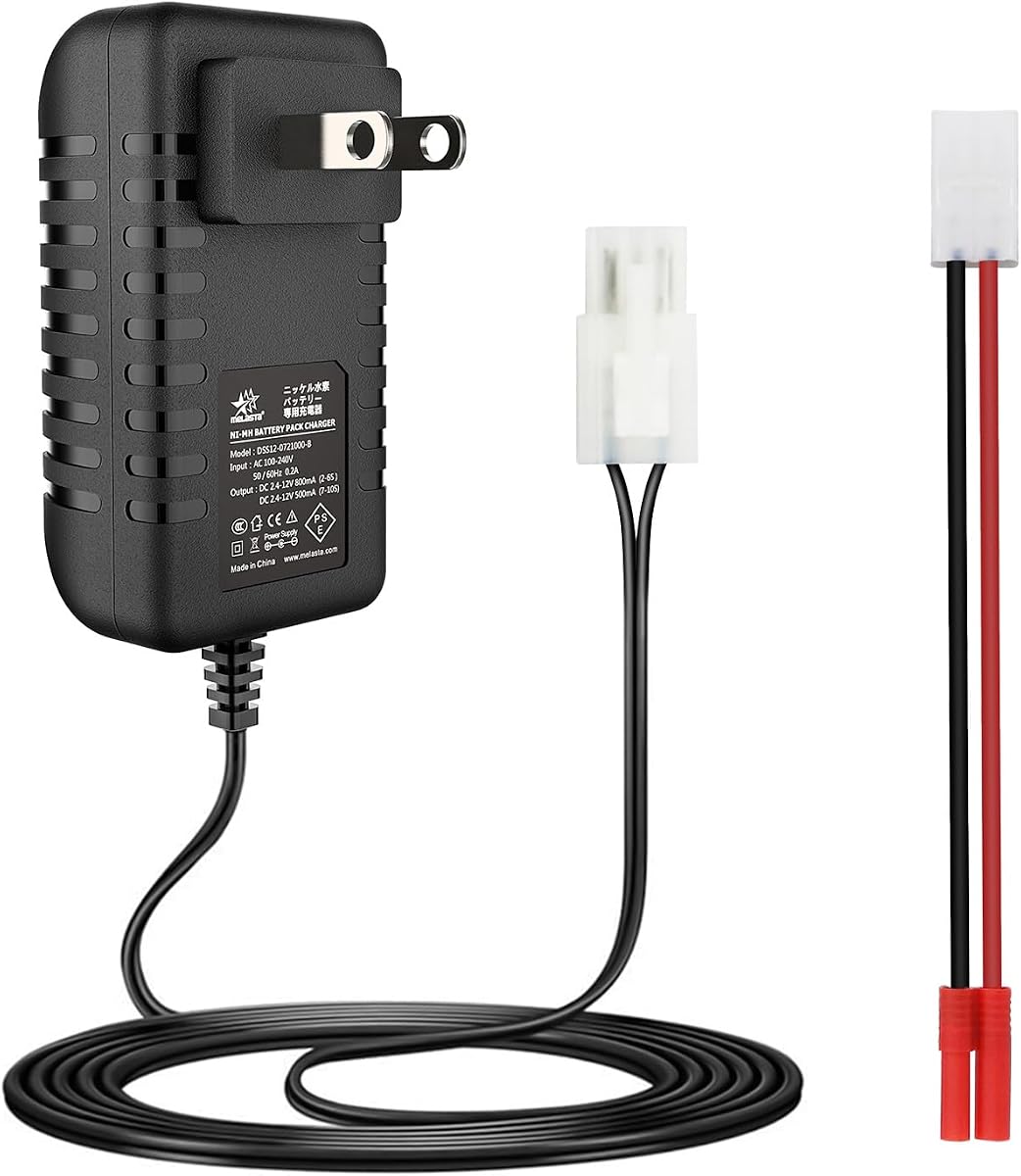
The Melasta Universal NiMH Charger is a 4.6-rated dedicated charger for NiMH and NiCd RC car packs from 2.4V to 12V. It emphasizes straightforward operation, automatic charging behavior, and a clear red-to-green status light, making it appealing to users who want reliable wall charging without a complicated interface.
We may earn a commission when you buy through this link, at no additional cost to you.
The standard Tamiya connector fits many common RC batteries, and the included Tamiya-female-to-banana-plug cable adds support for packs using 4.0mm banana connections, including the Redcat Hexfly format named in the product information. Automatic voltage detection determines the pack type, while the output changes from 800mA for 2.4-7.2V batteries to 500mA for 8.4-9.6V batteries.
Protection against overcharging, overcurrent, short circuits, and reverse polarity provides a sensible safety layer. The LED stays red while charging and turns green at completion; a flashing red light signals a bad connection, while an unlit light indicates a defective unit according to the supplied guidance. Typical charging time is listed at six to ten hours depending on capacity.
This charger is best for conventional RC cars and other applications using nickel batteries. It should not be used with Li-ion packs, and users seeking cell balancing, storage discharge, high-current charging, or two-channel operation need a more advanced model. For its narrower purpose, however, it offers clear status feedback and dependable automatic cutoff.
The color-coded LED gives users immediate information about charging, completion, and connection faults. That makes the charger approachable even for less technical hobbyists.
The charger supplies 800mA to lower-voltage packs and 500mA to higher-voltage packs. Automatic shutdown follows once the battery reaches full charge.
We may earn a commission when you buy through this link, at no additional cost to you.
The 300W 16A Dual Charger is a 4.7-rated premium station and the most powerful model in this guide. It offers two independent channels, up to 16A per channel, 300W maximum AC input power, and 400W maximum DC input power, delivering serious charging throughput for users who cycle through large RC battery collections.
We may earn a commission when you buy through this link, at no additional cost to you.
Compatibility includes 1-6S lithium chemistries, 2-20V lead-acid, and 1-15S NiCD and NiMH packs. Charge, balance charge, balance-only, discharge, and storage modes cover common preparation needs, and the automatic function can identify cell counts during balance operations. Cycling is available for nickel batteries, while battery-meter, adjustment, and high-precision functions add further control.
Two channels allow two separate batteries to charge simultaneously, and each channel delivers up to 16A. Actual charge current must still remain appropriate for the selected battery’s capacity and chemistry. A simple two-button interface keeps the physical design compact, though it may not provide the same menu depth as a larger screen-and-button charger. The package includes an AC cable, XT60 leads with multiple connector styles, balance extensions, a screen protector, and a manual.
This model is ideal for competition pilots, drone operators, and serious RC enthusiasts who want rapid turnaround and simultaneous balance charging. It is the best premium option for power, but its capabilities are unnecessary for casual users or small nickel packs. The top-tier rating reflects a station built around throughput, flexibility, and efficient use of two independent banks.
Each channel can charge independently at up to 16A, allowing two different packs to prepare at the same time. The balance current is specified at up to 1600mA per channel.
The 400W DC input ceiling provides strong operating headroom when suitable field power is available. The compact enclosure and included screen protector also suit mobile competition use.
We may earn a commission when you buy through this link, at no additional cost to you.
The 80W Mini B6 Charger is a 4.6-rated compact unit that delivers the familiar B6-style feature set without requiring a separate power supply. It supports 1-6S LiPo, LiHV, Li-ion, and LiFe, 1-15S NiCD and NiMH, and 2-20V lead-acid batteries, making it versatile for smaller and mid-sized RC collections.
We may earn a commission when you buy through this link, at no additional cost to you.
Charge, smart balance, discharge, and storage modes cover standard maintenance. The balance function can identify cell quantity, voltage, and current parameters, while the meter displays voltage and capacity and estimates lithium internal resistance. Independent cell-by-cell balancing supports routine pack upkeep, and the large screen makes those functions easier to navigate.
Maximum charging power is 80W, with adjustable charge current from 0.1A to 6A and a listed discharge current of 2A. Compared with the 150W and 300W dual chargers, it is better suited to smaller packs and users who prioritize size over rapid throughput. The accessory kit includes a DC power cable and several popular connectors, plus a user manual.
This charger is a compelling compact option for drone pilots, model-aircraft competitors, and hobbyists who want a balance charger they can carry. It is less attractive for users with several large packs to recharge simultaneously. Its strengths lie in broad compatibility, a readable display, and an integrated power solution.
Beyond charging, the unit can measure voltage and capacity, check reference internal resistance, and balance individual lithium cells. These functions support regular pack inspection and maintenance.
The integrated power supply and compact case reduce the number of separate items required at the bench. A large LCD helps preserve visibility when navigating settings.
We may earn a commission when you buy through this link, at no additional cost to you.
The OVONIC D15 is a 4.3-rated specialized charger for 1S-3S LiPo RC batteries. It uses two independent 15W channels with up to 1.2A each, allowing two compatible small packs to charge simultaneously. It is best suited to micro drones, tiny aircraft, and other hobby equipment using three-, seven-, or eleven-point-one-volt LiPo packs.
We may earn a commission when you buy through this link, at no additional cost to you.
Its balance accuracy is listed at five per mille, which the product information describes as better than a typical ten-per-mille level. The charger also detects abnormal batteries and keeps the red indicator illuminated as a warning to stop charging a faulty pack. GaN technology and synchronous rectification are used to support a compact design, lower heat, and conversion efficiency stated at up to 98%.
Overvoltage, overtemperature, overcharge, overcurrent, and short-circuit protection cover the main electrical risks. However, this is not a general RC battery station: it does not accept NiMH, NiCd, lead-acid, LiFe, LiHV, or larger cell counts. Its 1.2A per-channel output also means large-capacity 3S packs will require substantially more time than they would on a 150W balance charger.
The D15 is a good fit for owners with several small drones or compact aircraft who want simultaneous charging and accurate cell balancing. It is less useful for a mixed collection or high-performance fleet. Its appeal lies in efficient specialization, clear abnormal-battery detection, and a small footprint rather than high power.
GaN components and synchronous rectification support high conversion efficiency in a compact enclosure. The design is optimized for small LiPo packs rather than large high-capacity batteries.
Two independent 15W channels allow compatible 1S-3S packs to charge together. This reduces downtime when several micro-drone batteries rotate through use.
We may earn a commission when you buy through this link, at no additional cost to you.
Choosing an RC battery charger starts with the batteries you already own, then expands to power, channel count, balance functions, safety, connectors, and portability. Matching those needs prevents both wasted features and incompatible charging setups.
Begin by identifying every chemistry and nominal voltage in your collection. Multi-chemistry units support combinations such as LiPo, LiHV, Li-ion, LiFe, NiMH, NiCd, and lead-acid, while dedicated chargers are limited to nickel or lithium packs. Cell-count range matters just as much: a compact 1S-3S LiPo charger cannot service a 6S aircraft pack, and a 2-10S nickel charger may be inadequate for larger battery systems. Check the pack label and the connector documentation before selecting a model.
Choose a charger that supports every pack you realistically expect to own, not merely the battery currently in use.
Maximum wattage indicates how much aggregate power a charger can deliver, while maximum amperage determines the pace for an individual pack. A larger 150W or 300W station can prepare higher-capacity batteries faster, whereas an 80W or 15W charger is better matched to smaller packs. The correct current must also be suitable for the battery’s capacity and chemistry. A powerful charger does not mean every pack should be charged at its maximum output.
Match charger output to pack size, and use a current appropriate for the cell count and battery specification.
A single-channel charger is simpler and may be sufficient when one pack is used at a time. Dual-channel chargers can prepare two different batteries simultaneously, making them valuable for pilots, racers, and drone operators who regularly rotate packs. Independent channels provide the greatest flexibility, though their total wattage may be shared. A 300W AC model with up to 16A per channel offers more throughput than a compact 30W dual charger for small LiPos.
Choose dual channels for frequent pack rotation; select one channel for simplicity and a smaller equipment footprint.
Balance charging monitors individual cells and corrects voltage differences, helping maintain consistency across a multi-cell pack. This is particularly important for LiPo-based drones and aircraft, where uneven cells can affect performance and pack condition. A balance connector must be connected correctly, often in a specified right-to-left order. Chargers without balance mode are adequate for many NiMH packs but cannot provide the same level of LiPo cell maintenance.
For multi-cell lithium packs, prioritize a charger with automatic cell detection and a reliable balance lead.
The charger must physically match the battery’s connector. Common RC standards include Tamiya, mini Tamiya, Deans, XT60, EC3, EC5, JST, T-Plug, and receiver plugs, but connector shape alone does not guarantee correct polarity. Some models arrive with a broad harness or prewired collection of leads; others include only a main cable and require separate adapters. Review both the included accessories and the balance lead arrangement before buying.
Compare the battery’s connector and polarity with the charger’s included leads, not just the product title.
Useful safeguards include overcharge, overcurrent, overheat, short-circuit, reverse-polarity, low-voltage, and capacity or time limits. Automatic shutdown after full charge is a basic requirement for a dedicated wall charger, while multi-chemistry stations add temperature monitoring, delta-peak detection, and adjustable current limits. Battery meters and internal-resistance checks can also help identify deteriorating packs. These protections reduce risk but do not replace correct setup.
Look for layered protection, automatic cutoff, and clear battery warnings, while verifying every chemistry and cell-count setting.
A readable LCD or clear status lights help users identify charge state, cell count, voltage, and faults. Memory profiles are valuable for people with recurring pack types because they reduce repeated parameter selection. Some advanced stations use more buttons and deeper menus, while simpler wall chargers prioritize one-button or LED operation. Consider whether you need expert controls such as adjustable terminal voltage, cycling, storage discharge, or digital DC output, or whether straightforward automatic charging is preferable.
Favor readable status feedback and saved profiles, but avoid expert controls you will not use safely.
A home-based station benefits from AC power, while field users may prefer DC input or the ability to use both. Consider the size, weight, handle, screen visibility, and cooling arrangement. Compact units are easier to store and carry, but high-power chargers often require more space and produce more heat. Dual-input models provide flexibility, although the supplied instructions must be followed and AC and DC cords should never be connected simultaneously.
Choose AC, DC, or dual input according to where you charge, and favor portability only when it does not reduce needed capacity.
Before charging, identify the battery chemistry, cell count, nominal voltage, and connector. Inspect the pack for swelling, cracks, damaged leads, moisture, or other visible damage, and never attempt to charge a compromised battery. Select the matching charging mode and set a conservative current appropriate for the pack’s capacity and the manufacturer’s guidance. For balance charging, connect the main lead first and then the balance connector in the exact order shown by the charger.
Use the correct input arrangement for your location. When using AC, plug the charger into a suitable wall outlet before attaching the battery; when using DC, follow the stated voltage range. Do not use AC and DC cables at the same time. Never leave charging unattended around children, pets, combustible materials, or moisture, and keep the charger on a stable, ventilated, nonflammable surface. Watch the display and indicator lights, particularly when using a new battery type or unfamiliar connector.
Allow the charger to cool between demanding sessions, and clean its vents without allowing dust, moisture, or debris to enter the enclosure. Store batteries and the charger away from extreme heat, direct sunlight, and damp locations. For long-term storage, use a charger with a proper storage mode when available and follow the battery maker’s recommended storage voltage. Periodically inspect cables, connectors, balance leads, and cooling openings, replacing damaged accessories before the next charge.
Only if the charger explicitly supports each chemistry. Multi-chemistry units can handle suitable lithium, nickel, and lead-acid packs, but the user must still select the correct type and cell count. A dedicated NiMH charger should never be used with a LiPo battery, even when the connector appears to fit.
A regular charger primarily supplies power to the pack, while a balance charger also monitors and adjusts individual cell voltages. This additional function helps maintain consistency in multi-cell lithium packs. The correct balance lead and connector order are essential for the feature to work properly.
A dual-channel charger is useful when you regularly rotate two or more packs and want them prepared at the same time. It may also accommodate different battery types through separate channels. If you normally charge only one small pack at a time, a single-channel model may be simpler and more compact.
The safest choice is the current specified by the battery or vehicle manufacturer, within the charger’s supported range. High current can generate heat and may not suit small packs or sensitive cells. Never use the maximum charger output simply because the charger supports it.
No. Each connector has a different physical shape and may carry a different current rating. You need the correct adapter or lead, and you must verify polarity before connecting it. A plug that fits physically still needs to match the charger’s output configuration and battery connection.
You can charge two different batteries simultaneously when each is connected to its own channel, provided both are supported and appropriate settings are entered separately. Do not connect two different batteries to one channel, and do not assume both channels can deliver maximum power simultaneously.
A warning may indicate a loose connector, reversed polarity, an unsupported battery, an incorrect cell count, or a damaged lead or pack. Disconnect the battery before inspecting the connections and verify the selected chemistry and voltage. If the warning remains, use a known-good cable or have the charger and battery checked.
Balance mode is generally useful for multi-cell LiPo packs because it helps keep cell voltages consistent. It does not make an unsafe or defective battery safe, and it cannot compensate for physical damage. The pack must still be suitable for charging, and the balance lead must be attached correctly.
The 150W 10A AC/DC Balance Charger is the most complete general choice because it combines broad chemistry support, twenty profiles, dual power inputs, diagnostics, and extensive protection. The 300W 16A Dual Charger is the strongest premium option for simultaneous high-current work, while the Universal 2-10S NiMH Charger offers an efficient, connector-rich solution for nickel-based RC fleets.
Prioritize compatibility before power. Confirm the chemistry, cell count, connector, polarity, and balance requirements of every battery you intend to charge. Then decide whether simultaneous dual-channel operation and advanced diagnostics justify the added complexity, or whether a compact dedicated charger better fits a smaller collection of packs.
Specifications, included accessories, and product availability can change over time, so check the current listing and instructions before purchase. Use the comparison table to narrow the field, but always treat the battery maker’s charging recommendations as the final authority for safe operation.